
The AI Threat Agent Playbook
Executive summary
Security work stalls for a boring reason. The fleet grows, the calendar does not, and the people who can actually decide are busy reconstructing what the last scan meant. Vulnerability management becomes a quarterly project. Monitoring becomes a hope that someone will notice. Incident response becomes a room full of people reading logs line by line while the useful pattern sits three screens back. The cost of knowing stays high, so the organization chooses, quietly, to know less often.
An AI threat agent changes that shape of work. It does three jobs, and it does not do a fourth. It sweeps every machine for vulnerable software and tracks each fix until the last copy is gone. It watches the fleet between audits, so a new install or a silent machine shows up as a flag rather than as a surprise at the next meeting. When an incident hits, it traces the attack across logs and traffic, keeps the evidence, and drafts the report. The fourth thing, the thing it does not do, is act on production alone. Your team approves every change. The agent recommends, tracks, and assembles.
That is the economics. A small team covers the fleet it actually has, because the hunting, the matching, the grouping, and the first draft happen at machine speed. The people spend their time on the calls that were always theirs: which fix goes first, which change is allowed, which incident is contained and which one is watched. That is AI changing the economics of how we do business. This paper is the operating picture behind the short version on the AI threat agent page.
The figures in this paper come from vulnerability sweeps and incident investigations we ran in 2026 on fleets we manage. Client organizations are not named. Where a sentence is easier to say with a round figure, we say it that way, and we also give the count. A sweep window covered 727 machines, which we describe as 700+ when we are speaking rather than counting. That window checked about 1,400 browser installs and about 84,000 installed applications, across 6 organizations. Vulnerable browser installs stood at 1,042 at the open, fell to 351 within 3 days, and stood at 164 by day 11. That is 84% fewer, which we also describe as over 80%. In the same kind of work, 14,573 operating-system patch installs were recorded machine by machine, which we describe as 14,000+. On investigations, about 300 attacking sources were traced behind a single outage, about 6,500 malicious connections per minute were identified and characterized, and over 1.4 million exposed records were analyzed in a single breach review.
Those figures are not a promise that the next fleet will move by the same amount. They are evidence that the loop can be closed on a real fleet, and that tracing and review can be brought to a draft a responder can edit. The rest of this paper is how the loop is built, what the agent is not allowed to do, and how a team starts without handing production to a model.
Read it as a design, not as a catalog of tools. No product names appear here on purpose. The pattern is what you can take into a room with your own stack: collectors that read the fleet, a core that triages and matches and traces, an evidence locker, a report a person can mark up, and a gate in front of any production change.
Why security work stalls
The quarterly scan feels responsible. A date is on the calendar, a vendor or an internal team produces a workbook, and leadership can say the fleet was looked at. Then the workbook ages. Machines are rebuilt. Browsers update, or they do not. A laptop that was in a drawer during the scan comes back online with the old install still on it. By the time the steering meeting reads the workbook, the workbook is a photograph of a fleet that has already moved. The gap is not laziness. The gap is that a project cadence cannot describe a fleet that changes every week.
The spreadsheet makes the gap worse, because it looks like a system. Each row is a finding. Someone adds a column for an owner, and the column stays blank, or it says the name of a team rather than a person. Someone adds a column for status, and the status becomes "in progress" for the life of the sheet. The sheet is copied forward into the next quarter so the history is not lost, and the copy carries the blank owners with it. Nothing in the sheet re-reads the machine. A row can say "fixed" because a person believes a change was requested. The vulnerable install is still there.
Chasing the fix is where the weeks go. A finding is assigned in a meeting. The assignee opens a ticket. The ticket waits on a maintenance window. The window is used for something louder. The ticket is closed because the window passed, or because the assignee changed teams, or because the row was marked done in the sheet by someone who did not touch the machine. The next scan finds the same install. The organization has now paid for the finding twice, in calendar time, and the install has been exploitable the whole time. The stall is not the absence of a list. The stall is that nothing in the list is tied to a fresh read of the last machine.
Incident work stalls in a different room, for a related reason. An alert fires. Then another, which is the same event seen from a second system. An analyst opens the log and reads it line by line, because that is what careful people do when they do not yet know which lines matter. A second analyst opens the traffic and does the same. Hours pass. The pattern is real, but it is buried under volume. By the time someone can say what happened, the report is still a blank page, and the evidence is a pile of files in a personal folder. The next person who has to explain the incident starts over.
Small teams feel this first, and growing fleets make it structural. Headcount for security and IT does not track the number of machines, the number of installed applications, or the number of alerts. The team you have is the team you will still have next quarter. If the only way to know the fleet is to spend that team on collection, matching, and reading, then knowing the fleet is in competition with every other job those people do. They will scan when they can. They will read logs when an incident is already loud. The quiet risk, the browser that is one version behind on a laptop nobody is thinking about, waits.
There is a second stall that looks like discipline. Some teams refuse to automate the chase because they have seen automation close the wrong ticket or push the wrong change. That fear is correct. An unattended change on a production machine is not a time saver. It is an incident you caused. The mistake is to treat "a person must decide" as "a person must also collect, match, copy, and draft." Those are different jobs. The person is scarce. The collection is not.
What leaders usually ask for, when they are honest, is not a smarter dashboard. They ask why the open findings from last quarter are still open, why nobody can say which machines are silent, and why the incident report took days of reading to reach a paragraph they could stand behind. The answers are all the same shape. The work of knowing was batched, copied into a sheet, and then pursued by hand. The work of deciding never got a clean input.
The way out is not a thicker workbook. It is a loop that re-reads the machine, a watch that runs between the audits, and an incident path that groups, traces, and drafts while the responder still has the energy to decide. The next section says what kind of agent can run that loop without taking the decision away.
What an AI threat agent is (and is not)
An AI threat agent is an assistant to the people who already own the fleet and the incidents. It is not a replacement for them, and it is not a scanner you rent and then forget. Its job is to recommend, to track, and to assemble. Recommend means it says what it found, how the findings group, and what it thinks should happen next. Track means it does not lose the thread between the recommendation and the machine. Assemble means the evidence and the draft report are in one place when a person sits down, with the unknowns still marked as unknown.
It is not an actor on production. It does not install, uninstall, block, isolate, or notify a customer. Those are decisions with consequences, and consequences belong to a named person. The agent can prepare the recommendation so completely that the person's job is to approve or refuse. It cannot skip that step because the recommendation looks obvious. Obvious recommendations are exactly where a confident mistake is expensive.
It is not a chatbot with a log pasted into it. Pasting a fragment into a conversation produces a plausible paragraph and no custody. The next person cannot see what was omitted, what was collected, or whether the paragraph was edited after the fact. A threat agent that only chats has recreated the personal folder, with better sentences. The agent in this paper is wired to collectors, to a record of what it did, and to a locker. The sentences come last, from the record, not from a prompt someone typed in a hurry.
It is not a score. A single number on a finding feels like prioritization and usually is not. Two machines with the same vulnerable browser are not the same problem if one of them can be reached from outside the organization and the other cannot. A pile of low findings that share a cause is one campaign, not a hundred tiny emergencies. The agent groups and explains. People rank. When we describe a rank in this paper, we describe it in words: exposure, reach, whether a fix exists, whether someone already owns it. We do not invent a numeric score and then pretend the score is the decision.
The boundary is a design pattern, and it is the same pattern a careful team already uses with people. The person who drafts is not the person who approves. The record of the draft is kept even if the approval is refused. A later change to the draft does not inherit the old approval. We use that pattern with an agent for the same reason we use it with a junior analyst. Speed is welcome. Inherited authority is not.
This is also why the agent has a narrow set of jobs rather than a general instruction to "handle security." A general instruction expands. It will eventually touch a system someone assumed was out of scope, because the instruction did not say no. The three jobs are the scope. Vulnerability management. Continuous monitoring. Incident response, up to and not including the decision. Work outside those jobs is a different project, with a different approval, not a side effect of a helpful model.
If you have seen an accounting agent reconcile a ledger, the habit will look familiar. Every item is tied to a source. The work is not done when the sheet looks finished. It is done when the last item agrees with the source. A vulnerable install is that kind of item. The source is the machine, re-read, not the row someone typed. The threat agent is the security version of that habit, with a harder gate in front of any change, because a wrong patch on a production system is not a wrong column in a workbook.
What the agent will get wrong is part of the design, not a footnote. It will group two events that a specialist would split. It will describe a pattern more cleanly than the evidence supports, if you let the draft hide the gap. It will recommend a fix that is real for most machines and wrong for one fragile system. Those are reasons for the gate and for the log, not reasons to put the analysts back on line-by-line reading. The human job shifts from reconstruction to judgment. Judgment includes saying the draft is wrong.
The service page states the three jobs in brief. The sections that follow walk the architecture, then each job, then the oversight, then the economics, then a way to start that does not begin with a production change.
Reference architecture
The picture below is the whole system in one pass. Read it left to right. The fleet is where the facts live. Collectors read those facts on a schedule. The agent core turns the facts into groups, matches, and traces. An evidence locker holds what was found and what was done. Reports are drafts. Responders decide. Under all of it, an approval gate: nothing in production changes until a person says so.
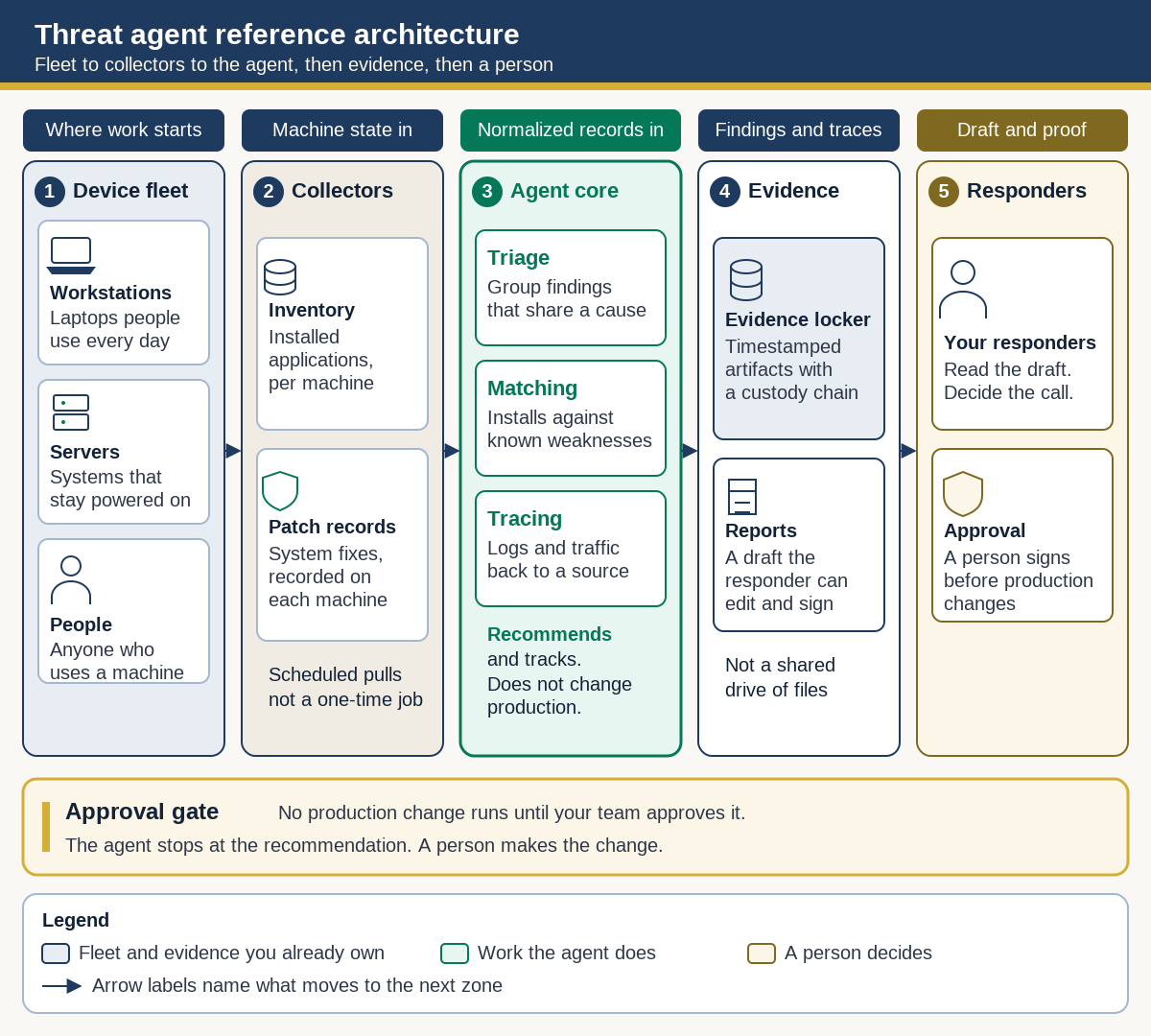
Start with the device fleet, because every later mistake is a mistake about what was in scope. The fleet is workstations people use every day, servers that stay on, and the odd machine that is easy to forget: a lab system, a laptop in a bag, a server someone built for a project and never added to the mental list. Scope is a list your team provides and maintains. The agent does not discover your company. It reads the machines you named, and it flags a named machine that stops reporting. A machine that was never named is not "clean." It is out of scope, and out of scope should be a conscious choice, written down, not an accident of who remembered to install a collector.
Two collectors sit in front of the core, and they are separate on purpose. The inventory collector reads installed applications, machine by machine. The patch collector reads operating-system patch records, machine by machine. A single feed that mixes the two will hide the most useful discrepancy you can get without an incident: a patch record that does not match the inventory, or an install that has no record of the fix you thought was applied. Separation makes that discrepancy visible. The pulls are scheduled. They are not a project someone kicks off when a meeting is coming. A scheduled pull that fails is itself a signal. Silence is not the same as healthy.
What moves from the fleet to the collectors is state, not the contents of people's work. Installed software. Versions. Patch records. The fact that a machine answered. You do not need the documents on the laptop to know the browser is old. Keeping the pull that narrow is data minimization, and it is also how you keep the sweep deployable. A collector that asks for everything will be refused by the first team that understands what "everything" includes. A collector that asks for inventory and patch state can be explained in a sentence.
The agent core has three duties, drawn as three boxes because they fail differently. Triage groups findings that share a cause, so a fleet-wide browser issue arrives as one campaign and not as a pile of identical rows. Matching sets each install against known vulnerabilities. The match is a record: the application, the version, the machine, and the reason the version is considered vulnerable. Tracing is the incident duty. It follows logs and traffic back toward a source. Triage should not be tracing. Matching should not be drafting the incident story. When one step does all three, a confusion in the story silently changes what you think is vulnerable. Separate duties keep a bad sentence from rewriting the inventory.
The core recommends and tracks. The arrow out of it is findings and traces, not commands aimed at production. This is the line teams try to blur once the recommendations look good. Do not blur it. The path that changes a machine should be the path your team already uses, under the account and the approval they already trust. The agent is not given a standing right to use that path. If the agent holds the credential that can change production, the gate is a sentence in a policy, and sentences do not stop a model. The gate has to be structural. The credential is not there.
The evidence locker is not a shared drive with a hopeful folder name. Artifacts go in with a timestamp, with who or what collected them, and with the system they came from. A later edit does not overwrite the original in place. The report is a draft generated from those artifacts, written so a responder can correct it. The draft includes what is known, what was collected, and what is still unknown. An unknown that the model fills in, because a complete paragraph sounds better, is a fabricated fact. The template forbids that completion. Empty is allowed. Invented is not.
Responders are the last zone because they are the point of the system. They read the draft. They decide whether to contain, to fix, to notify, or to watch. They approve a production change or they refuse it. Their decision is logged next to the recommendation, including a refusal. A refused recommendation is a successful run. It means the gate worked and the record shows why the change did not happen.
Read the arrows as a contract. Software and patch state move from the fleet to the collectors. Normalized records move into the core. Findings and traces move into the locker. A draft and the proof move to the responders. Nothing in that list is "please change the server." That request, if it is made at all, is made by a person after the draft, through your existing change path, and the approval is stored with the case.
Two practical consequences follow. First, you can adopt the architecture without replacing the systems your operators already know. The collectors have to be able to read inventory and patch state. The locker has to be able to store files and a log. The approval path is the one you have. Second, you can test the architecture by trying to break the gate. Ask whether a prompt hidden in a log line can talk the draft into claiming a change was already made. Ask whether a failed collector can be reported as an empty, healthy fleet. Ask whether a refused approval can be dropped from the log. Those questions are the beginning of a serious review, and they are the kind of review we do as AI red teaming when a team wants the boundary tested by someone who is paid to find the skip.
Vulnerability management, end to end
Vulnerability management is a loop, not a report. The loop has six steps. Sweep the machines. Match what is installed against known vulnerabilities. Prioritize the matches as campaigns a person can own. Assign a named owner. Verify the fix on the machine. Close only when the last vulnerable copy is gone. Then sweep again, because a close that is never re-read will rot back into a spreadsheet.
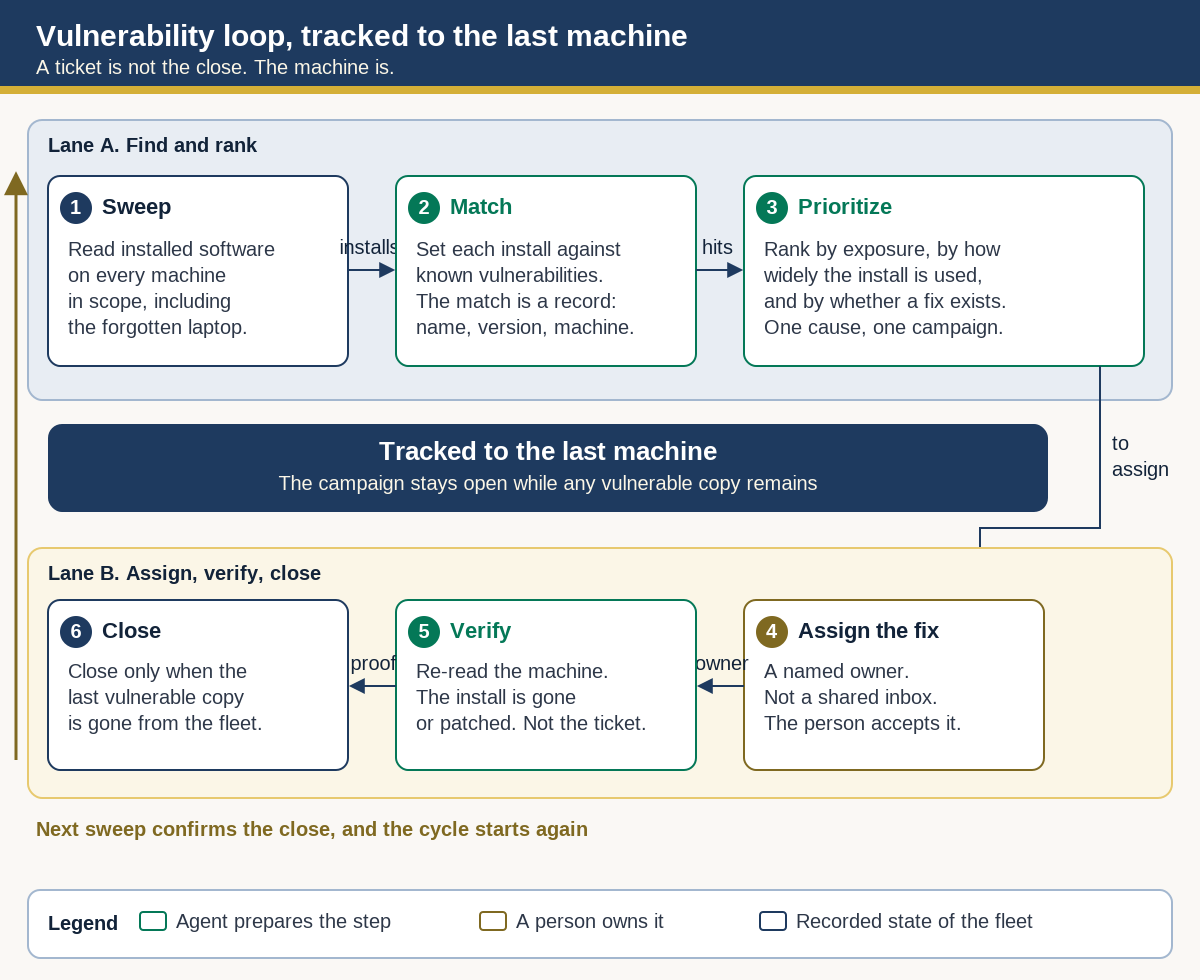
The sweep is a read. On each machine in scope, the inventory collector records installed applications and versions. The patch collector records operating-system fixes. A machine that does not answer is listed as silent, not omitted. Omission is how forgotten laptops survive every audit. Silence is a row with an owner, the same as a vulnerable install. The sweep does not rank yet. Ranking before you have finished reading teaches the system to prefer the machines that answered first.
Matching is a comparison, and it should look boring. An install is a name, a version, and a machine. A known vulnerability is a condition on a name and a version. The match stores the condition it used, so a later reviewer can see why this version was flagged and whether the condition still applies. We do not name the source of those conditions in this paper, and you should not build the process so that it only works with one source. Sources differ in coverage and in how fast they update. What the loop needs is a record of which condition fired. If the condition is withdrawn later, the open campaign can be re-opened and re-checked rather than trusted forever because it was true on the day of the match.
Prioritization is where teams either save the quarter or recreate the spreadsheet. The failure mode is to sort by a raw severity label and then work the list from the top until time runs out. That list is not a campaign. A useful priority answers four questions in words. Can the vulnerable install be reached from outside, or only by someone already inside? How widely is this exact install present, so that one fix covers many machines? Does a fix exist, or is the honest recommendation to remove the software or to isolate the machine? Does someone already own a campaign for this cause? A new cause outranks a repeat of an owned campaign, even if the repeat is louder, because the owned campaign already has a person. Volume is not priority. Volume is a reason to group.
Grouping is the practical heart of triage. The same vulnerable browser on many workstations is one campaign with many machines, not many tickets. The campaign names the cause, the fix, and the list of machines still open. People can see the list shrink. They cannot see a hundred tickets shrink, because nobody opens a hundred tickets. The agent maintains the list from the inventory. When a machine is verified clean, it leaves the list. When a new machine shows the same install on the next sweep, it joins the list. The campaign stays open. This is what "tracked to the last machine" means in practice. The unit of done is the machine, and the unit of work is the cause.
Assignment is a named person, not a queue. Queues feel fair and produce the stall described earlier. A named person can be on leave, and then the campaign needs a different named person, explicitly, with the change written down. The agent may suggest an owner from the team you provided. It may not invent an owner because a complete record "should" have one. A blank owner is a visible defect. A fictional owner is a false record. The person accepts the campaign. Acceptance is a message or an approval you keep, not a guess from who usually does this kind of work.
Verification is a second read of the machine, not a status field. After the owner reports the fix, the next pull must show the vulnerable version gone, or the patch record present, in the way that campaign defined "clean." If the machine is silent, it is not clean. If the version is unchanged, the campaign stays open and the draft says so, without scolding and without credit for effort. Effort is real and it is not the close. This is the step spreadsheet programs skip, because the sheet cannot see the laptop. The collector can.
Close is allowed when the machine list for that cause is empty. Not when it is almost empty. Almost empty is how the last laptop in a bag ships the old browser into the following month. A closed campaign is still re-read on the next sweep. If the install returns, the campaign reopens with the history attached, so you can see whether the fix did not stick or a new machine arrived with the old version. Reopening is a success of the loop. Hiding the reopen to protect a metric is how you get a green report and a vulnerable fleet.
The browser campaign
The loop is easier to trust when you can watch a real count move. Across the fleets we manage, the sweep window in 2026 covered 727 machines. We say 700+ in ordinary speech. The same window checked about 1,400 browser installs and inventoried about 84,000 installed applications. The work spanned 6 organizations. We do not name them. We do not name the condition source that flagged the browsers. What we can show is the count of vulnerable browser installs, tracked as one kind of campaign.
At the open, that count was 1,042. Within 3 days it was 351. By day 11 it was 164. The drop from the opening count to day 11 is 84% fewer vulnerable browser installs. When we round that for a conversation, we say over 80%. The chart below is those three counts and no others. The opening bar is the last day of October. The middle bar is 3 days later. The short bar is day 11.
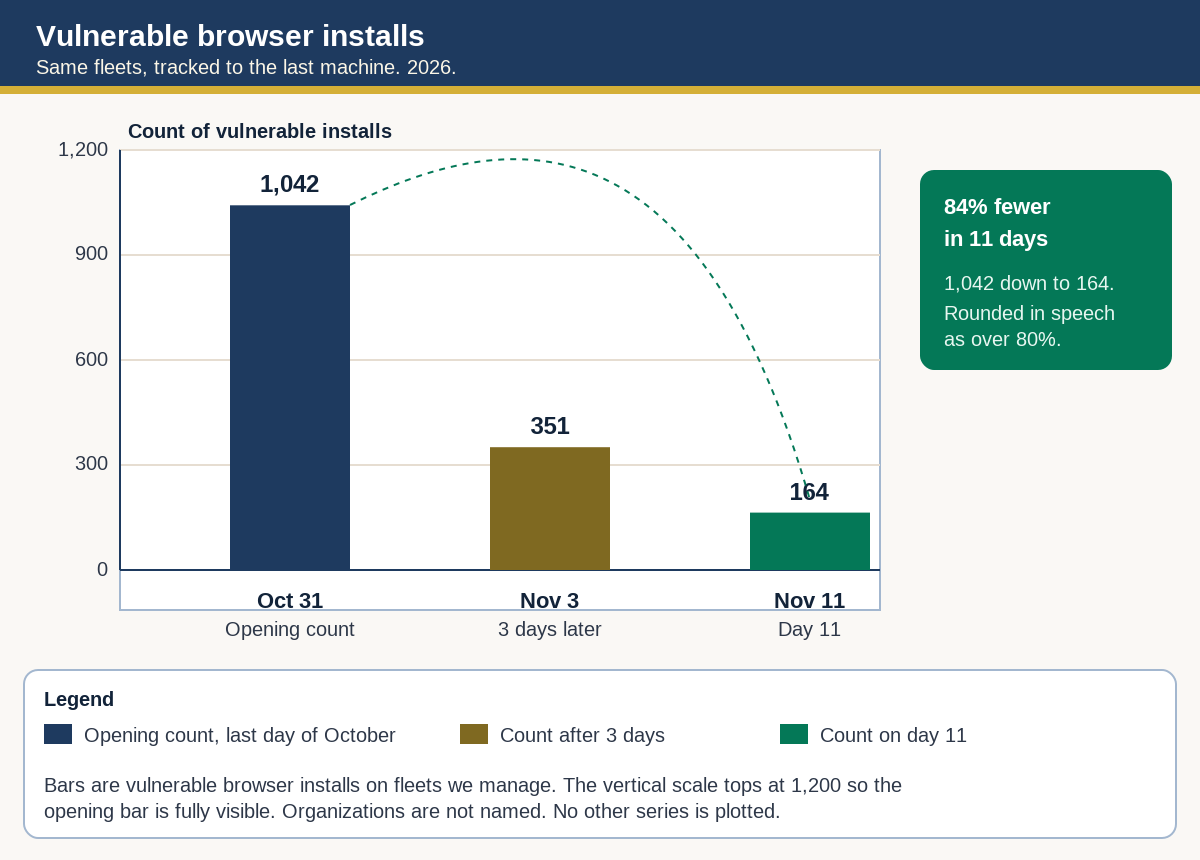
Read the chart as a campaign, not as a miracle. The installs were grouped as a shared cause. Owners were assigned. Machines were re-read. The count fell because copies were actually gone, not because rows were hidden. Day 11 still shows 164 vulnerable installs. The campaign was not "done" in the sense of an empty list. It was dramatically smaller, and the remainder was visible. That remainder is the point of tracking to the last machine. A program that celebrated the 84% and dropped the rest would have rebuilt the spreadsheet in a new costume. The honest status is: most of the exposure closed in days, and 164 installs still have names and machines attached to them.
What the story does not show matters as much as what it shows. It does not show that every campaign will fall by 84%, or by over 80%, or on this timetable. A campaign with no fix available will not move just because an agent is watching it. A campaign that requires a fragile system to be restarted will wait on a person, correctly. It does not show a reduction in "time spent" as a percentage, and we will not invent one. It shows that a loop with a re-read can move a large, real count inside the same effort a team would otherwise spend preparing the quarterly workbook.
It also shows why the sweep has to see browsers specifically, along with the rest of the installed applications. Browsers are everywhere, they update on their own schedule, and a single old version becomes a fleet-wide condition overnight. If your inventory is a list of servers and a shrug about laptops, you will not see this campaign until someone else does. The 1,400 browser installs were worth counting separately from the 84,000 applications because the campaign was a browser campaign. The wider inventory is what tells you the browser figure is not the whole fleet. Both numbers belong in the same sweep. Neither replaces the other.
If you adopt one practice from this section, adopt the re-read. Everything else in the loop can be done badly and then corrected. A close that is not verified on the machine cannot be corrected later, because you will believe it is finished. The agent is useful here because it does not get bored of the last machines. People do. The design gives the boredom to the schedule and keeps the judgment with the owner.
Continuous monitoring
A vulnerability loop that runs once a quarter is a better spreadsheet. It is not yet monitoring. Monitoring is the decision to pull inventory and patch state on a schedule, to notice change, and to raise a flag while the change is still small. The phrase we use is continuous, not quarterly. Continuous does not mean a person staring at a screen. It means the collectors run whether or not a meeting is coming, and the flags are grouped so the person who does look can see a campaign rather than a stream.
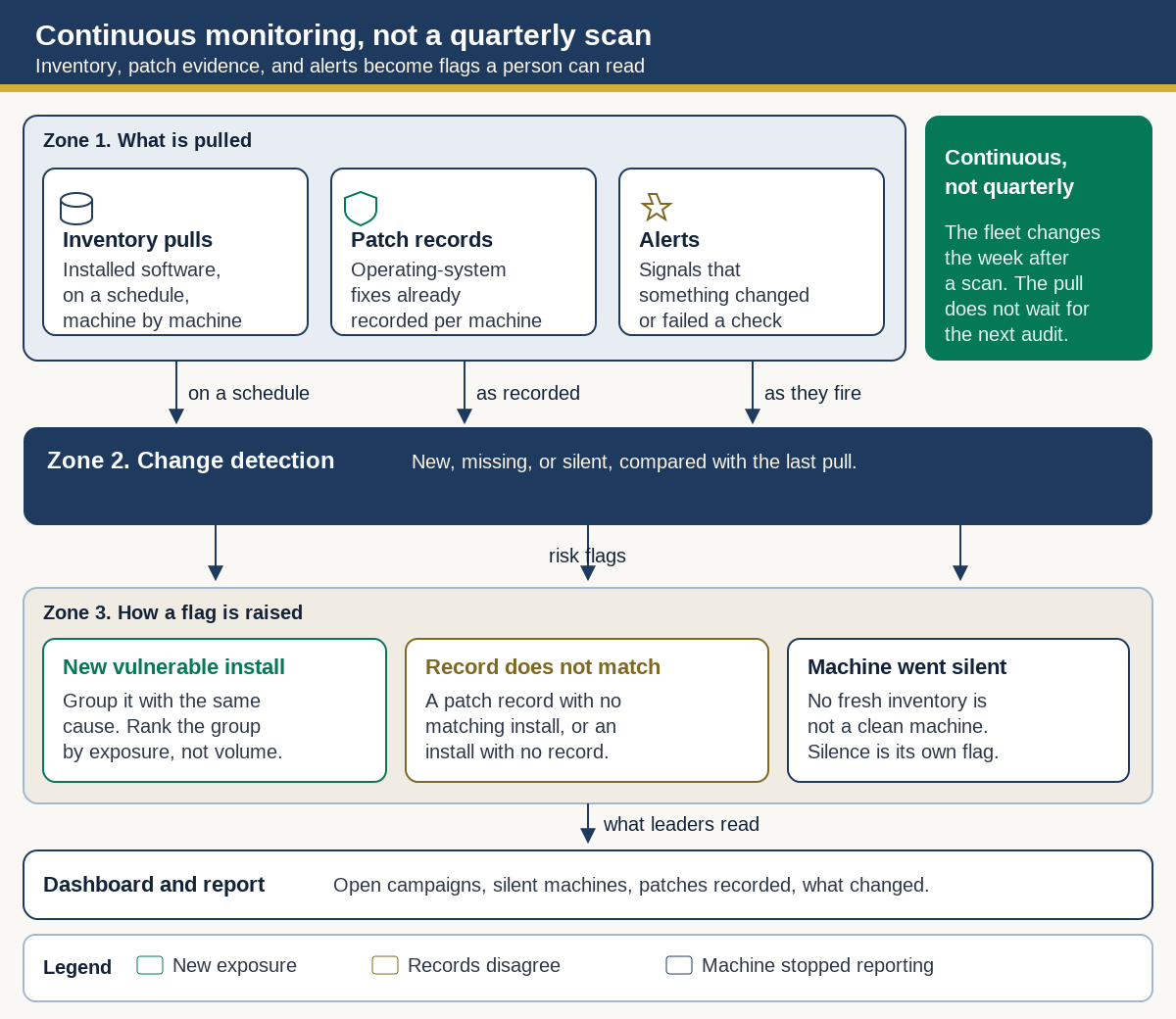
Three inputs feed change detection. Scheduled inventory pulls say what is installed now. Patch records say which operating-system fixes were recorded on each machine. Alerts say that some check failed or some signal fired. Each input is weaker alone. Inventory without patch records cannot tell you whether the fix you rely on was recorded. Patch records without inventory can claim a fix on a machine that no longer has the software, or hide a machine that never received the record. Alerts without either of the other two are how teams end up reading noise. Change detection is the comparison of this pull with the last one, plus the question of whether an alert belongs to a campaign you already have open.
In the sweeps behind this paper, 14,573 operating-system patch installs were recorded machine by machine. We describe that as 14,000+ when we are not reading the exact count. The value of the figure is not the size. The value is the grain. A patch install that is recorded per machine can be compared with the inventory of that machine. A patch install that is recorded as "we rolled it out" cannot. The agent does not get credit for the patches. Your existing process applied them. The agent makes the record inspectable, so a missing machine is a missing machine and not a rounding error inside a rollout story.
Change becomes a flag in three ways we want operators to recognize on sight.
A new vulnerable install is the first. Something appeared, or a version changed, and the match says the version is in scope for a known condition. The flag joins the campaign for that cause if one exists. If none exists, a new campaign is proposed, with no owner until a person accepts it. The agent does not page the entire team for every machine in an existing campaign. A new machine on an owned campaign is a line on that campaign. A new cause is the thing worth interrupting someone for.
A record that does not match is the second. The patch record says a fix is present and the inventory does not, or the inventory shows software the patch record has never mentioned. Mismatch is more interesting than a clean "missing patch" because it means your two stories about the machine disagree. Someone should find out which story is true before a third story, the incident story, is written from the wrong one. The flag names both records. It does not pick a winner. Picking a winner is a judgment, and it is cheap only after a person looks.
A machine that stopped reporting is the third. This flag is the one teams skip, because it does not look like a vulnerability. It is the absence of news. Absence of news is how a laptop leaves the sweep and returns later with the old browser, and how a server is rebuilt without the collector. Treat silence as a finding with an owner. The owner either restores the pull, or removes the machine from scope on purpose, with that removal written down. There is no third state called "probably fine."
Scoring and grouping are where monitoring either stays calm or becomes another noisy queue. Group first, by shared cause, before anyone talks about which flag is louder. A hundred machines with the same new browser version are one group. Then rank the groups with the same words used in the vulnerability loop: exposure, reach, whether a fix exists, whether an owner already has it. A group that is already owned does not outrank a smaller group that nobody has accepted, if the smaller group is a new cause on a reachable system. Repeats of an owned campaign are suppressed as interruptions and appended as lines. The person who owns the campaign sees the lines when they look. They are not poked once per machine.
What we will not do is publish a numeric score and call it the priority. Scores drift. They get tuned until they match someone's intuition, and then the intuition is forgotten and the score remains, intimidating and wrong. Words force the reason into the record. "Reachable from outside, fix available, no owner" is a priority a new team member can audit. A number is not, unless you also stored the formula, the inputs, and the day the formula changed. If you already have a formula you trust, the agent can carry its inputs. The approval of what "high" means stays with you.
The dashboard and the report are for two different readers. The dashboard is for the person running the week. It shows open campaigns, machines that are silent, patch records that disagree with inventory, and what changed since the last pull. It does not show a wall of individual findings unless someone opens a campaign. The report is for the person who was not in the week: a lead, an auditor, a colleague covering the owner's leave. It states the open campaigns, the closes since last time, the refusals, and the machines still silent. It is generated from the record. It is not a slide someone rebuilds from memory the night before a meeting.
A practical cadence, once the pulls are trusted, is ordinary rather than heroic. Operators look at new causes as they are proposed. They look at owned campaigns on a rhythm your team already has, the same way they look at other queues they truly own. Leadership looks at the report when they need to know whether the fleet is drifting. Nobody waits for the quarter. The quarter can still exist as a review of the record. It stops being the moment when collection starts.
Monitoring fails in a specific way if you let it. The pulls run, the flags accumulate, and nobody accepts the new campaigns. You then have a continuous record of a problem you are not touching, which is more honest than a quarterly surprise and just as incomplete. The fix is not more flags. The fix is the assignment rule from the vulnerability loop, applied to monitoring: a new cause needs a named owner or an explicit decision to watch rather than fix. "Watch" is allowed. "Ignore without a sentence" is not. The sentence is what the next person, and the auditor, can read.
Incident response
Incident response is the job people picture when they picture security, and it is the job most likely to be done as archaeology. Something is already wrong. The question is whether the team reconstructs it by reading, or whether they start from a trace, a custody chain, and a draft that says what is still unknown. The agent does the reconstruction steps it can do without deciding. The responder decides.
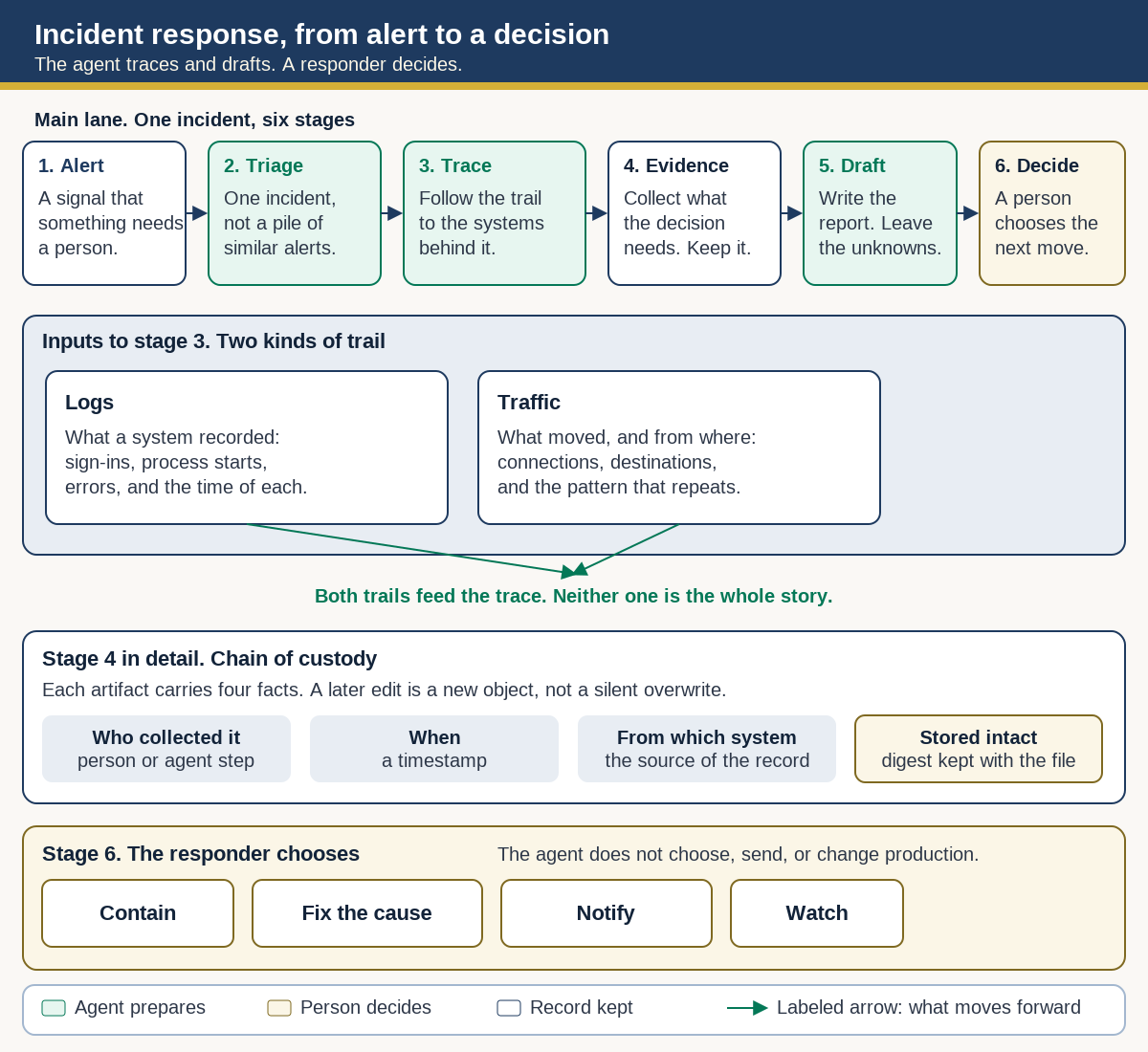
An alert is a signal, not a case. The first move is triage and grouping. Alerts that describe the same event from two systems should become one incident before anyone writes a timeline. Alerts that share a source and a short window usually belong together even if their text does not match. The agent proposes the group and shows the members, so a person can split the group if the proposal is wrong. Splitting is cheap at the start and expensive after two people have written two stories. Show the grouping before the prose.
Tracing comes next, and it has two inputs that should stay distinct. Logs are what a system recorded: sign-ins, process starts, errors, configuration changes, and the time of each. Traffic is what moved: connections, where they came from, where they went, and which pattern repeats. Logs without traffic tell you what a host thought happened. Traffic without logs tells you what crossed the wire and not what ran. The trace uses both, and the draft says which conclusions rest on which input. A conclusion that needs a log you do not have is an unknown, not a guess with confident verbs.
Evidence collection starts while the trace is happening, not the next morning. Each artifact is stored with four facts: who or what collected it, when, which system it came from, and a digest so a later reader can see that the file was not quietly replaced. Chain of custody is that set of facts, kept in order. It is not a form someone fills in after the incident so the folder looks complete. If the digest does not match, the file is a different object and the draft must say so. If the collector cannot name the source system, the artifact waits. An unattributed file is how a personal folder sneaks back into the process.
The draft report is a structured document, not an essay the model felt like writing. It has a short statement of what appears to have happened. It has the grouped alerts that opened the case. It has the trace, separated into logs and traffic. It has the evidence list with the custody facts. It has a section of unknowns that is allowed to be long. It has the decision being asked of the responder, in words: contain, fix the cause, notify, or watch. It does not have a notification already sent. It does not have a production change already made. It does not have a sentence that papers over a missing log with "it is likely." Likely is a person's word, used in the decision, not a filler in the draft.
The responder's decision is the product. Contain means stop the bleeding in the way your change process allows, approved by a person. Fix the cause means the vulnerability loop, or a configuration change, again approved. Notify means a person sends whatever your obligation and your judgment require. The agent does not know your relationships and should not speak for you. Watch means you have decided the evidence does not yet justify the other three, and you have written that down so it is not amnesia. All four are legitimate. The log stores which one was chosen, by whom, and when. A later reader should be able to tell a watch from a forgotten case.
Three investigations from our own work show what this path is for. The clients are not named. The figures are the ones we are willing to stand behind. They are not a menu of outcomes you should expect on a timer.
The first was an outage with a crowd behind it. About 300 attacking sources were traced behind that single outage. Three hundred sources is not a finding a person can read as a list during the outage. It is a list that hides the shape. The useful trace grouped the sources, tied them to the systems they touched, and separated the pattern that explained the outage from the noise that merely accompanied it. The responders still decided what to block, what to watch, and what to say. They did not spend the outage building the list by hand. The agent did not get to apply the block. A list of 300, grouped, is a decision aid. A list of 300, acted on by a model, is how you take down a partner or a clinic or a payment path because it shared a netblock with something noisy. Grouping is the agent's job. The cut is the person's.
The second was a rate. About 6,500 malicious connections per minute were identified and characterized. A rate by itself is a number on a screen. It does not say what the connections were trying to do, which hosts they hit, or which pattern repeated often enough to be the campaign rather than the weather. Characterization is the work: cluster the connections, name the pattern in words, attach the evidence, and leave the outliers labeled as outliers. At that point a responder can decide whether the rate is an incident that needs containment or a condition to watch with a tighter rule. The agent can keep up with a rate at that scale. A person reading line by line cannot, and should not be asked to. The person is there to decide what the characterization means for the business, which is a question the rate cannot answer.
The third was a breach review, not a live outage. Over 1.4 million exposed records were analyzed in a single review. The headline count is the easy part and the least useful. The work is to sort what was actually exposed, which records support that conclusion, and which supposed exposures are duplicates, tests, or records the evidence does not reach. A draft that repeats "1.4 million" in every paragraph has not done the review. A draft that says what the review could show, what it could not show, and which evidence supports each claim is something a responder, a counsel, and a leader can use without starting over. We do not describe the contents of those records here. The figure is the scale of the analysis, not an invitation to guess the organization.
Across all three, the division of labor is the same. The agent gathers, groups, traces, preserves, and drafts. The person decides, including the decision that the draft is overconfident and must be cut back. The record keeps both the draft and the correction. If you only keep the final prose, you have lost the moment where judgment happened, and that moment is the one an auditor or a later incident commander needs.
Incident work also has a temptation the vulnerability loop does not. During an incident, people will ask the agent to "just isolate the host" because minutes feel expensive. Minutes are expensive. An unapproved isolation is still a production change, and it can be the wrong host, or the right host done in a way that destroys the evidence you needed. The design answer is to make the approved action fast, not to remove the approval. A responder who trusts the draft can approve a prepared action quickly. A responder who does not trust it yet should not be outrun by the tool that is supposed to help them. Speed belongs to preparation. Authority stays where it was.
Governance and human oversight
Governance is the answer to a fair question. If the agent is fast, what stops it from being fast in the wrong direction? The answer is a table of duties, not a slogan about humans in the loop. Someone has to be able to point at a row and say who recommends, who approves, and where the proof lives. If the answer is "the platform," you do not have governance. You have a vendor sentence.
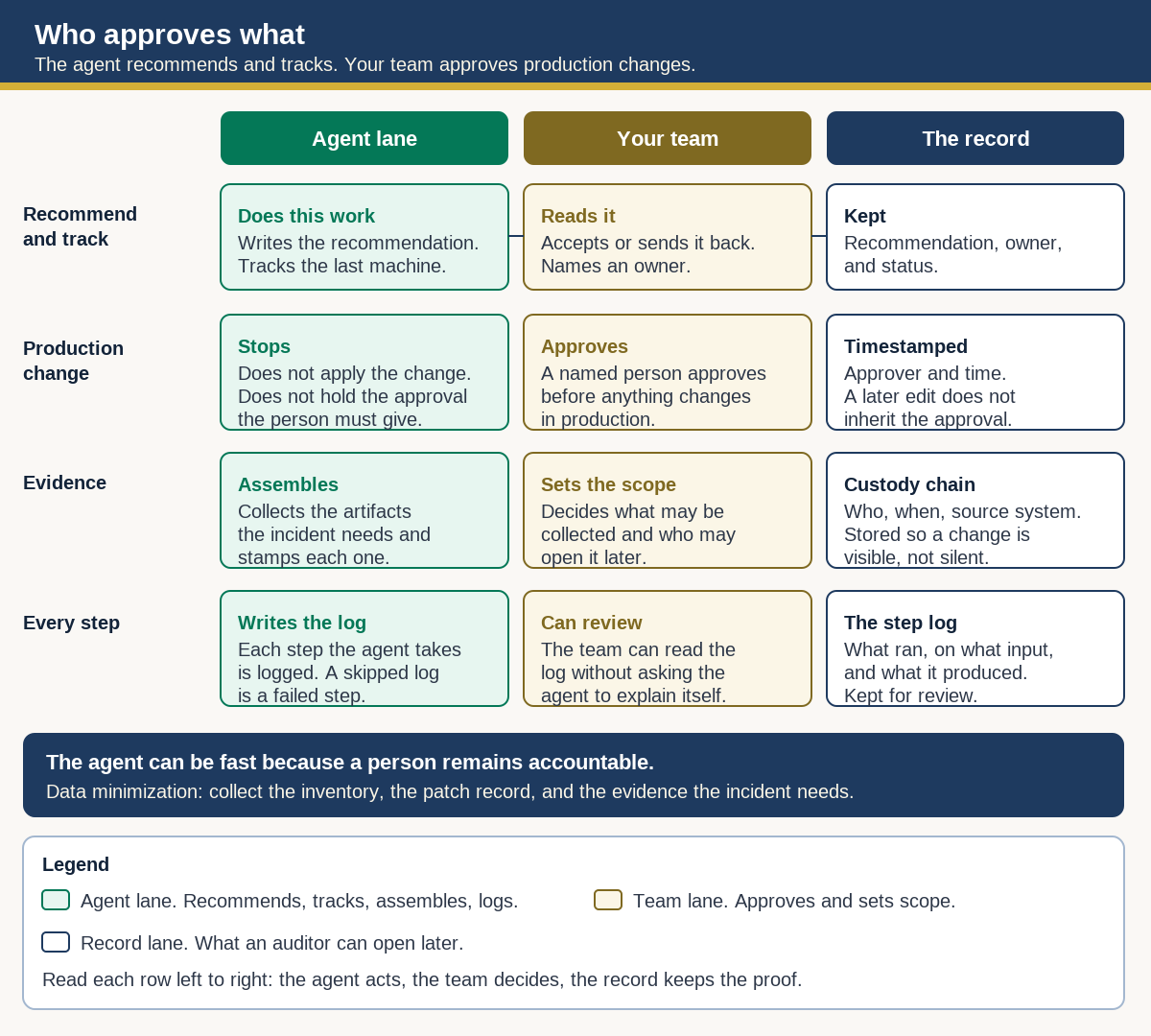
Four activities cover the life of this agent.
Recommend and track. The agent prepares the recommendation and follows the work to the last machine. Your team reads it and either accepts it or sends it back. A named owner is a person, accepted in the record. The record stores the recommendation, the owner, and the status, including the status "refused" or "sent back." Nothing here changes a system. It changes what the team is committed to look at.
Production change. The agent stops. It does not hold the credential, and it does not treat a confident recommendation as permission. A named person approves before anything changes in production, using the change path you already run. The record stores the approver and the time. A later edit to the recommendation does not inherit that approval. If the fix itself changes, the approval is void and must be given again. This is the same rule you would want if a colleague edited a change request after you signed it. The agent does not get a softer rule because it types faster.
Evidence. The agent assembles artifacts and stamps them. Your team sets the scope: what may be collected, and who may open it later. Scope is a decision, because logs can contain more than the incident needs. The record stores custody. Who collected the artifact, when, from which system, and how a reader can tell it was not swapped. A shared folder with last-modified times is not custody. Last-modified times move when someone helpful renames a file.
Every step. The agent writes a log entry for what it ran, what it read, and what it produced. A step that cannot be logged does not run. Your team can read the log without asking the agent to explain itself. Explanations after the fact are stories. The log is the work. The record keeps the log for review, for the next incident commander, and for anyone who has to answer "what touched this case."
Data minimization runs through all four. The sweep collects installed software, versions, patch records, and whether the machine answered. It does not collect the contents of personal files, mail, or documents to decide whether a browser is old. An investigation collects the logs and the traffic the case needs. It does not take a full copy of every machine because a copy might be useful later. Wider collection is allowed when a person widens the scope, in writing, for that case. The default stays narrow so the default is deployable and explainable. A minimization rule that is only true until the first incident is not a rule. It is a brochure.
Audit readiness is the ability to show the record without reconstructing it. An auditor, or your own lead, should be able to open a campaign and see the inventory match, the owner, the verification read, and the close. They should be able to open a change and see the recommendation, the approver, and the time. They should be able to open an incident and see the grouping, the trace inputs, the custody chain, the draft, and the decision, including a decision to watch. They should be able to open the log and see the steps. What they should not need is a specialist who remembers how the quarter went. Memory is not a control. The record is the control.
We do not claim a certification for the agent, and we do not claim one for you because you used it. Certifications are about a specific scope, a specific assessor, and a specific date. They are not a property of a diagram. Jacobian Engineering is a HITRUST Authorized External Assessor. That is a credential of the assessor practice. It is not a statement that this agent, or any client, has been assessed, and it is not a shortcut around the record described above. The record is what an assessment would look at. The diagram is not the assessment.
Oversight also means testing the boundary on purpose. Before you depend on the agent for a sensitive fleet, have someone try to skip the gate. Can a string inside a log redirect the draft into claiming that a change was approved? Can the agent be talked into a production action by a user who is impatient? Can the log be disabled for a "quick" run that then becomes the normal run? Can evidence be overwritten because the locker and the draft share a file? These are red-team questions. They are cheaper before the first real incident than during it. The AI red teaming practice exists for that test. Use it on the design, not as a badge after the fact.
A few rules keep the oversight from turning into another unread policy.
The agent cannot create its own approvals. Approval is a human message, stored, tied to a specific recommendation. A paraphrase of the approval is not the approval.
The agent cannot widen its own collection. Scope changes are human messages too.
The agent cannot delete or compact the log as a housekeeping convenience. Housekeeping that destroys review is not housekeeping.
A person can always stop a campaign, an investigation, or a pull. Stopping is logged. A stopped case is visible. It does not vanish to keep the dashboard tidy.
New duties are out of scope until someone adds them the same way the first three were added: a written job, a record, and a gate. "While you are in there" is how an assistant becomes an actor.
If you want a single sentence for the leadership page, use this one. The agent can be fast because a person remains accountable, and the record shows the accountability without asking anyone to remember it.
The economics
The economics are not a rate card. They are a change in what the same team can finish. Before, security work was a quarterly scan, a spreadsheet, weeks of chasing fixes, and analysts reading logs line by line when something broke. After, the sweeps are continuous, the fixes are tracked to done, the tracing and the paperwork happen at machine speed, and the responders spend their time deciding. The people are the same people. The scarce resource was never intelligence. It was attention, and attention was being spent on reconstruction.
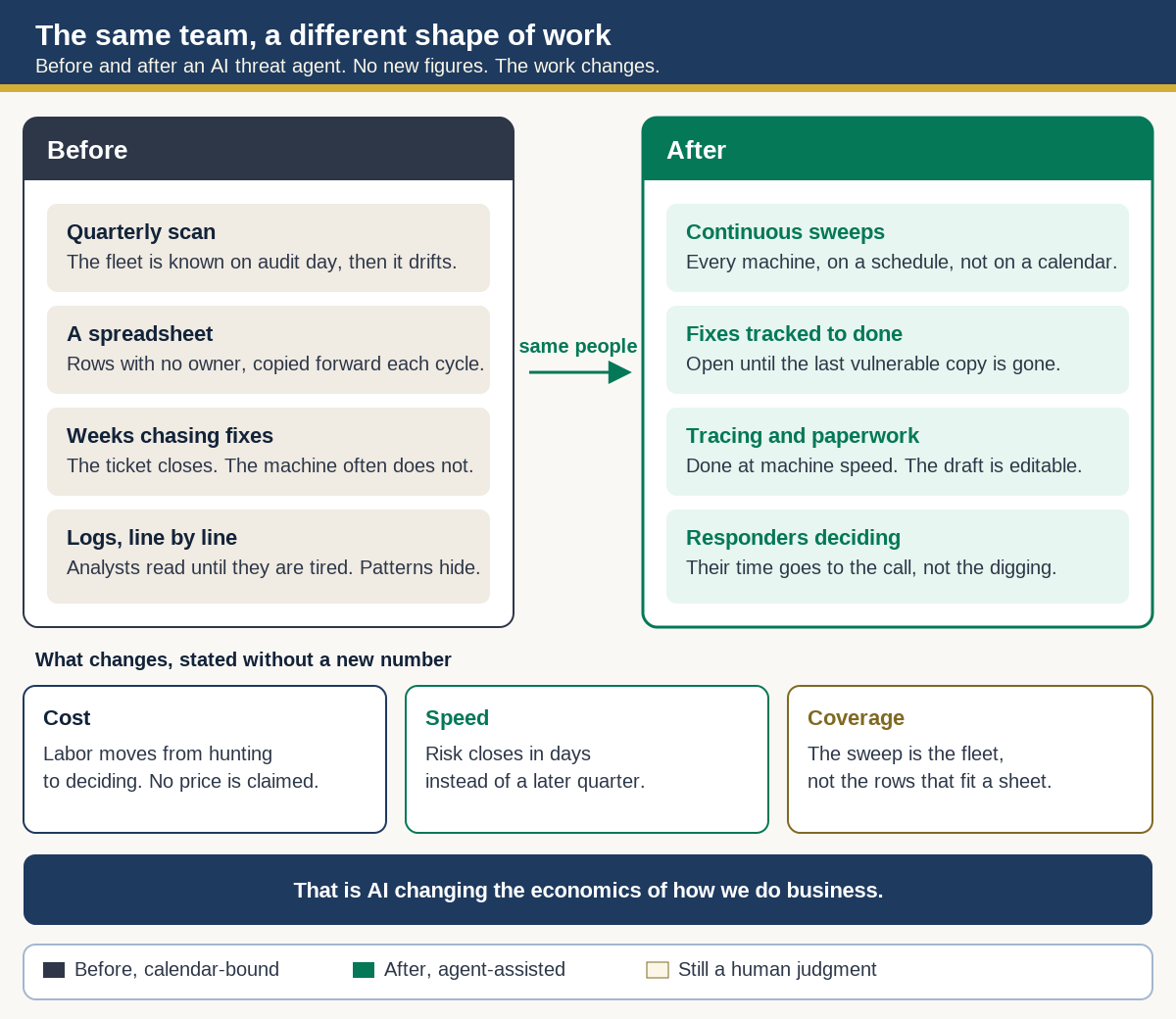
Cost, said honestly, is where the labor goes. We are not going to quote a price, a savings percentage, or an industry figure for the cost of a breach. Those numbers are how papers slide from evidence into advertising. What we can say is structural. Collection, matching, grouping, re-reading, and the first draft are a large share of the hours in a small security and IT team. Those hours are exactly the hours an agent can take without taking authority. The hours that remain are the ones you wanted the specialists for: which campaign matters, which change is safe on this system, which incident is what you will say it is. You still pay for the people. You stop paying them to copy rows and to read past the pattern for the third time. If that trade is not worth it on your fleet, the pilot will show you, because the pilot measures the loop and not a promised percentage.
Speed is the browser campaign, and only that campaign, unless you have your own. Vulnerable installs went from 1,042 to 351 within 3 days and to 164 by day 11, an 84% reduction we also call over 80%. That happened inside a window that would, in the old shape, still have been the week someone was scheduling the quarterly scan. We do not generalize it into "everything is that fast." We do say the old alternative was to discover the same condition at the next quarterly read, after weeks of chasing whatever the previous workbook still listed. Days instead of a later quarter is the speed claim we will sign. A percentage of time saved is a claim we will not sign, because we did not run the controlled comparison that would justify it.
Coverage is the sweep itself. 727 machines, about 1,400 browser installs, about 84,000 installed applications, 6 organizations, and 14,573 operating-system patch installs recorded machine by machine. Coverage here means the unit of work is the machine you named, not the sample that fit in the sheet and not the servers someone remembers. A silent machine stays on the list. A campaign stays open until the last copy is gone. A small team can hold that standard only if the re-read is scheduled. Held by hand, the standard collapses back to "the important servers" within a month, because the important servers are the ones people can bear to check. The economics of coverage are the economics of not dropping the rest.
Put the three incident figures next to the same idea. About 300 attacking sources behind one outage is a coverage problem during a crisis: can you see the shape, or only the first page of the list? About 6,500 malicious connections per minute is a speed problem: can characterization keep up with the rate, or does the rate become a feeling? Over 1.4 million exposed records in one breach review is a labor problem: can the review sort what the evidence supports, or does the team drown in the headline count? In each case the agent widens what the same responders can look at, and the decision stays expensive in human attention, which is correct. Decisions should be expensive. Digging should not be.
There is a cost the diagram does not put in the "after" column, and leaders should expect it. You will spend attention up front on scope, on owners, and on the gate. You will throw away recommendations. You will sit in a short argument about whether a silent machine is in scope. That attention is the price of a record you can trust. Teams that skip it get a fast draft sitting on a rotten inventory, which is the old spreadsheet with better grammar. The economics work when the first month is spent making the sweep true. They do not work when the first month is spent asking the agent to change production so the project looks decisive.
The line under the diagram is the line under the business. That is AI changing the economics of how we do business. Not because a model is impressive. Because the work of knowing the fleet and the work of deciding what to do about it are no longer the same task, competing for the same afternoon.
A sales manager agent exists for a similar defect in a different queue. A pipeline that lives in a sheet, with owners that are really team names, goes stale for the same reason findings go stale. Nobody re-reads the source. Security is not sales, and the gate in front of production is stricter than the gate in front of a forecast. The economic lesson is still the lesson. A queue nobody re-reads is not a system. It is a memory, and memory is the expensive way to run a fleet.
Getting started
Start with inventory, then monitoring, then incident playbooks. That order is deliberate. A playbook on top of an inventory you do not trust will draft confident nonsense. Monitoring on top of a collector that only answers on the servers you already worry about will tell you those servers are fine and will hide the laptops. The first phase is a sweep you believe. The second phase is a schedule and a set of flags your team actually accepts or refuses. The third phase is an incident path you have rehearsed on a case that did not start as a crisis.
What your team provides is short and non-negotiable.
A scope list. The machines in, the machines out, and a named person who can change the list. Out of scope is written down. A machine that appears and is not on either list is a question, not an automatic add and not an automatic ignore.
A reader for inventory and a reader for patch records. We do not name products. We do require that both can be pulled per machine, on a schedule, without a person exporting a workbook. If the only interface is an export someone runs by hand, you are still in the quarterly world, and the agent will simply narrate the workbook.
A named group of owners for campaigns, and a rule for what happens when an owner is away. The rule is another named person, not "the team."
A change path for production that already requires a person. The agent will prepare recommendations that fit that path. It will not become a second path.
A place to put evidence that your responders can open and that your reviewers can open later. If the only place is someone's laptop, you do not have a locker.
For incident work, a list of the log sources and traffic sources you are willing to use, and a person who can widen that list for one case. Widening is allowed. Silent widening is not.
What you measure, in the first phase, is whether the sweep is true. Every in-scope machine either has a fresh inventory or is flagged silent. The silent list has an owner. A sample of machines that operators know by hand matches the inventory. If it does not, you stop and fix the collector. You do not proceed to a clever priority model on a lie.
What you measure in the second phase is the campaign habit. Each new cause is either accepted by a named owner or explicitly watched, with a sentence. Owned campaigns show a machine list that changes because machines were re-read, not because rows were edited. Patch records that disagree with inventory show up as their own flags. You can use the same kinds of counts this paper uses, once they are yours: machines swept, browser installs checked, applications inventoried, vulnerable installs open at the start of a campaign and still open when you look again, patch installs recorded per machine. Do not import our 84% as your target. That figure belongs to one browser campaign on fleets we manage. Your campaign will have its own opening count. Watch that count the way the chart does. An opening count, a count a few days later, and a count when you are ready to talk about what remains. The remainder is part of the report.
What you measure in the third phase is the incident habit, on a rehearsal before you need it. An alert can be grouped. A trace can say what came from logs and what came from traffic. Evidence lands in the locker with custody. A draft exists before the responder starts from a blank page. The draft has a visible unknown. A person makes the practice decision, and the log shows that the agent did not make it. If the rehearsal only works when a particular specialist is in the room, it does not work.
A phased rollout fails in predictable ways. The first failure is skipping to incident drama because drama is easier to fund than an inventory project. You will get a demo and a rotten scope. The second failure is asking the agent to change production in the first month so sponsors can see "action." Action of that kind is the gate failing on schedule. The third failure is boiling the ocean: every old log, every old workbook, every machine anyone has ever owned, pulled into the first sweep. Scope is a decision. A huge first scope is how the collector gets refused and the project stalls back into the quarterly scan. Start with a fleet your owners can recognize, prove the re-read, then add the next group of machines in writing.
The product manager agent is relevant here in a narrow way. A rollout like this is a sequence of verified slices, not a launch date with a slide behind it. Each slice has a check a person can run: the sample matches, the silent list has an owner, the rehearsal produced a draft with an unknown still in it. Shipping the next slice because the calendar said so, while the check is red, is how the gate erodes. Treat the checks as the work. The agent helps you reach them. It does not get to mark them passed.
You do not need a large program office. You need the scope list, the two readers, the owners, the change path, and the locker. You need one person who can refuse a recommendation in public, inside the record, so the team sees that refusal is normal. You need a date for the rehearsal that is not the date of the next real incident. That is the whole start. Everything else is a later slice.
Start the conversation
If this is the operating picture you want, start with a sweep you are willing to believe, on a scope you are willing to write down. The AI threat agent page is the short form of the offer: find the weak spots, watch them around the clock, and turn incidents into a draft your responders can stand behind. This paper is the long form: the loop, the gate, the figures from 2026, and the things we will not claim.
Bring the scope list, or bring the honest statement that you do not have one yet. Both are a usable first meeting. We will talk through collectors, owners, and the approval path you already have. We will not ask the agent to change production to prove it is serious. Serious is a record of the fleet, a campaign tracked to the last machine, and a person whose name is on the decision.
That is the work. The economics follow from the work, not from a slogan. When the same team can see 727 machines without spending the quarter on the workbook, can watch the count move from 1,042 toward 164 without losing the remainder, and can walk into an incident with the trace already grouped, they spend themselves on judgment. That is AI changing the economics of how we do business. When you want it on your fleet, talk to us.
About This Resource
Need Expert Guidance?
Our team can help you put these insights into practice.
Schedule a Consultationor call (415) 644-8208Ready to Take the Next Step?
Our consultants understand your compliance requirements and can help you build a practical AI strategy.