
The AI SEO Agent Playbook
Executive summary
Growth work stalls for a boring reason. The site changes, search results change, and the people who can decide are busy reconstructing last quarter's audit. Technical fixes sit in a ticket queue. Leads fall between a form, a spreadsheet, and the CRM. Ads spend against a conversion nobody trusts. The weekly report, when it exists, is assembled by hand the night before someone asks. The cost of knowing stays high, so the firm quietly chooses to know less often. Headcount does not arrive. The work waits.
An AI SEO agent changes that shape of work. It does four jobs, and it reports on them. It finds and fixes the technical problems that keep pages from being found: indexing, canonicals, titles and metadata, sitemap freshness, structured data, and page speed. It counts every lead, from the visit through a consent choice and a form, into web analytics and the CRM, without a second copy in a side file. It sends conversion signals to ad platforms so spend learns from real outcomes, not from a guess about what a click was worth. It hands the lead to sales as a record they can open. Each week it says what moved, what shipped, and what is still open. It does not publish public copy on its own. Your team approves anything a customer will read. The agent proposes, checks, ships behind that approval, and verifies.
That is the economics. A small marketing team covers the site it actually has, because the audit, the match of a lead to one record, the conversion signal, and the first draft of the weekly report happen at machine speed. People spend their time on the calls that were always theirs: which fix goes first, which sentence may go live, which campaign deserves more budget, which lead a salesperson should call. That is AI changing the economics of how we do business. This paper is the operating picture behind the short version on the AI SEO agent page.
The figures come from our own site. Impressions went from 5,970 in the four weeks of September 22 through October 19, 2026, to 12,720 in the four weeks of October 20 through November 16, 2026. That is a rise of 113%, more than doubled. Clicks went from 24 to 38, a rise of 58%. Ranking pages went from 102 to 179, a rise of 75%. Visible queries went from 367 to 905, a rise of 147%, nearly two and a half times. On November 20, 2026, 186 of 196 sitemap pages were indexed, about 95%, nearly every page. Industry-standard page audits on the agent pages returned a search score of 100 and performance in the high 90s. We call those perfect search scores. They show the loop can close on a real site. They are not a forecast for yours.
The pattern travels: your website, search engine data, web analytics, ad-platform conversion signals, and a CRM, feeding an agent that audits, prioritizes, plans, and verifies, then a change queue, a human approval gate, staging and checks, and a weekly report. The agent reviews search engine data and web analytics every weekday. It reports weekly. Weekday attention from the system. Weekly judgment from the person.
Why growth work stalls
The quarterly audit feels responsible. A date is on the calendar, an agency or an internal owner produces a deck, and leadership can say the site was looked at. Then the deck ages. Pages are redesigned. Titles drift. A section launches without a canonical. A template duplicates a description across a directory. By the steering meeting, the deck is a photograph of a site that has already moved. The gap is not laziness. A project cadence cannot describe a site that changes every week.
The ticket queue makes the gap look like a system. Each row is a finding. The owner column stays blank, or it names an agency rather than a person who can ship. Status sits at "in progress" for the life of the sheet. The sheet is copied forward, blank owners included. Nothing in it re-reads the page. A row can say fixed because someone believes a change was requested. The title is still wrong. The page is still absent from the index. The sitemap still lists a URL that does not resolve.
Chasing the fix is where the weeks go. A finding is assigned. A ticket waits on a sprint that is already full of something louder, usually a page a salesperson promised. The ticket closes because the sprint passed, or the assignee changed roles, or someone marked the row done without opening the live page. The next audit finds the same issue. The firm has paid for the finding twice, and the page was hard to find the whole time. The stall is not a missing list. Nothing in the list is tied to a fresh read.
Attribution stalls next door. Marketing says the ad did it. Sales says a colleague made the introduction. Web analytics shows a session. The ad platform shows a conversion that may not be the same person. The CRM shows a contact typed in later, source left on the default. Budget moves by the loudest anecdote. A working channel gets cut because the proof was split across tools. A weak channel keeps its budget because someone remembers a good month. Guesswork is what remains when the systems do not share a lead.
Leads disappear in the seams. The form submits. The thank-you page loads. The event never fires, fires twice, or fires only in the browser and dies when the browser blocks it. A copy lands in an inbox several people watch and nobody owns. The CRM record appears at the end of the week, or never. Sales works the leads they can see. You cannot manage a lead you never stored, and you cannot manage two records that are one person. Duplicates make the pipeline look healthier than it is, and the buyer gets two notes or none.
Small teams feel this first. The people you have are the people you will have next quarter. If staying findable means spending them on audits, tickets, exports, and slides, then findability competes with every other job. They audit when they can. They chase a lead when sales complains. The quiet canonical, pointed at the wrong page on a template nobody is thinking about, waits.
Some teams refuse to automate because they have seen a wrong sentence go live, or a bad title pushed across a template. That fear is correct. An unattended public change is a brand incident, and the index can remember it after you have fixed the page. The mistake is treating "a person must approve" as "a person must also collect, compare, copy, and draft." The person is scarce. The collection is not.
Founders meet this as a hiring argument. The board asks why growth is flat. The site is hard to find for queries the firm should own, and inquiries never become records. A hire is proposed. The hire inherits the same tools and the same deck. The economics do not move, because the shape of the work does not move. In a professional-services firm the trap is sharper. The people who may approve a public sentence are the people who sell. They will choose the buyer conversation, correctly, and the site will drift. A retainer moves the reconstruction onto someone else's calendar and then waits on a ticket. The drift continues between tickets. A weekly picture does not ask the partner to become an analyst. It asks the partner to stay the approver.
What an AI SEO agent is (and is not)
An AI SEO agent assists the marketing lead who already owns the site, the leads, and the budget. It is not a replacement, and it is not an audit you buy and forget. It proposes, ships behind an approval, and verifies. Propose means it says what it found, how the findings group, and what should change, with the check written before the work starts. Ship behind an approval means staging and automated checks come first, and live comes only after a person says so. Verify means it goes back to search engine data and to the page and asks whether the fix worked. A change that cannot be verified is a hope.
It does not publish public copy alone. Titles, descriptions, and any sentence a buyer will read stay drafts until your team says yes. The agent can make the draft so complete that the person's job is to approve or refuse. It cannot skip that step because the draft looks obvious. A wrong title on one page is a nuisance. The same wrong title across a template is a week of cleanup, and a search result that misrepresents you until the index catches up.
It is not a chatbot with an export pasted in. That produces a plausible paragraph and no custody. The next person cannot see what was omitted or whether the paragraph was edited later. The agent in this paper is wired to the site, to search engine data, to web analytics, to ad platforms, and to the CRM. Report sentences come from the record, not from a prompt typed in a hurry.
It is not a score you chase. Two pages with the same thin title are different problems if one earns impressions and the other is absent from the index. Issues that share a template are one campaign, not a stack of emergencies. The agent groups and explains. People rank, in words: can the page be found, does a fix exist, does someone own it, will a buyer see the change. The agent does not invent a numeric priority and call it the decision. A search score is an audit of a page, not a formula for the queue.
The boundary matches how a careful team already treats people. The drafter is not automatically the approver. On a small team they may be the same person, and the approval is still a separate stored act. Saving a draft is not a yes. A refused draft stays in the record. A later edit does not inherit the old approval. Speed is welcome. Inherited authority is not.
The jobs stay narrow, because a general instruction to "handle marketing" expands until it touches a claim or a budget someone thought was out of scope. The scope is technical search fixes, lead tracking, ad conversion signals, CRM handoff, and the weekly report. Brand campaigns and pricing promises are not smuggled in because the agent was already on the site.
If you have seen a sales manager agent keep a pipeline honest, the habit will look familiar. An item is done when it agrees with the source, not when the board looks finished. A lead's source is the form, the consent choice, and the CRM record. A wrong public claim is worse than a wrong forecast column, so the gate in front of a sentence is harder.
The agent will group issues a specialist would split, and it will write a cleaner pattern than the evidence supports if you let the report hide the gap. It will propose a title that is right for most pages and wrong for one constrained page. Those are reasons for the gate, not reasons to return the marketing lead to line-by-line auditing. Judgment includes saying the draft is wrong. The agent will also not invent demand. A fixed canonical does not create a market. A counted lead is not a qualified lead. A clean signal does not rescue a weak offer.
There is a version of this category that is a dashboard beside a chat box. You upload an export and receive confident prose about the week. That is a writing aid. It does not re-read the page on the next weekday, block a bad title, or tie one submission to one CRM record. If a demo centers on the paragraph, ask for the queue, the gate, and the re-check. Missing those, you are buying a narrator for the stall. Narration is cheap. A closed loop is what changes the week.
Reference architecture
Read the picture from the sources, through the agent, to the gate, and only then to the live site. The website, search engine data, web analytics, ad-platform conversion signals, and the CRM hold the facts. The core audits, prioritizes, plans, and verifies. A change queue holds the proposals. A human approval gate stops anything public. Staging, checks, then live are the path after a yes. A weekly report closes the loop. The gate is a stop, not a caption.
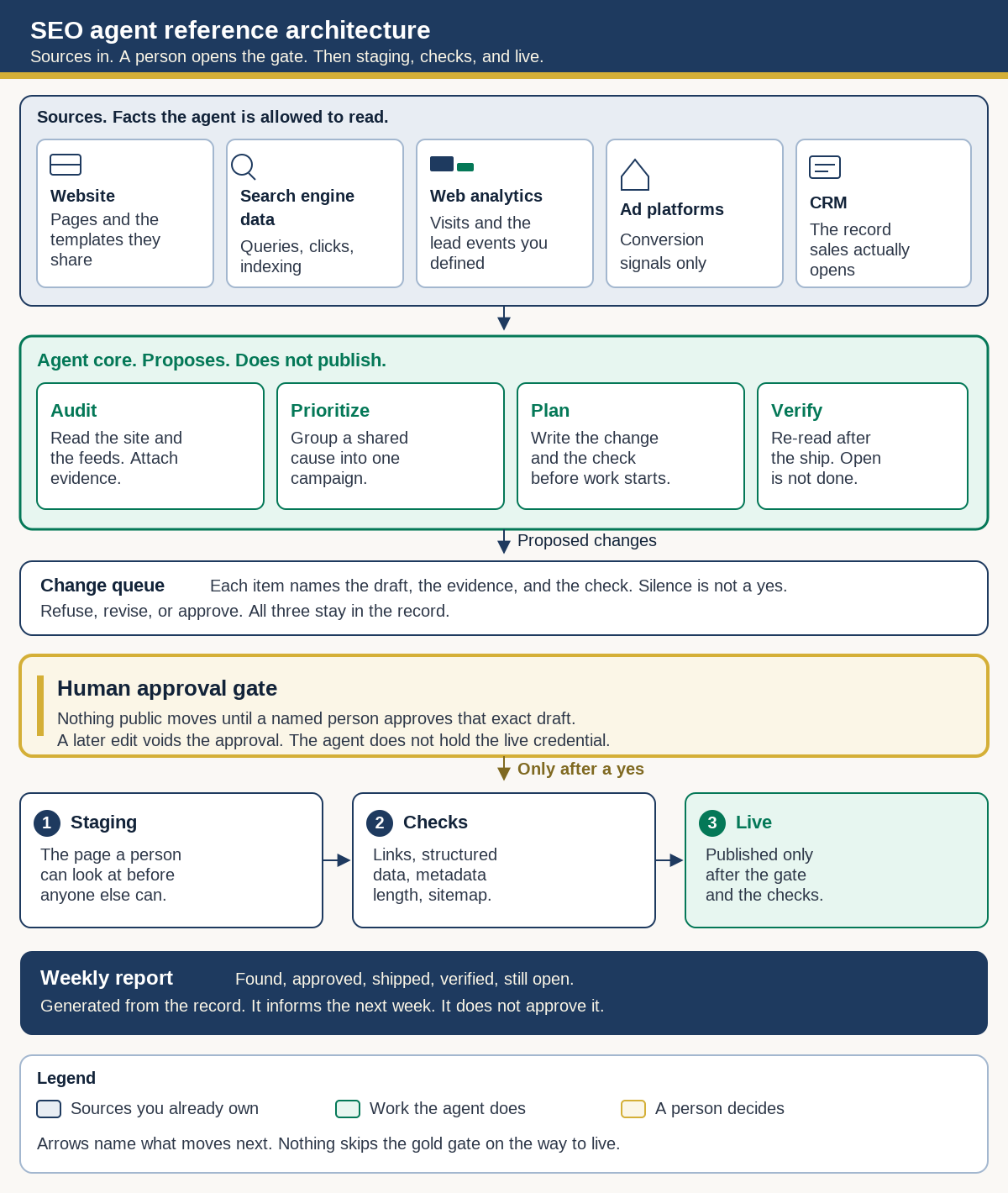
Start with the website, because later mistakes are scope mistakes. Scope is the pages a buyer can request, the templates they share, and the easy-to-forget URL: last year's landing page, a trailing duplicate, a file that should have been retired. The agent does not discover your company. It reads the site you named and flags a named page that stops resolving. A page never named is not healthy. It is out of scope, and that should be written down.
Four feeds stay separate on purpose. Search engine data says how the site is found: queries, impressions, clicks, indexing, and which pages appear. Web analytics says what happened on the site, including the lead events you defined. Ad-platform signals say what paid channels were told. The CRM says what sales received. Mix the four and you hide the useful discrepancy: web analytics counted a form the CRM never stored, or an ad platform celebrated a conversion no salesperson can find. Pulls run every weekday. A failed pull is a signal. Silence is not health.
What moves inward is state, not the contents of every conversation. Page structure, indexing, titles and metadata, sitemap entries, lead events, consent choices, conversion signals, CRM records. You do not need a sales call to know a form failed to create a record. A narrow pull is also how the agent stays deployable. Asking for everything gets refused. Asking for search state, lead events, and CRM records can be explained in a sentence.
The four duties fail differently, so they are four boxes. Audit says what is wrong or missing, with evidence. Prioritize turns a template-wide title problem into one campaign instead of a pile of identical rows. Plan writes the change and, before the work counts as started, writes the check that will decide whether it worked. Verify runs that check after go-live and records whether the evidence moved. Planning must not quietly become publishing.
The arrow out of the core is a queue, not a live edit. Do not blur that once recommendations look good. If the agent holds a credential that can publish without a person, the gate is a policy sentence, and sentences do not stop a model. The live credential stays absent until that change is approved. Each queue item names the page or the tracking change, the reason, the draft, and the measurement set beforehand. Items do not age into a yes. Silence is not approval. Refuse, revise, and approve are all recorded.
The gate is the wide bar so nobody misses it. A person approves copy and anything the public will see. Technical repairs that do not change a sentence still pass the same gate in this design. The exception has to be earned. Staging comes first. Checks confirm that links resolve, structured data is valid, metadata is within the length you set, and the sitemap matches the pages you mean to offer. Only then does the change go live. A failed check does not ship on a shrug unless a named person records an exception. A gate people routinely override is a suggestion.
The weekly report tells the marketing lead what was found, approved, shipped, verified, and still open. It is generated from the record. It does not approve the next week. You can adopt the picture without replacing tools your team already knows, as long as the feeds are readable on a schedule, the site changes through a path you trust, and the CRM accepts a lead. Test it by trying to break the gate. Can text hidden in a page make a draft claim it was already approved? Can a failed feed look like a healthy empty site? Can a refusal vanish from the log?
The same shape appears in security work, for different jobs. The AI threat agent whitepaper walks a fleet, a locker, and a person who decides before production changes. A search fix is not an incident response. What they share is the refusal to let speed become authority. If a design cannot be told in one sentence — facts in, queue, a person opens the gate, staging and checks, then the report — it is hiding a shortcut, and the shortcut is the gate.
The weekly operating loop
The picture of parts is not the week. The week is a loop. Pull data. Spot issues and opportunities. Plan, with the measurable check set before the work starts. Ship only after approval. Verify the fix. Report. Repeat. Skip a step and you have the quarterly deck again, written faster.
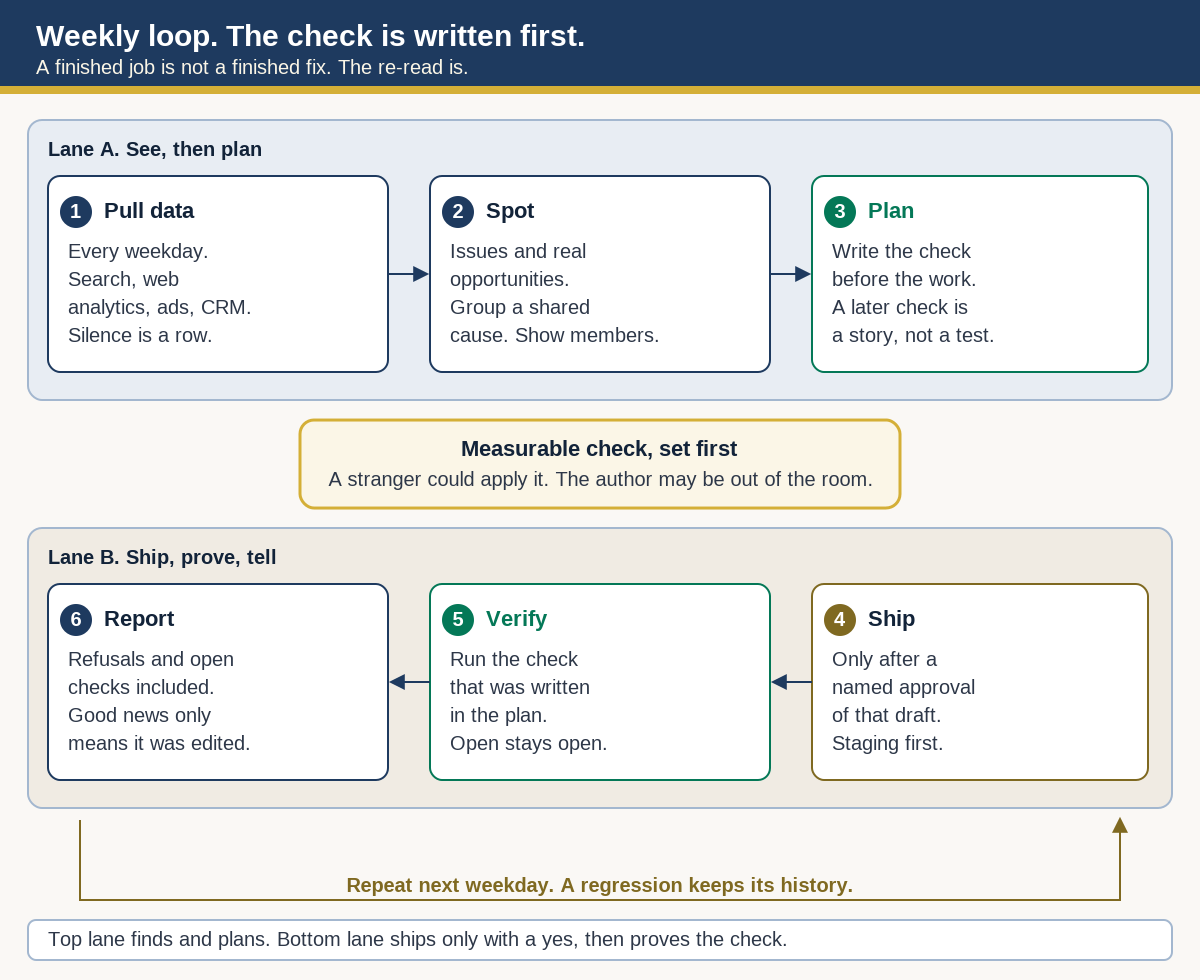
The pull happens every weekday: search engine data, web analytics, ad-platform signals, the CRM, and the live pages in scope. A silent source is listed, not omitted. Omission is how a broken feed survives every report. The pull does not rank yet. Ranking early teaches the system to trust whichever source answered first, which is how a dead CRM connection becomes "a quiet week."
Spotting should look boring. Index status against last week. Titles and metadata against rules you wrote down. The sitemap against pages that resolve. Lead events against CRM records. Signals against leads sales accepted. An opportunity is not a vibe. It is a page that already earns impressions and lacks a clear title, or a query the site has started to show for while a canonical or a thin page sits in the way. The agent proposes the group and shows the members. A person can split it. Splitting is cheap now and expensive after two plans exist.
The plan answers, in words, what will change, which pages or events, what must not change, and which later evidence counts as success or failure. The check is written first. A check written afterward will always find a flattering movement, because a week contains many and a narrator can pick. The checks worth trusting are blunt. The page is indexed or it is not. The canonical matches the preferred URL or it does not. The lead event and the CRM record are the same submission or they are not. The signal fired once or it did not.
A stranger should be able to apply the check. "Improve the page" fails that test. "The canonical matches the preferred URL, and search engine data no longer lists the duplicate" passes it. "Get more leads" fails. "Each accepted form creates one CRM record, retries collapse, and the consent choice is stored" passes. The author of the plan may not be the person reading the result later.
Shipping waits. A green staging check is not a launch. The approval names the exact draft. Edit the draft and the approval is void. The agent does not get a softer rule because it types faster. On a small team the reader and the approver may be the same person. The act is still separate, and the log shows it.
Verification is a second read. A cheerful queue note is not the check. Indexing is not instant, so a check may stay open past a weekday. Open is allowed. Calling open "done" is not. The report, written for someone who was not in the tools, includes refusals and open checks. A report of only good news was edited. The next pull is the same loop, not a new project. A regression keeps its history, so you can see a template overwrite or a new page that copied the old mistake. Reopening is success. Hiding it is how the site drifts under a green story.
Opportunities are not a license to publish by Friday. Name the existing page that should carry the query, what must not be claimed, and how you will know the appearance held. Urgency is how thin pages multiply. The loop may notice every weekday. It still waits for a check and a yes. Once pulls are trusted, the marketing lead reviews plans on a rhythm the team already has. The quarter becomes a review of the record, not the moment collection starts. If plans pile up with no yes and no no, you do not need more findings. You need a sentence: approve, refuse, or watch.
Technical search, fixed and proven
Technical search is usually a document and a promise. The useful version is an issue with evidence, a draft, a check, and a second read. The agent reconstructs. Your team decides what ships.
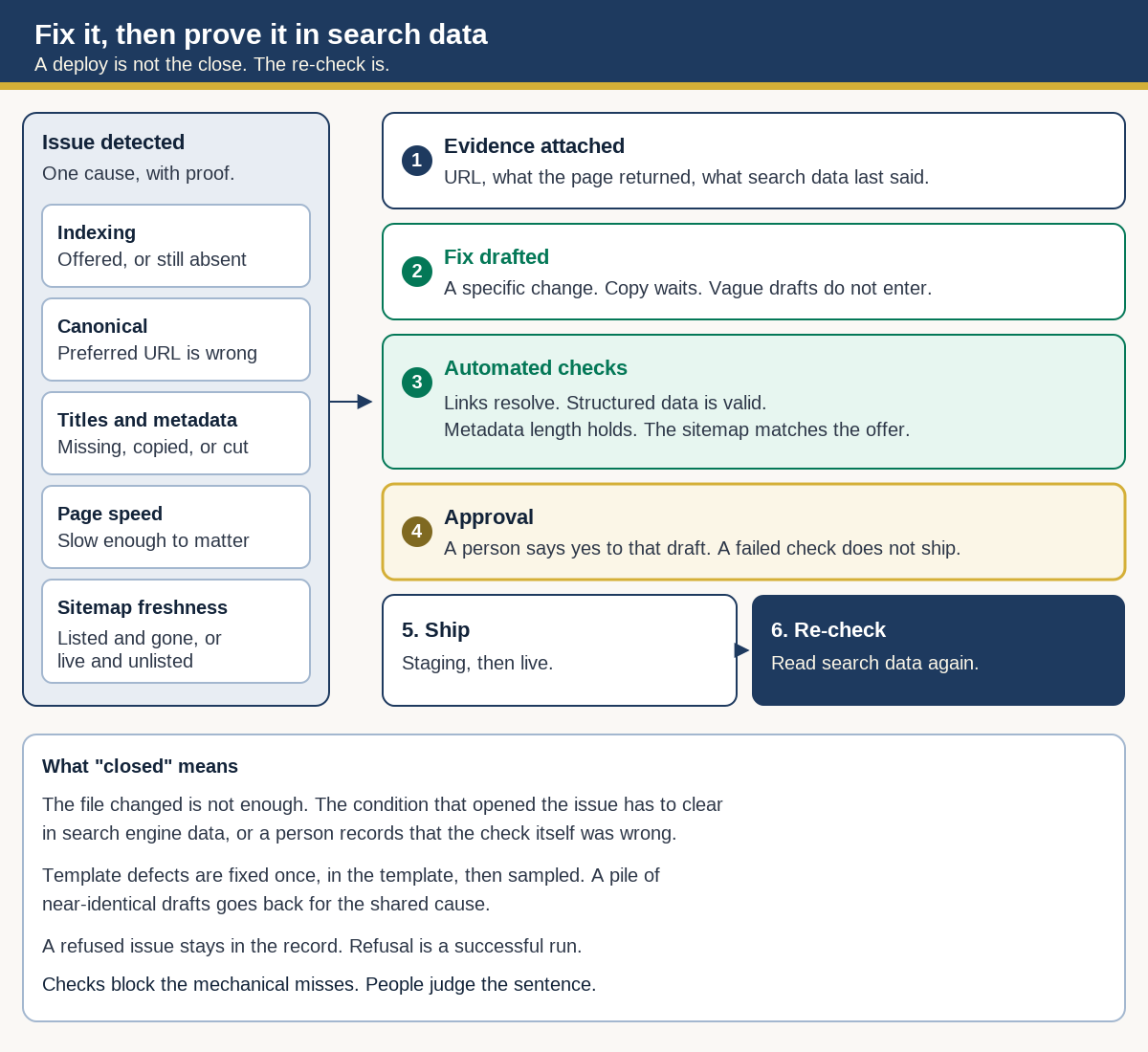
An issue is a specific defect. Indexing: a page you mean to offer is absent, or a retired page is still offered. Canonicals: the preferred URL is wrong, points at a duplicate, or pages point at each other in a circle. Titles and metadata: missing, duplicated by a template, or so long the result cuts them off. Page speed: slow enough that the visit and the audit both suffer, fixed and re-measured rather than sloganized. Sitemap freshness: the map lists pages that do not resolve, or omits pages you just published. Structured data: invalid markup, or markup for a page you do not have, so the enhancement is discarded.
Evidence is attached, or the queue fills with rumors. Which URL. What the page returned. What the canonical, title, and description said. Whether the sitemap listed it. What search engine data last said about indexing. The record keeps which condition fired. A false alarm can be refused, and the refusal stays. That is a successful run.
The draft is not a live edit. A canonical draft names the preferred URL and the pages that should point at it. A title is copy, and copy waits. The agent may propose from the page and the queries. It may not decide the proposal is the brand. Sitemap work is a list of additions and removals. Structured data is corrected markup. Page speed is a specific template change, not "make it faster." If a person cannot see the change, they cannot approve it.
Checks run before a person spends time, and again before the live ship. Links resolve. A canonical does not point at a missing page. Structured data matches the shape you intend. Titles and descriptions sit inside the lengths you set. The sitemap matches the offer, including removals. A failed check blocks the ship. Eyes are for the sentence and the claim, not for catching a broken link.
Copy is always a human yes. A canonical that changes no words is still approved here, because the preferred URL is a public fact and the wrong one consolidates the wrong page. The order is staging, checks, then publish. Publishing first is how a broken sitemap spends a day in public. The re-check does not ask whether the file changed. It asks whether the opening condition cleared in search engine data. The issue stays open until that read, or until a person records that the check itself was wrong. Closing on a successful deploy is the spreadsheet habit.
Change a shared title pattern once, in the template, then verify a sample of the pages that inherit it. Editing pages one by one creates a second pattern, and the next redesign resurrects the first. If the agent proposes a pile of near-identical drafts, send them back and ask for the shared cause. That refusal is the system working. For a retired page, remove it from the sitemap and decide whether the URL should resolve, redirect, or stay gone. The agent must not invent a redirect target to make the plan look complete. A wrong redirect consolidates attention where you did not choose. Empty and waiting is better than a confident guess.
Our own site, as the worked example
The site is ours. Before is September 22 through October 19, 2026. After is October 20 through November 16, 2026. Four weeks against the prior four. The lift belongs to the whole loop, not to a single title. The work was the work above: issues found, fixes shipped behind review, results read again in search engine data.
Impressions went from 5,970 to 12,720, up 113%, more than doubled. Clicks went from 24 to 38, up 58%. Ranking pages went from 102 to 179, up 75%. Visible queries went from 367 to 905, up 147%, nearly two and a half times. Each pair is drawn on its own scale. One axis would flatten clicks under impressions and pretend four facts were one.
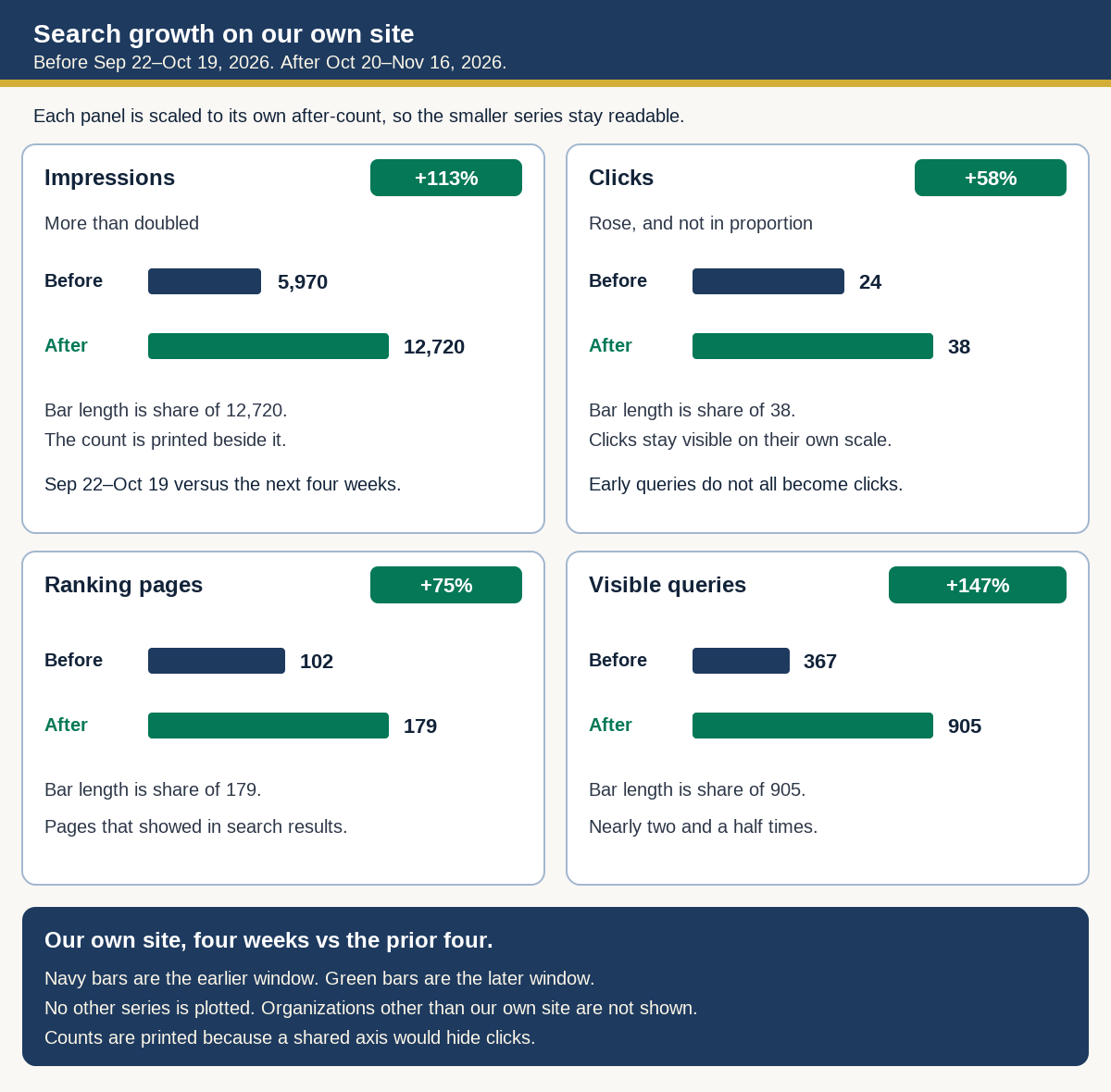
Clicks did not rise in proportion to impressions. That is what early appearances on many new queries look like. Impressions more than doubled, from 5,970 to 12,720. Queries rose nearly two and a half times, from 367 to 905. Clicks went from 24 to 38. Ranking pages went from 102 to 179. On November 20, 2026, 186 of 196 sitemap pages were indexed, about 95%, nearly every page. The remainder stays visible. The four-week chart and that index snapshot answer different questions, and they stay separate.
Industry-standard page audits on the agent pages returned a search score of 100 and performance in the high 90s. Those are perfect search scores. A score of 100 means the mechanical checks were clean on those pages. It does not mean the market is won, or that a larger site scores the same on a first pass. It is evidence that a re-check can move a real site in the kind of month otherwise spent building the quarterly deck. Indexing, canonicals, titles, the sitemap, and page speed stay in one loop because they fail together. On our site the exciting panel is impressions and the sober one is clicks. Both belong in the week.
Every lead counted
A site that is easier to find, attached to a form that loses the person, is a more expensive disappointment. The path is: visitor, consent choice, form submit, a lead event in web analytics, a server-side conversion signal to ad platforms when consent allows, a deduplicated CRM record, then sales follow-up. Skip dedupe and the pipeline lies. Skip consent and the signal should not leave.
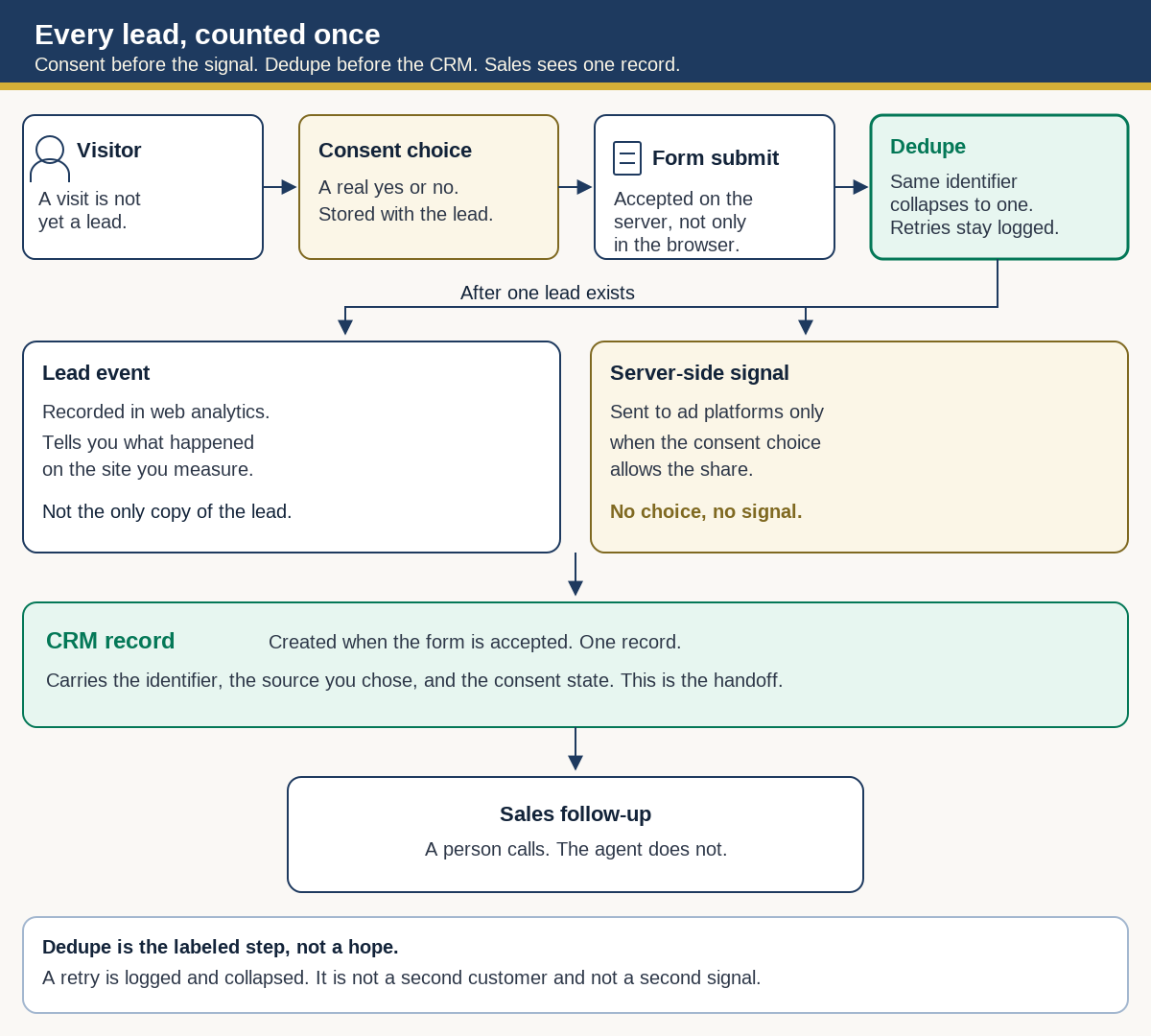
A visit is not a lead, and the agent will not promote one to brighten a quiet week. A lead starts at the form, or at the explicit action you defined. Quiet weeks are information. Consent is stored with the submission and is checked before the signal, not repaired in the report. A CRM record so your team can answer someone who asked is not the same path as telling an ad platform. When the choice says no, those paths split. The agent does not get to override the choice because the lead looks valuable. The log shows which branch ran.
The submission should carry an identifier the CRM can store, and it should not live only in a browser script. Scripts fail or get blocked, and those are often the visits you most wanted. Record the lead on the server when the form is accepted. The browser event can still feed web analytics. When the two disagree, flag it. Do not silently keep the larger number.
Dedupe is on the diagram because teams skip it. A refresh, a double click, or a retry becomes two records, or three, and more than one signal. Sales calls twice. The report overstates demand. Collapse on the identifier you chose, inside a window you describe in words, not on a hunch that two names match. Similar names are a human review. The collapsed copies stay in the log. The report counts the lead once and may still mention the retry. It may not pretend the retry was another customer.
The signal carries the conversion and the consent state, not a dossier. Extra personal detail is a written scope decision. The CRM record is created as the form is accepted, with source, consent, and identifier. Instant means that, not "someone pastes it in later." A missing record is an issue with evidence, same as a broken canonical, watched every weekday: submissions, records, collapses, gaps.
Follow-up stays human. The agent does not call, write the note, or declare the lead qualified. It removes the excuse that the lead was lost between tools. The sales manager agent is the natural next reader of a clean handoff. This paper stops at the handoff.
Watch the failures that rot the path. A banner that treats every visit as a yes is decoration, and it should block the signal until the choice is real. If the form and the CRM do not share a key, do not loosen the match until the week looks tidy. An inbox kept "just in case" becomes the system, and the CRM becomes the archive. Test submissions must be labeled or they will be counted. A started form is not an accepted form. Creating a record so a partial is not "lost" stores someone who did not ask to be contacted. Count every real lead once, where sales actually works, consent still attached. Found and then lost is not growth.
Ads that learn from real conversions
Paid budget drifts the way audits drift. The platform is told to optimize, and it is handed a blur: a click, a page view, a soft event on load. It finds more of that blur. The team concludes ads do not work. Often they were never given a true outcome. The fix is a signal that means a lead, sent once, after consent, from the server, matched to the CRM record sales can see.
A rare real event teaches slowly and points somewhere. A common hollow event teaches quickly and points nowhere useful. The chart moves. The pipeline does not. Signals sent and CRM records created should be the same set. When they diverge, that divergence is the issue. Do not let the platform keep the larger number to make the week match.
A browser-only signal describes the visits where the script ran. That is not a random sample. It teaches the platform to find more easy visits. A server-side signal, fired when the form is accepted and consent allows, describes the leads you received. If the choice refuses the share, the signal does not go, and the CRM record still can. The ad side of the week may look quieter than the sales side. Say so in a sentence: these leads asked not to be used to train the ads.
The places you already pay for attention are enough. Clean in, the platform can stop treating every click as the goal. A duplicate teaches it that one lead was several. Nothing from the server, and it only knows the browser's story. The agent owns the cleanliness of the signal. It does not own the bid, the audience, or the creative. Spend and the public voice stay behind approvals.
The paid marketing agent sits on the other side of the handoff, running campaigns once the outcome is real. The agent's job is to make the outcome real first. Folding both into one instruction would change a bid and a headline in the same breath. Those are different approvals. Send the signal after dedupe and after consent. Do not send a page view you hope will correlate, and do not attach an invented value. A made-up value is a fiction with a unit. A real value, later, needs its own source. Keep a browser event for web analytics if you want one. Do not let it be the only teacher. Review the match in the weekly report.
Creative still matters. The signal cannot invent the offer, the page, or the sentence a partner will sign. It changes the argument, from whoever spoke last to whether the people who submitted were the people you meant to reach. The agent does not pause a campaign or raise a bid when the match looks bad. It reports. A person decides. Ads aimed at real conversions will not rescue a weak offer. They will stop spending so efficiently on the wrong goal, which is the point for a firm that sells expertise.
Governance and human oversight
Speed needs a table of duties, not a slogan. Who proposes, who approves, what the gate blocks, where the proof lives. If the answer is "the platform," nobody owns the decision.
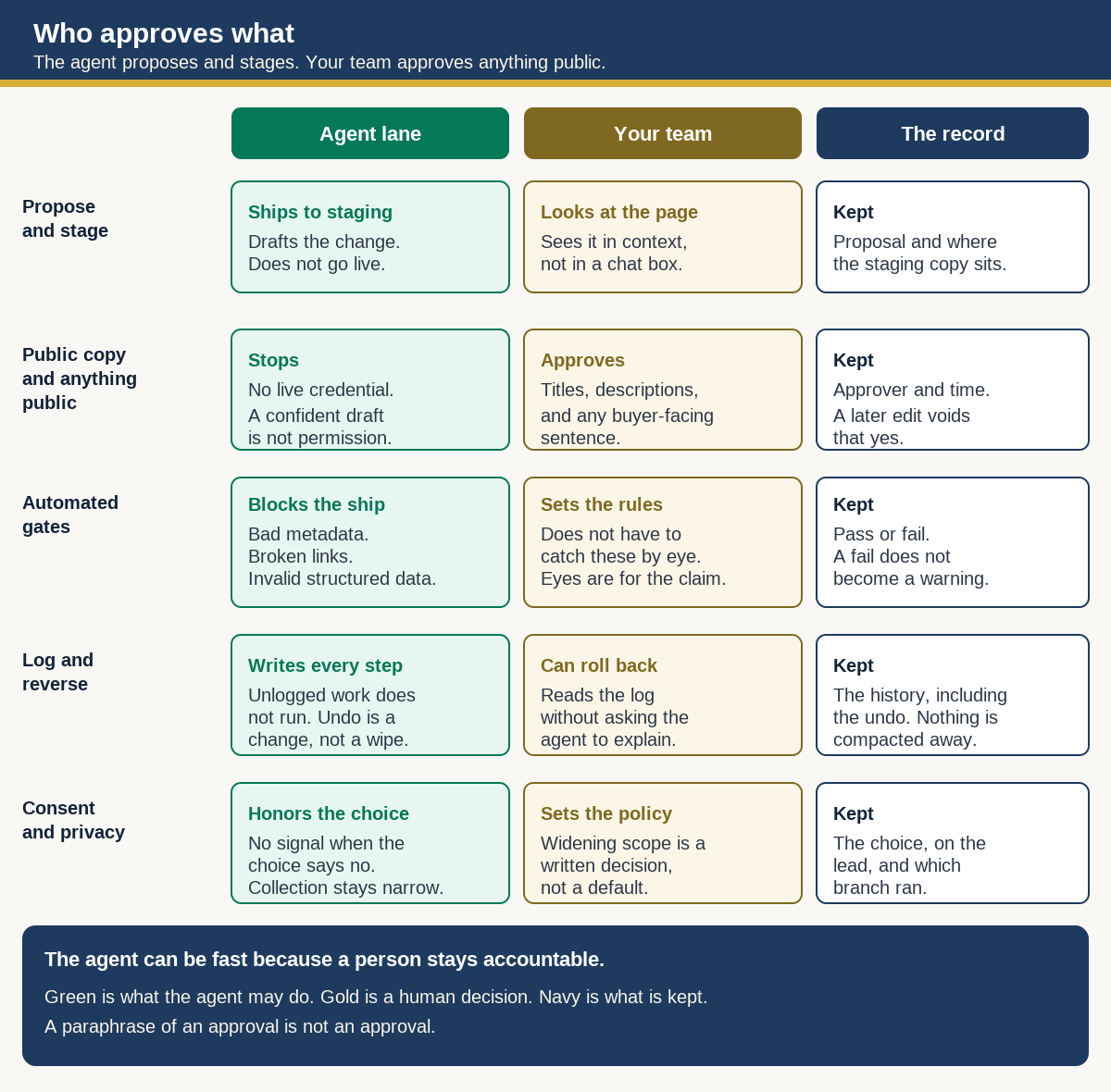
The agent proposes and ships to staging, where a person can see the page. A chat preview is not staging. The record keeps the proposal and the status, including refused. Your team approves copy and anything public: titles, descriptions, body copy, and anything a search result will offer as yours. The agent does not hold the publish credential. A later edit voids the yes, because the index remembers a wrong sentence after the deploy is over.
Automated gates block bad metadata, broken links, and invalid structured data before they become the approver's puzzle. A gate that fails closed is the point. A warning that still ships is a log of regrets. Your team sets the length limits. The agent does not loosen them to let a draft through. Changing a threshold is a human policy change, stored like any other.
Every step is logged: what was read, proposed, checked, approved, shipped, and re-checked. A step that cannot be logged does not run. Reversal is part of the same row. The undo is a logged change, not a quiet overwrite. Weekly pace is safe because you can go back. Without that, everyone waits for the quarter.
Consent stays on the lead. Disallowed signals are not sent. Collection stays narrow: page structure, search state, lead events, consent, conversion signals, CRM identifiers. The agent does not read the sales call or the mailbox to judge a canonical. Wider collection is a written decision. Public copy includes the result title, the description, the button, the form confirmation, and structured text you hope will be shown. A template that generates them still generates copy. Approving the pattern is allowed. Changing the pattern needs a new yes.
A skeptical partner should open a change and see evidence, draft, approver, and re-check, and open a lead and see consent, dedupe, the web analytics event, the signal or its absence, and the CRM record. Memory is not a control.
We do not certify the agent, and using it does not certify you. Jacobian Engineering is a HITRUST Authorized External Assessor. That is a credential of the assessor practice. It is not a statement that this agent, or any client, has been assessed, and it is not a shortcut past the record. The diagram is not the assessment.
Have someone try to skip the gate before you depend on it. Hidden text that claims an approval. An impatient user who wants a live publish. A log disabled for a "quick" run. A consent choice overwritten by a careless default. Those tests are cheaper now than during the first public mistake. The agent cannot approve itself, widen its own lead definition, or compact the log as housekeeping. A person can stop a change, a signal, or a pull, and the stop stays visible. New duties need a written job, a record, and a gate. The leadership sentence is simple. The agent can be fast because a person remains accountable, and the record shows it.
The economics
This is not a rate card. It is a change in what the same team finishes. Before: quarterly audits, agency tickets, guesswork attribution, leads lost between tools, reports assembled by hand. After: weekly fixes shipped and verified, every lead counted, ads optimized on real conversions, the CRM updated when the form is accepted, a plain weekly report. Attention was the scarce resource, and it was being spent on reconstruction.
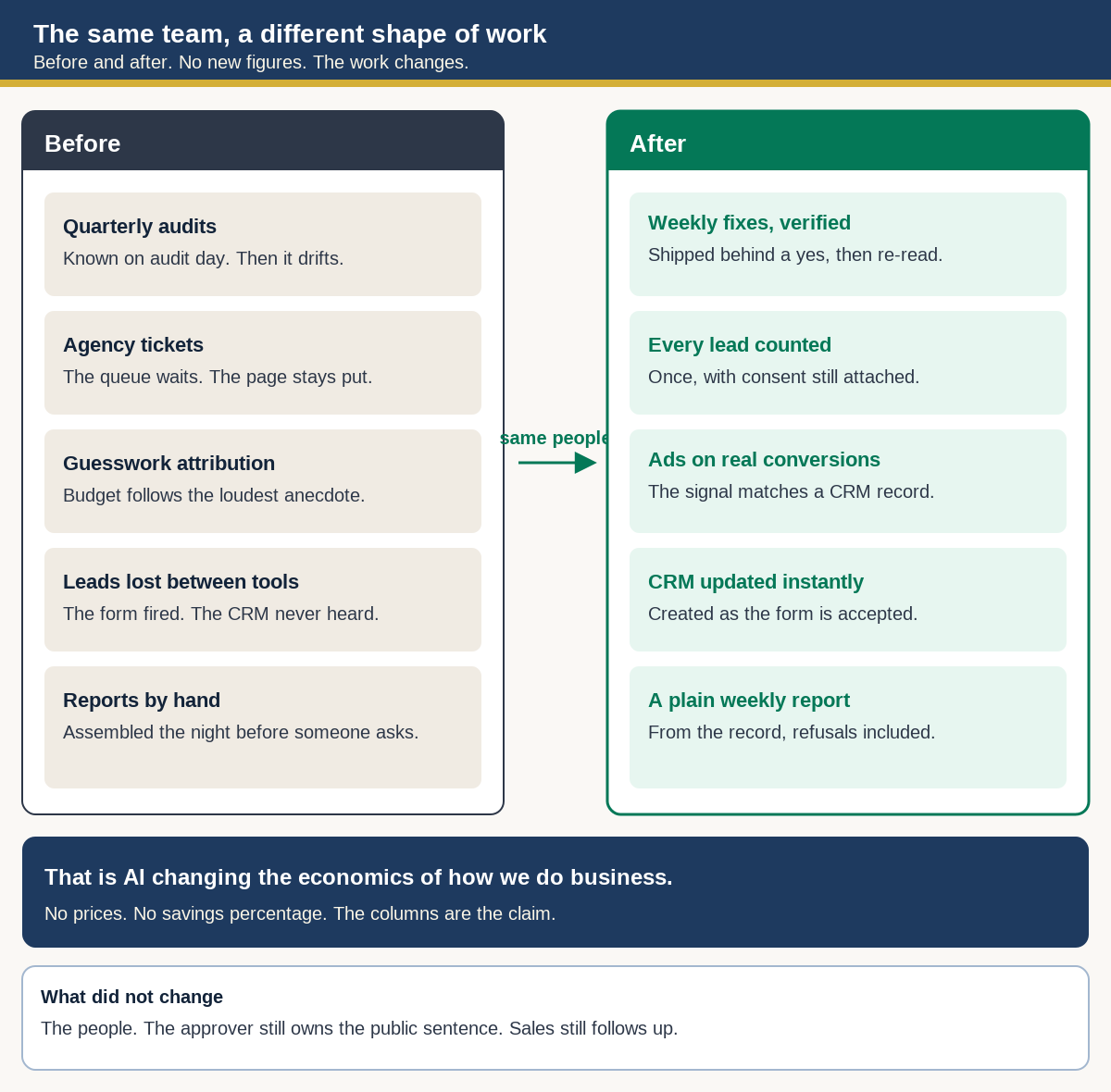
The cost is where the hours go. Collection, comparison, dedupe, re-checking, and the first draft of the report are a large share of a small team's hours, and they are hours an agent can take without taking authority. The hours you keep are the ones you hired the marketing lead for. Which fix matters. Which sentence is allowed. Which campaign deserves the budget. Which lead is real. You still pay for people. You stop paying them to rebuild the same slide. If the trade is not worth it on your site, the pilot of the loop will show that.
Speed is the cadence. Search engine data and web analytics are reviewed every weekday. The report is weekly. On our own site, while that cadence ran, impressions more than doubled, from 5,970 to 12,720, up 113%. Queries rose nearly two and a half times, from 367 to 905, up 147%. Clicks went from 24 to 38, up 58%. Ranking pages went from 102 to 179, up 75%. One site, and the exhibit for what a weekly loop can do. On November 20, 2026, indexing stood at 186 of 196, about 95%, nearly every page. A small team holds "nearly every page" only if the re-read is scheduled. By hand, coverage collapses to the pages people can bear to open.
The four jobs are the same idea in four rooms. See the template defect once, or only the first broken URL. Keep the submission, or depend on an inbox. Show the platform the real outcome, or only the easy browser event. Let sales start from a record, or narrate the week from memory. Decisions stay expensive. Digging should not. You will spend real attention up front on scope, the lead definition, consent, and the gate, and you will throw drafts away. That is the price of a record. Skip it and you get a fast draft on a rotten sitemap.
That is AI changing the economics of how we do business. Knowing the site and deciding what to say are no longer the same afternoon. A firm that sells expertise already runs delivery this way. Seniors judge. Reconstruction does not eat the week. Growth was oddly exempt, as if being found required the marketing lead to reconcile four tools every Friday. The craft is the offer, the sentence, and the decision. The reconciliation is a machine job. The columns are the claim. You still need the approver and you still need sales. You no longer need a second person to notice sitemap drift and paste leads. Removing that unfilled role, while the person you have keeps the voice, is the whole economic change.
Getting started
Measure first. Then technical fixes. Then content and ads. A campaign on a lead definition you do not trust spends against a fiction. Content on an unread sitemap publishes into a site that cannot be found. Fixes on a feed that only sees hero pages hide the rest. Copy and budget move after the first two phases are boring.
Your team provides a scope list, with a named editor, and out-of-scope written down. A page on neither list is a question. You provide search engine data and web analytics that can be pulled every weekday without a hand export. If the only interface is an export, the agent will narrate the workbook and you are still in the quarterly world. The schedule is the requirement. You provide a definition of a lead: the form, the identifier, the consent choice, the CRM field. If you cannot say what a lead is, the agent must not guess. You provide a CRM sales will open. An inbox pipeline should be fixed before anyone celebrates tracking. You provide a change path that already needs a person, and staging. Live-only editing makes the gate theater. You name an approver and a backup who is also a person, not "the team." For ads, you list the platforms that may receive a signal, and a person who can stop one. Silent additions are not allowed.
Phase one asks whether measurement is true. In-scope pages are in the pull or flagged silent. A sample the marketing lead knows by hand matches titles, canonicals, and index state. A test form creates one CRM record, collapses a retry, stores consent, and signals only when the choice allows. A mismatch stops the work. Do not prioritize on a lie.
Phase two is the fix habit. Each issue is accepted or explicitly watched, with a sentence. An accepted fix shows a check written first, staging, approval, ship, and re-check. Do not import our 113% as a target. That number is impressions on our own site, 5,970 to 12,720, across those two windows in 2026. Watch your own opening read, your later read, and the remainder. Our indexed pair on November 20, 2026 was 186 of 196. Yours will differ. Put the pair in the report, not a trophy.
Phase three moves voice and spend slowly. One approved draft at a time. Ad changes only after the signal matches the CRM across ordinary weeks. The product manager agent matters here in a narrow way: this is verified slices, not a launch date. Each slice has a check a person can run. Shipping because the calendar said so, while the check is red, erodes the gate. The agent does not mark its own checks passed.
The usual failures are skipping straight to a campaign, publishing in the first month so sponsors see action, and pulling every old page into the first week. Start with a section owners recognize. Industry-standard page audits can be a phase-two check, not a quota. Our agent pages came back with perfect search scores. A pretty score on a page the index cannot see is still a failed check. When the first report is dull — pulls ran, the test lead behaved, little to refuse — you are ready. Excitement usually means the prose is compensating for bad measurement. You should be able to tell a skeptical partner, without a slide, that a known page matches the feed and that one test lead landed once. If you cannot, you are not done, however much the room wants a new title.
Start the conversation
Start with measurement you believe and a scope you will write down. The AI SEO agent page is the short form: get found, track every lead, and grow without the headcount this work used to demand. This paper is the long form of that page: the loop, the gate, and the results.
Bring the scope list, or the honest statement that you do not have one. We will talk through feeds, the lead definition, and the approval path you already have. We will not publish a page to prove seriousness. Serious is a record of the site, one CRM lead, a signal that respects consent, and a name on the draft.
On our own site, the results were these. Impressions from 5,970 to 12,720, more than doubled, up 113%. Clicks from 24 to 38, up 58%. Ranking pages from 102 to 179, up 75%. Visible queries from 367 to 905, nearly two and a half times, up 147%. Indexed pages, 186 of 196 on November 20, 2026, about 95%, nearly every page. A search score of 100 and performance in the high 90s, perfect search scores, from industry-standard page audits. Windows of September 22 through October 19, 2026, against October 20 through November 16, 2026. A weekday read and a weekly report.
That is the work. When the same team can see the site every weekday, watch a lead reach the CRM, and walk into a budget talk with a conversion that matches a record, they spend themselves on judgment. That is AI changing the economics of how we do business. When you want it on your site, talk to us.
About This Resource
Need Expert Guidance?
Our team can help you put these insights into practice.
Schedule a Consultationor call (415) 644-8208Ready to Take the Next Step?
Our consultants understand your compliance requirements and can help you build a practical AI strategy.