
The AI Sales Manager Agent Playbook
Executive summary
The forecast looks fine until someone opens the record behind it. Two contacts are the same buyer. The lead source is blank, so marketing and sales tell two stories about the same deal. A hot flag is still hot from a conversation nobody remembers. A past customer who would take a call sits in the archive with no reason and no owner. The board is full. The pipeline you can sell from is smaller, and the people who should be in conversations are reconciling the board instead.
An AI sales manager agent changes that shape of work. It cleans and enriches the CRM. It merges duplicates when the evidence agrees and holds the rest for a person. It fills missing lead sources from evidence you already have, and it leaves a source unknown when the evidence is not there. It scores past customers for win-back and tags a lost account with why it left when the record supports a reason. It triages every inbound lead: enrich, score, and screen junk and fraud before a seller spends the hour. Email activity and calendars flow into the CRM so the pipeline is current without a nightly paste. It prepares the pipeline review your team already holds. It does not send a customer-facing message on its own. A person approves any note a buyer will read, and a person approves any bulk change.
That is the economics. A small sales team covers the book it actually has, because the audit, the match, the source, the score, and the first draft of a note happen at machine speed. People spend their time on the calls that were always theirs: which account to win back, which lead is real, which sentence may go out, which deal is stuck because nobody owns the next step. That is AI changing the economics of how we do business. This paper is the operating picture behind the short version on the AI sales manager agent page.
The figures come from our own CRM. The agent's audit and run logs, October–November 2026, rounded, cover 2,700+ contacts, along with 600+ deals and nearly 200 accounts. The same run filled in 2,500 missing lead sources, merged 200+ duplicate contacts, and scored 300+ past customers for win-back. Lost accounts were tagged with why they left where the record supported a reason. Champions who changed jobs were flagged at the new company. Records were enriched from email history. The lead screen caught a fraud attempt posing as a customer. Those are the results of a loop on one CRM. They are not a forecast for yours.
The pattern travels. The CRM, inbound leads, email activity, and calendars feed an agent that audits, matches, scores, and triages. A queue holds the proposals. A person opens the gate before a bulk write or a customer-facing sentence. Judgment stays with the person who will sign either one.
Why the pipeline you sell from is lying
A cleanup project feels responsible. A date is on the calendar, someone exports the contacts, and a few heroic afternoons later the duplicates are gone and the sources look filled. Leadership can say the CRM was looked at. Then the file ages. New leads arrive half filled. A seller creates a second contact because search did not find the first. A campaign lands and the source field stays on the default. By the next forecast the cleanup is a photograph of a book that has already moved. The gap is not laziness. A project cadence cannot describe a CRM that changes every day.
Duplicates are how the board flatters you. The same buyer exists twice, under a shortened name, or under a personal address and a work address. One record has the notes. The other has the open deal. The forecast counts both, or it counts the empty one because that is the row a report was built on. Two sellers call, or nobody calls, because each assumed the other owned it. You cannot manage a person you stored twice, and you cannot trust a total made of copies.
A blank lead source is the same failure in a quieter column. Marketing says the campaign did it. Sales says a colleague made the introduction. The CRM says nothing, because the field was optional and the form did not require it. Budget follows the loudest anecdote. A working channel gets cut because the proof was never written down. A weak channel keeps its spend because someone remembers a good month. Guesswork is what remains when the source is empty on the record sales actually opens.
Stale flags make the week feel busy. A contact stays hot after the buyer went quiet, and the review walks those rows while a past customer waits unnamed. Decoration is not a pipeline. Win-back is a list of people you already sold, scored on fit and timing, with a reason attached when you know why one of them left.
Junk eats the calendar next. A fake company. A student project. A competitor. A fraud attempt wearing a real customer's name. Each one looks like work until someone spends the morning, and sometimes a careful email, on it. The careful email is the part that can hurt you. A machine that answers junk, or that answers a fraud attempt as if it were the customer, creates a conversation you did not mean to have. Screening is how a small team keeps its hours.
Small teams feel this first. The people you have are the people you will have next quarter. If a trustworthy pipeline means spending them on exports, merges, and the night-before deck, then selling competes with the cleanup. They clean when a leader complains. The quiet duplicate waits. Some teams refuse to automate because they have seen a wrong note go out, or a bad merge collapse two different people into one. That fear is correct. An unattended message is a relationship you cannot unsend, and a bad merge is a person you can no longer find. The mistake is treating "a person must approve" as "a person must also collect, compare, and draft." The person is scarce. The collection is not.
Founders meet this as a hiring argument. The CRM is full and the conversations are not, so a coordinator is proposed. The hire inherits the same decay. In a services firm the people who may approve a sentence to a buyer are the people who sell. They will choose the conversation, correctly, and the record will drift. A current CRM does not ask them to become clerks. It asks them to stay the approver. A required field with a default will be filled wrong, and the forecast will read a number nobody can defend.
What an AI sales manager agent is (and is not)
An AI sales manager agent assists the sales lead who already owns the book, the forecast, and the voice that goes to a buyer. It is not a replacement, and it is not a cleanup you buy and forget. It proposes, writes behind an approval, and reads the result back. Propose means it says what it found, how the findings group, and what should change, with the check written before the work starts. Write behind an approval means a bulk change waits for a person, and a customer-facing message waits for a person. Read back means it opens the record after the write and asks whether the change landed. A change that cannot be read back is a hope.
It does not send mail on its own. Personal and high-value contacts get a drafted message for a person to send, never an automated sequence. The agent can make the draft so complete that the person's job is to approve, edit, or refuse. It cannot skip that step because the draft looks obvious. A wrong sentence to one buyer is a nuisance. The same wrong sentence across a book of past customers is a week of apology.
It is not a chatbot with an export pasted in. That produces a paragraph and no custody. The agent is wired to the CRM, to inbound leads, to email activity, and to calendars, so the review comes from the record. It is not a score you obey. Two past customers with the same rough fit are different problems if one has a reason to talk and the other left angry. People decide whether it is the same person, whether the source is known, and whether a buyer should see a message.
The drafter is not automatically the approver. On a small team they may be the same person, and the approval is still a separate stored act. Saving a draft is not a yes. A refused draft stays. A later edit voids the old yes. The jobs stay narrow on purpose: CRM hygiene, deduplication, lead-source backfill, win-back scoring, lead triage, the pipeline review, and the draft a person will send. A discount or a promise does not ride along because the agent was already in the CRM. A general instruction to "handle sales" expands until it touches a commitment someone thought was out of scope.
If you have seen a paid marketing agent bring more of the right inquiries, the next failure will look familiar. Demand without a clean record is a louder mess. The inquiries still have to land as one contact, with a source, or the campaign that worked becomes an argument. This agent starts where that handoff ends. It does not bid, and it does not write the ad. When a deal is real, the accounting agent is the next reader of a customer the CRM can name once. A duplicate is how an invoice goes to the wrong record and a win gets counted twice. The sales agent does not close the books. It stops handing finance two spellings of one buyer.
The agent will propose a tidy merge that is wrong if a similar name passes for the same person, and it will invent a source if you treat blank as a failure. Those are reasons for the gate. A merged contact is not a new buyer, and a scored past customer is not a renewal. If a demo is only a paragraph about your export, ask for the queue, the gate, and the read-back. A list that writes to everyone on it is not a pipeline. This design drafts. A person sends.
Reference architecture
Read the picture from the sources, through the agent, to the gate, and only then to the CRM a seller opens. The CRM, inbound leads, email activity, and calendars hold the facts. The core audits, matches, scores, and triages. A change queue holds the proposals. A human approval gate stops a bulk write and anything a customer will read. Clean records, a win-back list, drafted messages, and a pipeline review are what come out. The gate is a stop, not a caption.
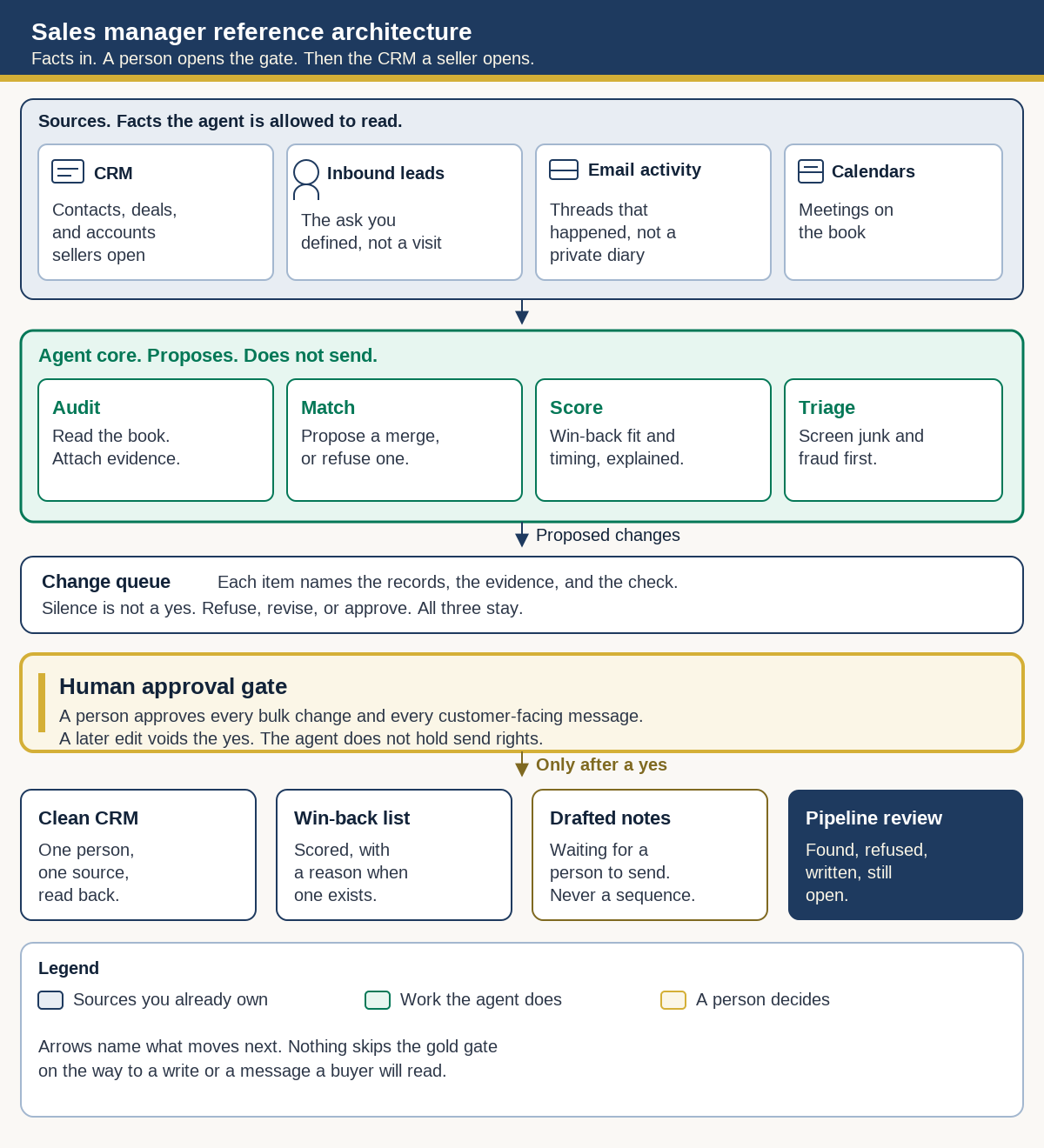
Start with scope, because later mistakes are scope mistakes. Scope is the contacts, deals, and accounts a seller can open, plus the easy-to-forget row: a former employee still listed as the buyer, a test contact from a demo, a duplicate an import created. The agent does not discover your company. It reads the book you named. A record never named is not healthy. It is out of scope, and that should be written down so the review does not congratulate you for ignoring it.
Four feeds stay separate on purpose. The CRM says what sales believes. Inbound leads say who just asked. Email activity says which conversations happened. Calendars say which meetings are on the book. Mix them and you hide the useful discrepancy: a meeting happened and the deal did not move, a lead arrived and no contact was created, a thread exists and the CRM calls the account untouched. A failed pull is a row in the review. Silence is not a quiet week.
What moves inward is state: fields, stage, source, owner, next step, duplicate candidates, lead events, activity, and meeting times. You do not need a private note to know a thread exists and the CRM never heard it. Wider collection is a written decision.
The four duties fail differently, so they stay four boxes. Audit says what is wrong, with evidence. Match proposes a merge or refuses one, and shows the fields that agree and the fields that conflict. Score puts a past customer on the win-back list with a reason, or leaves them off. Triage turns an inbound lead into a screened record, into junk, or into a fraud hold. The arrow out of the core is a queue, not a live edit. If the agent holds a credential that can write in bulk or send mail without a person, the gate is a sentence, and a sentence does not stop a model. The live write and the send stay absent until that item is approved. Items do not age into a yes. Silence is not approval. Refuse, revise, and approve are all recorded.
The gate is wide so nobody misses it. A person approves any bulk change. A person approves any customer-facing message, including a short note that only confirms a meeting. Calling the message small does not earn an exception. The order is proposal, approval, write, read-back. Writing first is how a bad merge spends a day as the only record of a person. You can adopt the picture without replacing the CRM the team already opens, as long as the feeds are readable on a schedule and a person can open the same record the agent wrote.
The same shape appears where search work hands you a lead. The AI SEO agent whitepaper walks a site, a form, and a person who decides before anything public goes live, and it stops when one CRM record exists. A merge is not a title change. What the two designs share is the refusal to let speed become authority. If you cannot tell the picture in one sentence — facts in, a queue, a person opens the gate, a write, a read-back — the missing step is the gate.
The pipeline review loop
The picture of parts is not the week. The week is a loop. Pull the CRM, the leads, the email activity, and the calendars. Spot hygiene gaps, new leads, stalled deals, and win-back candidates. Plan, with the check written before the work starts. Write only after approval. Read the result back. Report. Repeat. Skip a step and you have the heroic cleanup again, already aging.
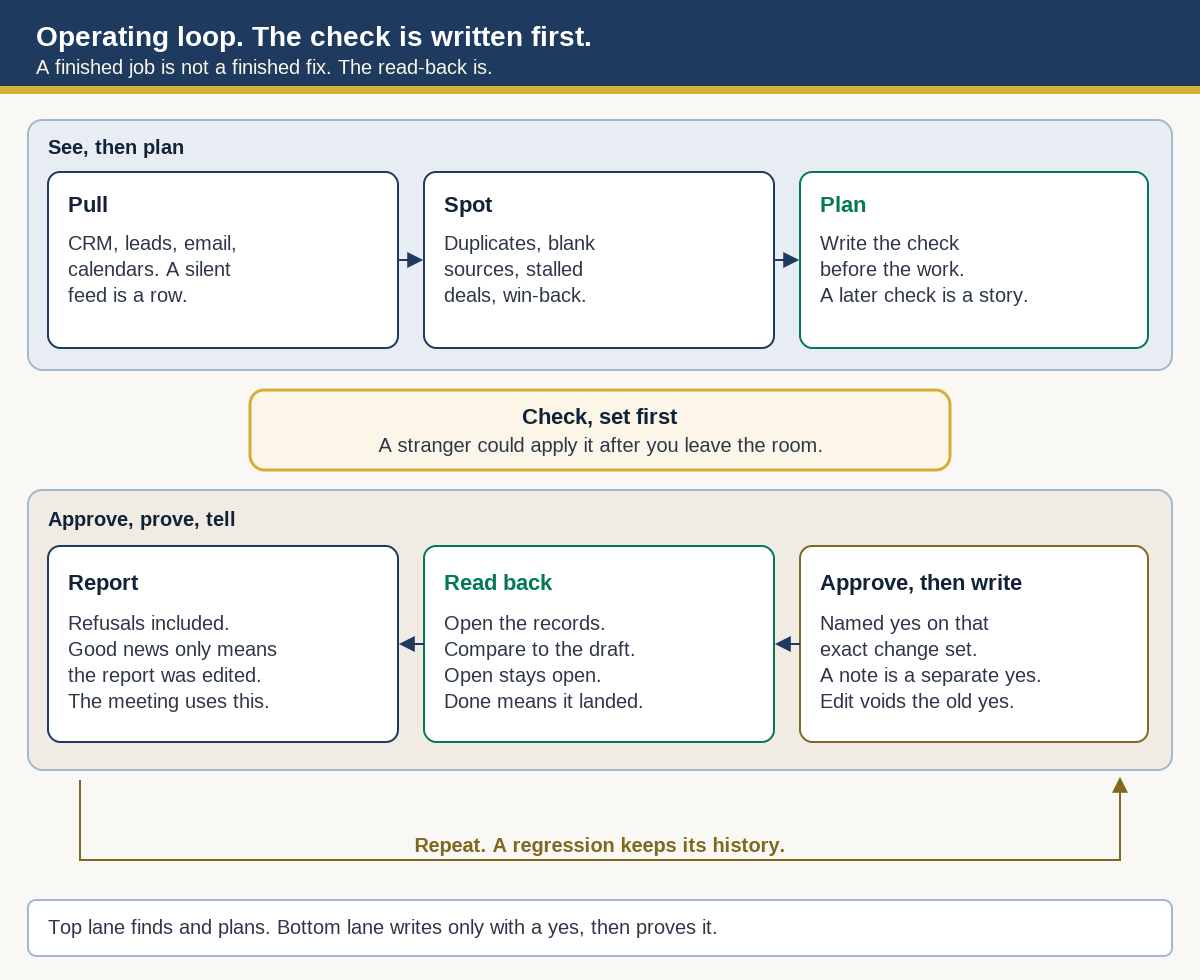
The pull follows the feeds. Email activity flows in every few hours. Calendars stay mirrored. The CRM and the new leads are read on that same rhythm, not when someone remembers an export. A silent source is listed, not omitted. Omission is how a broken connection survives every forecast. The pull does not rank yet. Ranking early teaches the system to trust whichever source answered first, which is how a dead mailbox becomes "a quiet book."
Spotting should look boring. Duplicate candidates against the rule you wrote down. Sources against blank and against the default that means nobody chose. Hot flags against age. Stages against a next step that is missing or already past. New leads against contacts that exist. Win-back candidates against fit and timing. A champion whose company changed. The agent proposes the group and shows the members. A person can split the group. Splitting is cheap before two merges exist and expensive after.
The plan says, in words, what will change, which records, what must not change, and which later evidence counts as success or failure. The check is written first. A check written afterward will always find a flattering movement, because a week contains many and a narrator can pick. The checks worth trusting are blunt. The two contacts are one record or they are not. The source matches the evidence or it stays unknown. The past customer is on the win-back list with a reason, or is not on the list. The new lead is one contact, or it was refused as junk. The write and the read-back agree. A stranger could apply that check. "Clean up the CRM" fails. "These contacts are one person, the notes were kept, and a read-back shows one record" passes.
Writing waits. A tidy preview is not a write. The approval names the exact change set. Edit the set and the approval is void. On a small team the reader and the approver may be the same person. The act is still separate, and the log shows it. Approving a merge does not approve a note. They are different rows because they hurt you in different ways. Read-back is a second look, not a cheerful queue note. The agent opens the records it claims to have changed. A field that did not stick stays open. Open is allowed. Calling open done is not. The report includes refusals. A report of only good news was edited.
The pipeline review is the meeting you already have, fed by this record. The agent prepares stalled deals, missing owners, win-back candidates, and leads the screen held back. The sales lead decides: approve, refuse, or watch. An untouched queue is decay with extra steps. A forecast tomorrow is how bad merges happen. The loop may notice a candidate immediately. It still waits, because a wrong merge is harder to undo than a duplicate you can still see.
CRM hygiene, from evidence to a read-back
Hygiene is usually a spreadsheet and a promise. The useful version is an issue with evidence, a proposed change, a check, an approval, a write, and a read-back. The agent reconstructs. Your team decides what is written.
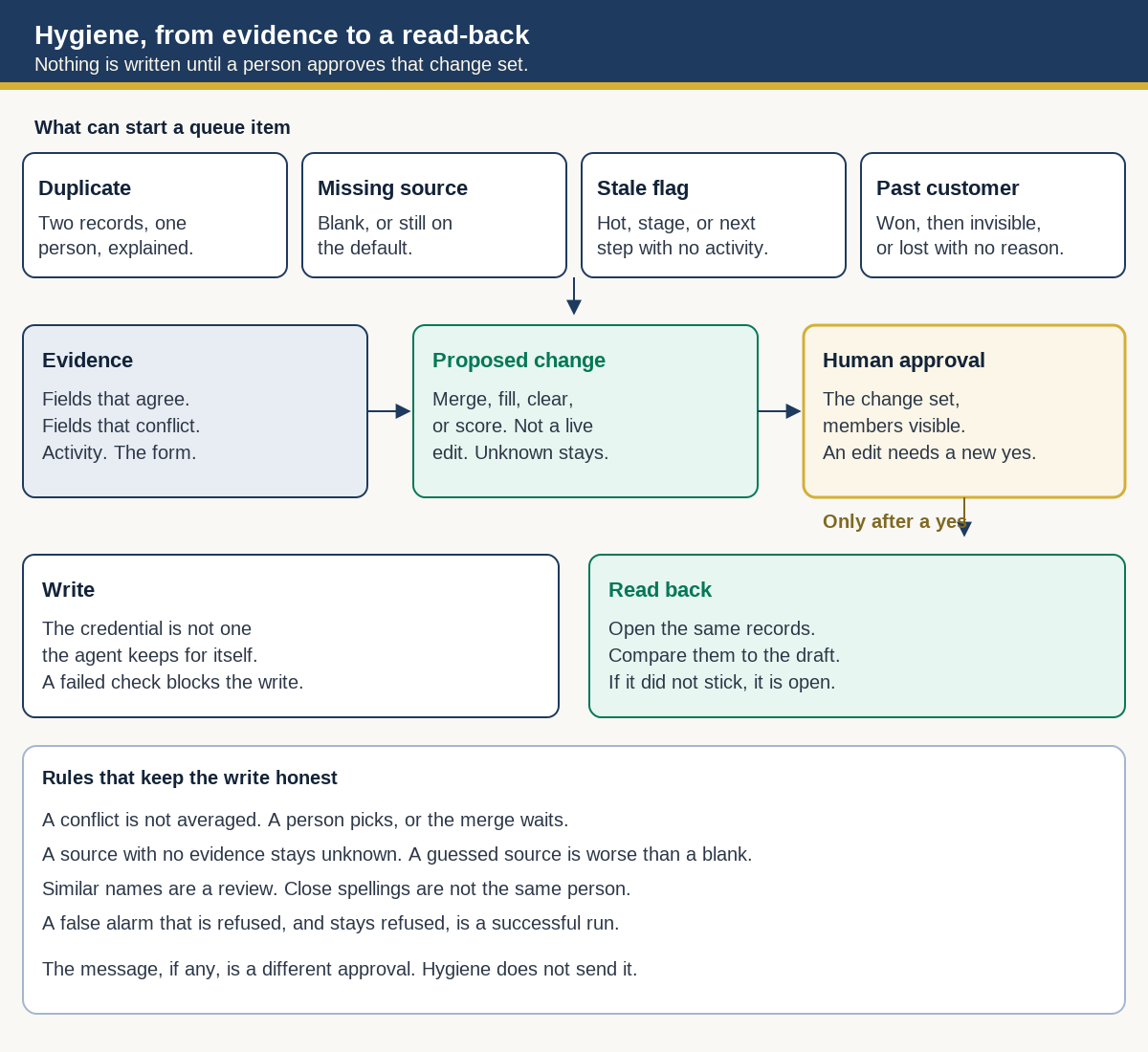
An issue is a specific defect. A duplicate the match can explain. A source that is blank or still on the default. A hot flag, a stage, or a next step that no activity supports. A past customer who became invisible, or a lost account with no reason. A champion who changed jobs: the person is the same and the company is not. Evidence is attached, or the queue fills with rumors. Which records. Which fields agree. Which fields conflict. What the activity shows. What the form stored. A false alarm can be refused, and the refusal stays. That is a successful run.
The proposed change is not a live edit. A merge draft names the surviving record, the fields that move, and the fields that conflict. A conflict is not averaged. A person picks, or the merge waits. A source draft names the value and the evidence: the form, the campaign, the introduction a seller already wrote down. If the evidence is missing, the draft says unknown. Inventing a source so the column looks finished is how the next budget argument starts. You will have a value you cannot defend. Unknown is a real status. A stale flag is cleared or renewed. No activity, and the proposal is to clear. A seller who disagrees renews it with a sentence, and that sentence is the new evidence. A win-back draft names fit, timing, and the reason they left when the record supports one. It does not include the message. The message is a later approval, if a person decides to write at all.
Checks run before a person spends time, and again before the write. The merge does not combine two contacts the rule calls different. The source is one you allowed, or it is unknown. The score cites the fields it used. A failed check blocks the write. Your team sets the match rule and the source list. The agent does not loosen them to let a draft through. Changing a threshold is a policy change, stored like any other. Approval is of the change set, with the members visible. A person who cannot see the members cannot approve them. Edit one member and that member needs a new yes. The write uses a credential the agent does not keep for itself. The read-back opens the same records. A merge that did not collapse, a source that did not stick, a score that did not save: each stays open.
If an import created the duplicates, fix the import and then merge. A pile of near-identical drafts should be sent back for the shared cause. Similar names are why the gate exists. Two people at one company can share a phone. The match can show the overlap. It cannot know they are different people. Apart and visible beats together and wrong.
Filling every blank with the most common source makes the column look finished and the story false. On our CRM, 2,500 sources filled in is a count of evidence, not a count of guesses. A row you cannot point at was not part of the success. Win-back fails the same way when the score becomes a blast list. Fit and timing put someone in front of a person. They are not a reason to write to all of them. A lost account with a reason is a briefing. One without a reason is a question.
What the cleanup changed on our own CRM
The CRM is ours. The window is October–November 2026. The figures are the agent's own audit and run logs, rounded. They are counts of work, not a before-and-after rate. Contacts, deals, and accounts are the scope. Sources, merges, and win-back scores are the changes inside that scope.
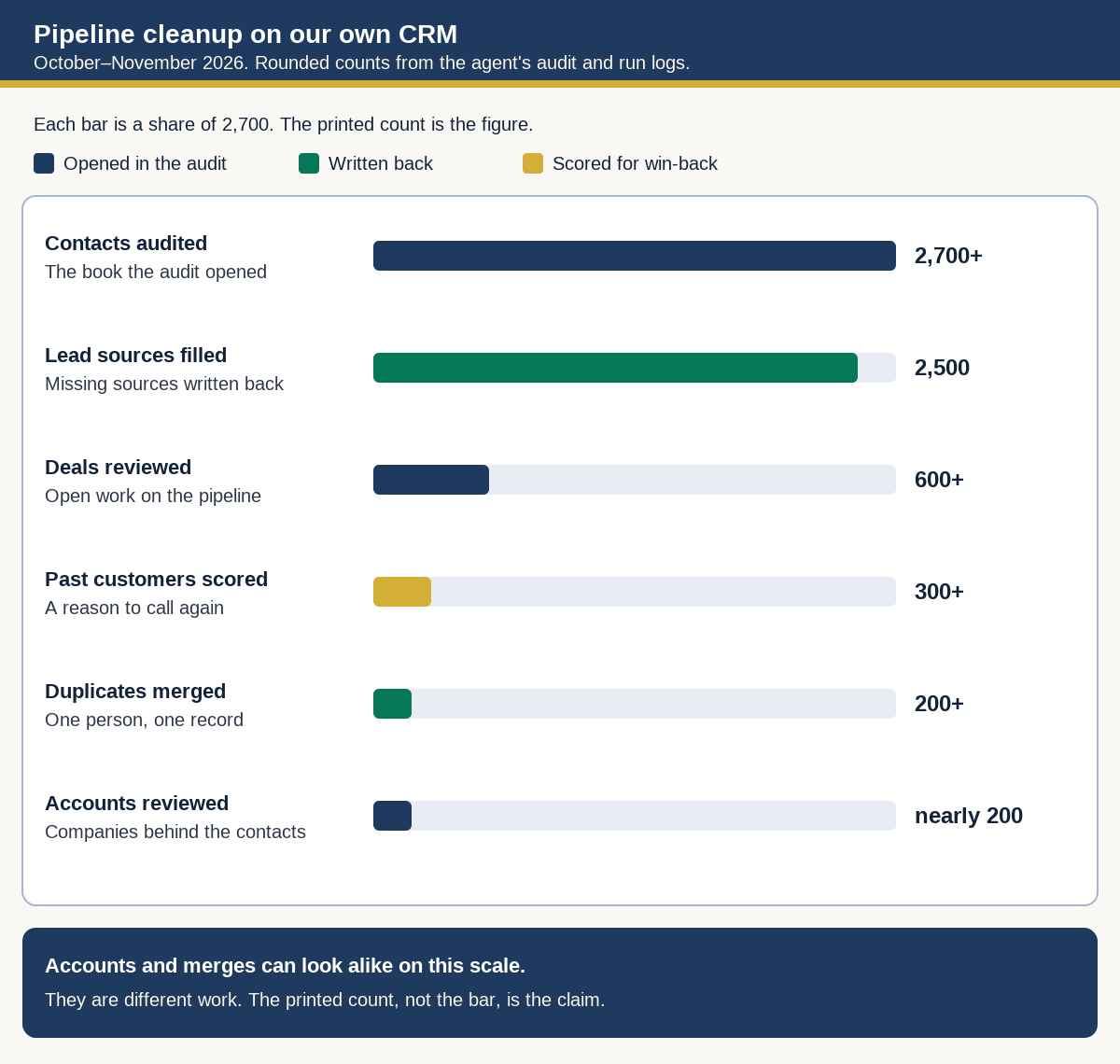
Read the scope first. 2,700+ contacts were audited, along with 600+ deals and nearly 200 accounts. That is a working book, the kind a small team pretends it can scan by eye and cannot. Eye-scanning finds the row someone complains about. An audit finds the blank source on a quiet contact and the duplicate that never owned a deal. Both matter. Only one of them raises a hand.
Then read the changes. 2,500 missing lead sources were filled in, which is the column that makes a later budget conversation possible. Until it is filled from evidence, every channel argument is an anecdote. 200+ duplicate contacts were merged. Each merge is a person you can find once, and a total the forecast can stop counting twice. 300+ past customers were scored for win-back, a list a seller can open without building it first. The three changes are different jobs. They share a gate and a read-back. They do not share a meaning, which is why the chart does not add them into one heroic total.
Other results sit in the same window and do not need a second scale. Lost accounts were tagged with why they left where the record supported a reason. Champions who changed jobs were flagged at the new company, a warm lead the old account will not show you. Records were enriched from email history, so a contact is more than the fields someone typed on the day it was created. The lead screen caught a fraud attempt posing as a customer. That last one is why triage sits in the loop. A fraud attempt that reaches a seller, or receives a reply, costs more trust than a week of tidy fields.
Do not import 2,700+, 2,500, 200+, or 300+ as a quota. A smaller book still decays, and unknown remains a valid result. The exhibit is that the loop can do this class of work on a real CRM.
Every lead triaged, once
A clean history, attached to a door that still lets junk in, is a cleaner disappointment. New leads are where decay restarts. The path is an inbound lead, enrichment, a score, a screen for junk and fraud, one CRM record, then a person. Email activity and calendar changes join that record. A customer-facing message, if one is warranted, is drafted for a person to send. Skip the screen and the team works fraud. Skip the match and the same person becomes two leads. Skip the person and a sequence speaks in your voice.
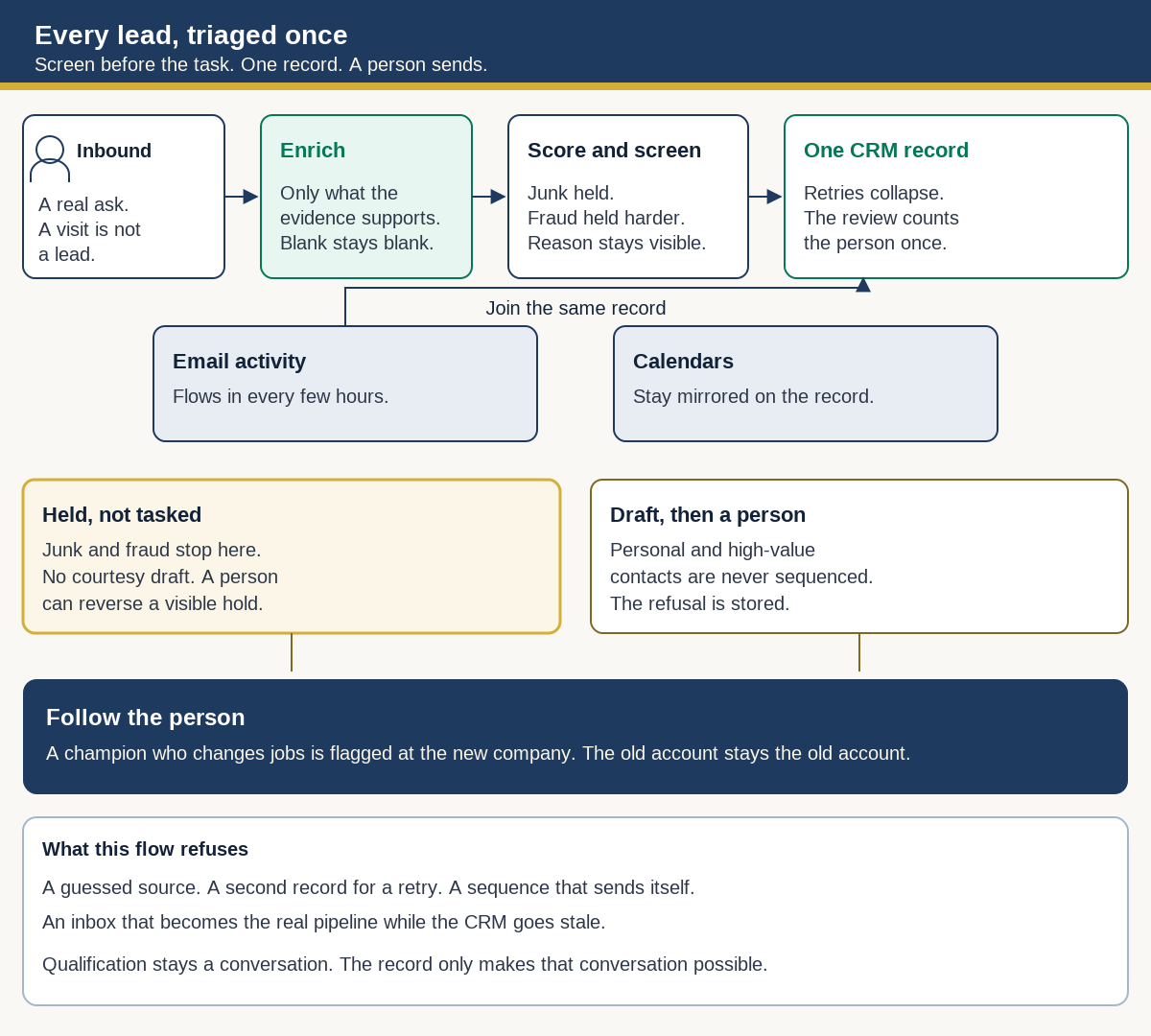
A visit is not a lead, and the agent will not promote one to brighten a quiet week. A lead starts at the ask you defined: a form, a referral a seller entered, a reply that requests a conversation. Enrichment adds what evidence you already hold can support, including email history. It does not invent a title, a size, or a source to make the card look finished. A guessed title becomes the opener of a call, and the buyer hears that you did not look.
The screen decides with a reason. Junk is held. Fraud is held harder. On our CRM the screen caught a fraud attempt posing as a customer, and that attempt did not become a task or a courtesy draft. The hold stays visible so a person can reverse it. A score does not enroll anyone in a sequence. Low fit is labeled, not deleted. Deletion is its own approval.
New leads are how duplicates are born. A retry, a second form, a seller typing what the form already created: one person, two records, and a forecast that grew for no reason. Collapse on the rule you wrote, not on a hunch that two names match. The copies stay in the log. The review counts the lead once. The same rule that merged 200+ existing contacts keeps the new ones from replacing them. Email activity is in the CRM every few hours, so a thread that happened is visible without a paste. Calendars stay mirrored, so a meeting on the book is a meeting in the record. This is not surveillance of the seller. It is how the review stops depending on memory. A stage change, if one is needed, is still a decision.
Follow the person when the person moves. A champion who changes jobs is not a lost account and is not a cold stranger. The agent flags the new company and keeps the history that makes the warmth real. The old account stays the old account. Mixing them is how you congratulate the wrong company. The flag is a queue item. A person decides whether to write. Follow-up stays human. The agent does not call, does not send, and does not declare the lead qualified. The record's job is to make the conversation the first hour, not the third.
Check the screen against leads you know are real. A screen that holds everyone, or no one, has not earned its place. Test leads must be labeled. A started form is not an accepted lead.
The handoff from search belongs here as a boundary. A lead that arrives already tied to one record, with a source, is a gift. The AI SEO agent whitepaper describes that gift from the other side and stops at the record. This paper starts there, including the case where the record arrives messy anyway. A clean handoff can still decay. Personal and high-value contacts are where teams try to skip the gate so nobody forgets. Forgetting is a risk. An automated sequence to a named buyer is a larger one. The refusal is stored, so a later seller can see that someone already decided not to write.
Governance and human oversight
Speed needs a table of duties, not a slogan. Who proposes, who approves, what the gate blocks, and where the proof lives. If the answer is "the platform," nobody owns the decision.
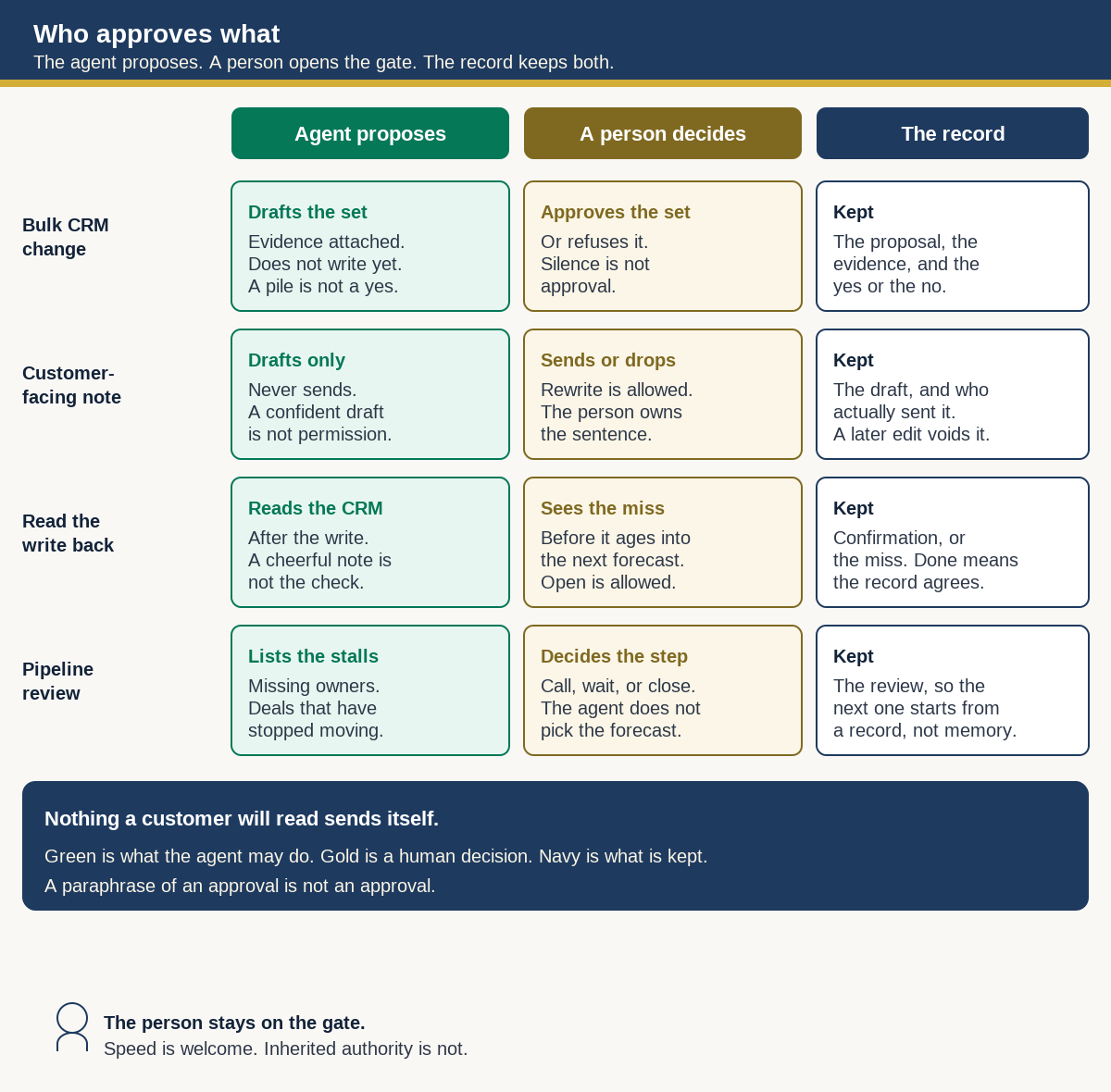
The agent proposes the change where a person can see the records. A chat preview is not a review. The record keeps the proposal, including the ones you refuse. Your team approves two kinds of act. Any bulk change: merges, source fills, flag clears, scores, enrichment across many rows. And any customer-facing message. The agent does not hold the credential that sends, and it does not hold an unattended credential that can rewrite the book. A later edit voids the yes, because a buyer remembers the sentence you actually sent, not the one you meant.
Automated checks block a merge the rule rejects, a source outside the list you set, and a write that does not match its draft. A check that fails closed is the point. A warning that still writes is a log of regrets. Every step is logged: what was read, proposed, checked, approved, written, and read back. A step that cannot be logged does not run. Undoing a merge is a logged change, and it is harder than not merging. That difficulty is a reason to keep the gate. Collection stays narrow. The agent does not need a seller's private commentary to judge a duplicate. A draft is built from the record the approver can also see. A draft that cites a fact the approver cannot find is not ready.
A skeptical partner should be able to open one change and see evidence, draft, approver, and read-back. Memory is not a control. If the review only makes sense beside a side file, the side file has become the system.
Jacobian Engineering is a HITRUST Authorized External Assessor, so the team that builds the agent reviews controls for a living, and that is why the evidence, approval, and read-back record is designed the way it is.
Have someone try to skip the gate before you depend on it. Hidden text that claims an approval. A bulk merge someone wants finished tonight. A log turned off for a quick run. A message sent because the button sat next to the preview. Those tests are cheaper now than during the first note a buyer did not ask for. The agent cannot approve itself, widen what counts as a lead, or compact the log as housekeeping. A person can stop a change, a draft, or a pull, and the stop stays visible.
Once the agent can send, every other control is a request. Keep the send on the person. A change set that mixes record repairs and outbound notes will be approved for the repairs and will send the notes by accident. Split them. A large preview that looks consistent is not the same as a correct one. Show the approver the members the rule was least sure about, not only the tidy ones. High-value contacts stay on the human side even when the field update around them is boring.
The economics
This is not a rate card. It is a change in what the same team finishes. Before: a CRM that decays when the cleanup ends, sellers researching instead of selling, past customers slipping away, junk eating the week, blank sources, duplicates that inflate the board, a forecast assembled from memory. After: hygiene that continues, sources filled from evidence, duplicates merged, past customers scored, leads triaged before the call, email and calendars already on the record, a review that starts from the CRM. Attention was scarce, and it was being spent on reconstruction.
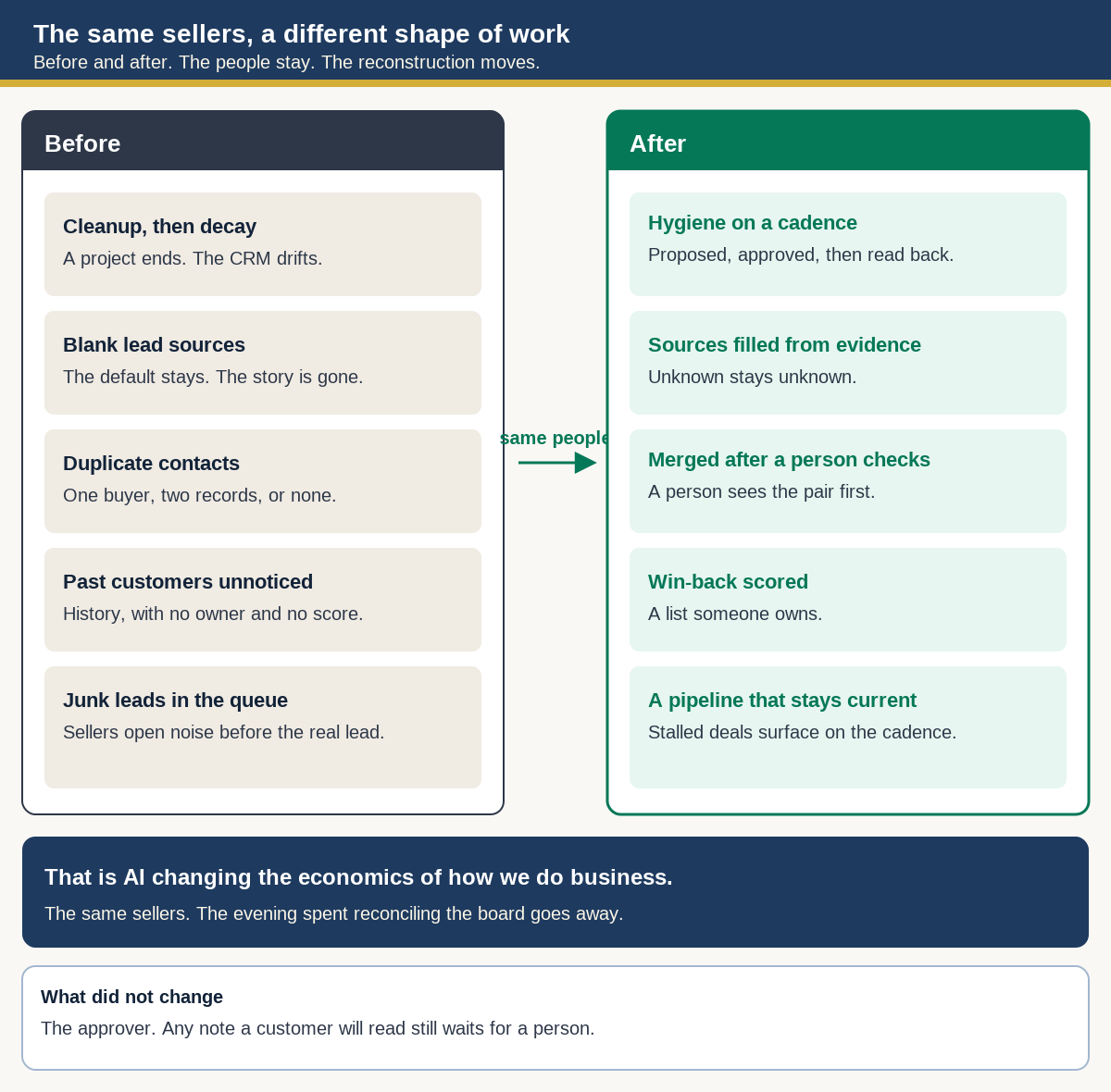
The cost is where the hours go. Comparison, dedupe, source backfill, scoring, screening, and the first draft of a note are a large share of a small team's week, and they are hours an agent can take without taking the decision. The hours you keep are the ones you hired the seller for. Which account is real. Which sentence is allowed. Which stalled deal needs a person. Which past customer should hear from you, and which one should not. You still pay for people. You stop paying them to rebuild the same list. If the trade is not worth it on your book, a short run of the loop will show that, in the queue and in the refusals.
On our own CRM, through October and November 2026, the audit covered 2,700+ contacts, 600+ deals, and nearly 200 accounts. It filled 2,500 missing lead sources, merged 200+ duplicate contacts, and scored 300+ past customers. One book, and the exhibit for what a continuing loop finishes. A small team holds a book of that shape only if the re-read is scheduled. By hand, coverage collapses to the rows already in the meeting. See the duplicate once, or only the one a buyer complains about. Keep the source, or argue from memory. See the past customer, or meet them again under a competitor's name. Screen the lead, or spend the morning on junk and on a fraud attempt. Decisions stay expensive. Digging should not.
That is AI changing the economics of how we do business. Knowing the book and deciding what to say are no longer the same afternoon. A firm that sells expertise already runs delivery this way. Seniors judge. Reconstruction does not eat the week. Selling was oddly exempt, as if a trustworthy pipeline required the best seller to reconcile lists every Friday night. The craft is the offer, the sentence, and the decision. The reconciliation is a machine job. You still need the approver and the seller. You no longer need an unfilled second person to notice duplicates and paste activity.
The first weeks produce refusals: similar names, sources that stay unknown, scores the sales lead does not accept. A team that approves every proposal has installed a faster way to be wrong. A thinner board a seller believes is worth more than a thick board everyone discounts in the hallway. Headcount is the wrong first answer. Another seller dropped onto a dirty CRM becomes another author of duplicates. You have scaled the decay. Clean the loop, then decide whether you need another seller. Often the conversations waiting inside 300+ scored past customers, and inside leads the screen has already separated from junk, are the capacity you thought you had to hire.
Getting started
Measure first. Then hygiene. Then triage and messages. A win-back note written on a match rule you do not trust goes to the wrong people. Triage without a definition of a lead will pass junk or hide buyers. Messages move after the first two phases are boring.
Write the scope: which contacts, deals, and accounts, who owns the list, and what is out of scope. A record on neither list is a question. Write the match rule in words, including which conflicts forbid a merge. If you cannot say what a duplicate is, the agent must not guess. Write the source values you accept, and include unknown. A near miss is not a fill. Write what a past customer is, and what fit and timing are allowed to mean. "Someone we like" will score the seller's friends.
Use a CRM the team will actually open. A side sheet that feels easier should be retired before anyone celebrates an import, or you have decorated an archive. Name an approver and a backup who is a person, not "the team." Say which messages may be drafted. Personal and high-value contacts are drafted for a person and never sequenced. A prohibition you do not write down will be forgotten on a Friday. Provide feeds that can be read without a download. If the only path is an export, the agent narrates a workbook and you are still in the project world. Email activity every few hours, and calendars that stay mirrored, are what make a review possible on an ordinary day.
Phase one asks whether the picture is true. In-scope records are in the pull or flagged silent. A sample the sales lead knows by hand matches owners, sources, and duplicate pairs. A test lead creates one contact, collapses a retry, and does not become a message. A known junk pattern is held. A known good lead is not. A mismatch stops the work. Do not merge on a lie.
Phase two is the habit. Each issue is accepted, refused, or watched, with a sentence. An accepted change shows the check, the members, the approval, the write, and the read-back. Do not import our 2,500 filled sources or our 200+ merges as a target. Those counts are what the evidence supported on our CRM in October and November 2026, inside an audit of 2,700+ contacts, 600+ deals, and nearly 200 accounts. A week with many unknowns and few bad merges is a good week. A week with no unknowns and no refusals is a week to inspect.
Phase three moves notes slowly, one approved draft at a time, starting with a past customer the sales lead would have written anyway. The 300+ scores on our book are proof a list can exist, not a quota for yours. The paid marketing agent can raise inbound volume once the screen and the match are boring. More leads before that point spends the team on a larger mess. The accounting agent benefits when the account a deal closes against is the account finance already sees. Do not wait for a perfect book to stop double-counting customers you are about to invoice. Do wait for the match rule before you merge the ones you are unsure of.
The usual failure is a sequence or a mass merge in the first week, so the room sees motion. Start with a slice someone can explain. You are ready when you can say that a known duplicate was proposed and not written until a person said yes, and that you know how to undo it. "The system did it" means you are not ready to write.
Start the conversation
Start with a book you can describe and a match rule you will write down. The AI sales manager agent page is the short form: a CRM you can trust, win-back scored, every lead triaged, and a pipeline that stays current while the team spends itself on conversations. This paper is the long form: the loop, the gate, and the results.
Bring the scope, or say honestly that you do not have one. We will talk through the feeds, what a duplicate is, which source values you accept, and the approval path you already have. We will not send a note to prove seriousness. Serious is one merged contact a person approved, a lead screened before anyone wrote to it, and a name on the draft.
On our own CRM the results were these. An audit of 2,700+ contacts, along with 600+ deals and nearly 200 accounts, in October and November 2026. 2,500 missing lead sources filled in. 200+ duplicate contacts merged. 300+ past customers scored for win-back. Lost accounts tagged where a reason existed. Champions who changed jobs flagged at the new company. Records enriched from email history. A fraud attempt posing as a customer caught at the screen. Figures rounded, from the agent's own audit and run logs.
That is the work. When the same team can open a pipeline that matches the book, defend a source in a forecast, and spend the hour on a buyer instead of a duplicate, they spend themselves on judgment. That is AI changing the economics of how we do business. When you want it on your CRM, talk to us.
About This Resource
Need Expert Guidance?
Our team can help you put these insights into practice.
Schedule a Consultationor call (415) 644-8208Ready to Take the Next Step?
Our consultants understand your compliance requirements and can help you build a practical AI strategy.