
The AI Product Manager Agent Playbook
Executive summary
Delivery moves when the record moves with it. The product changes, the decision stays attached to the change, and the next session starts from what shipped. A small team gets that record when an AI product manager agent writes the spec and the acceptance checks before any code, hands the build to a builder agent, and sends every change through a separate reviewer that tries to break it. Production opens when the checks pass, the review is clean, and someone has seen the change in staging. The handoff says what was decided, what shipped, and what is still open.
Leaders keep strategy, spend, and every new public sentence. The agent carries those calls onto the exact change, and the change stays reversible. People spend their time on the calls that were always theirs: what is worth building, what may be said in public, what may be spent, and whether a residual risk is acceptable. The spec, the adversarial read, the evidence, and the handoff happen at machine speed. That is AI changing the economics of how we do business. This paper is the operating picture behind the short version on the AI product manager agent page.
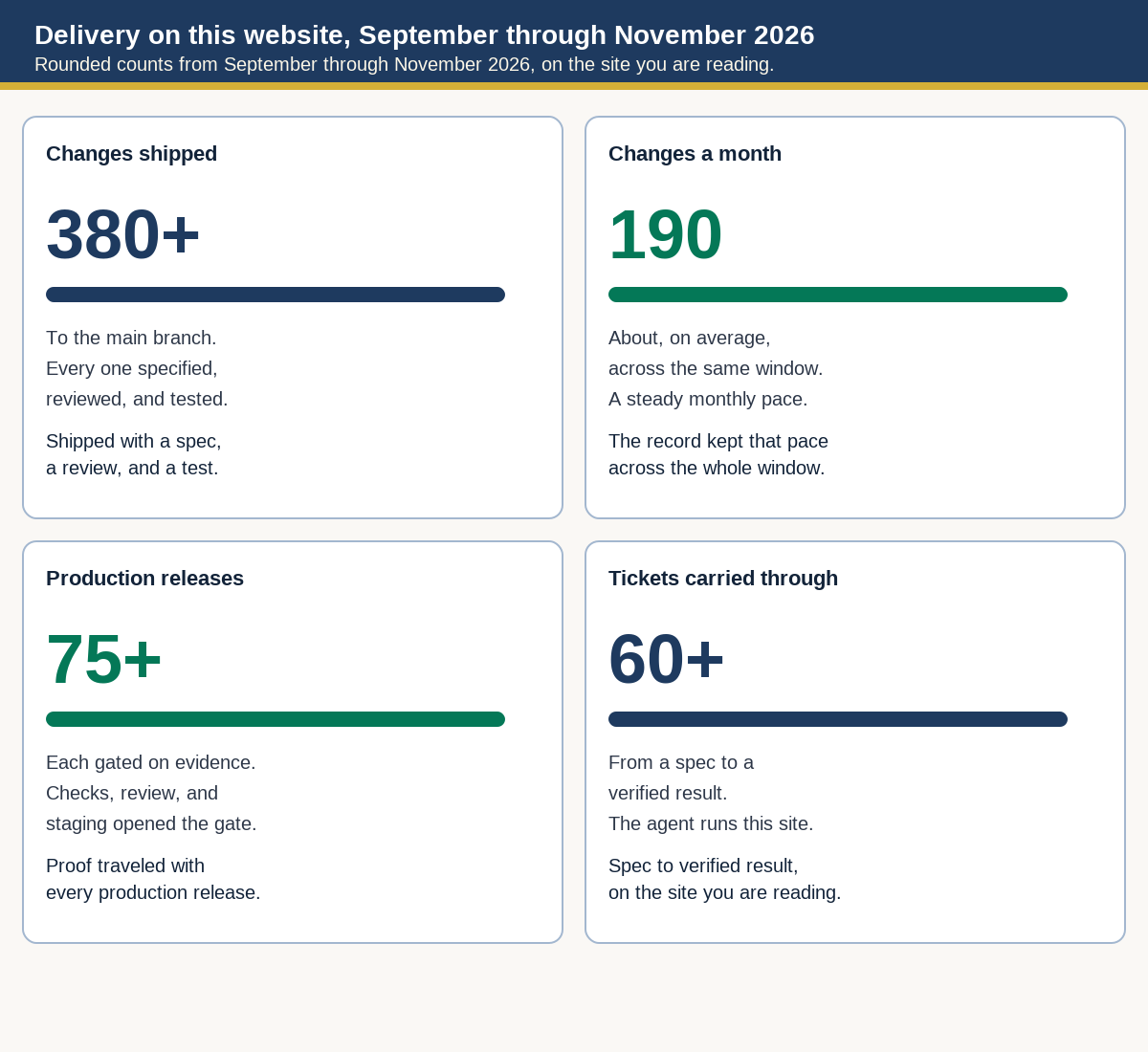
The figures come from our own site, the website you are reading. The agent runs it. From September through November 2026, rounded: 380+ changes shipped to the main branch, every one specified, reviewed, and tested; about 190 changes a month on average; 75+ production releases, each gated on evidence; 60+ tickets carried from spec to verified result. The loop closed on a live product, at a pace a small team can sustain.
Why delivery stalls
A status meeting can be a fine place to decide. It becomes expensive when the board is the only record. A date sits on the calendar, someone walks the rows, and leadership can say the work was looked at. Then the board ages. A ticket moves because a person dragged it. The sentence in the ticket is the sentence from the day it was opened. By the steering meeting, the board is a photograph of a product that has already moved. A meeting cadence describes yesterday. A product that changes every day needs a record that changes with it.
The ticket queue can look like a system and still be a list of wishes. The acceptance column is empty, or it says the work should behave as expected. The owner column names a team rather than a person who can say yes. Status sits in progress for the life of the row. A row can say done because someone believes a change landed, while the behavior a buyer sees is still the old one. A hold a leader asked for lives in a chat, and the row keeps moving. The useful row names the change, the checks, and the hold in the same place.
Writing the spec after the code is where the weeks go. The builder starts from a title. The interesting decisions happen inside the change, where they are hardest to see. The spec, when it arrives, describes what was built, fitted to the result, so it always passes. The next person inherits a document that agrees with the code and has drifted from the original ask. You have paid for the ticket twice: once to build a guess, and once to narrate it. A spec written first is cheaper, because the guess happens on paper.
Review stalls in the same week. The person who wrote the change is asked whether it is good. They remember the intent, so the missing case stays invisible. Or the review waits on a scarce person who is also selling and also in the status meeting. The review becomes a bottleneck, or it becomes a stamp applied the hour before the release. Both leave the same hole. A separate reader, looking while there is still time to fix the change, is the review that changes the release.
Releases then follow the calendar. A date was promised. The checks are failing, or they were still unwritten, and the date wins. The firm calls this pragmatism. Customers become the test. The opposite failure is just as expensive. Everything waits for a perfect review that keeps going, the work ages, and the next change stacks on an unreleased one. Speed and safety look like a law. They are a missing record. Put the checks, the review, and the way back on the ticket, and the date can wait for the evidence.
Decisions disappear in the seams. A leader says a public sentence stays inside a result you have measured. The builder was out of the room. The ticket stays as it was. The sentence ships. A later session reverses a real decision because the approval was a memory. A decision you store is a decision you can carry. The product then follows the record, rather than whoever typed last.
Small teams feel this first. The people you have are the people you will have next quarter. When staying honest means spending them on status, reconstruction, and re-reading their own changes, delivery competes with every other job. The right fear is an unattended release. The useful design keeps the person on the decision and takes the collection off their desk: the spec, the checks, the independent read, the evidence, and the handoff. The person stays scarce. The record becomes abundant.
What an AI product manager agent does
An AI product manager agent assists the person who already owns the roadmap, the backlog, and the release. It specifies, coordinates, and verifies. Specify means it writes what will change, what stays as it is, and the checks that will decide, before a builder starts. Coordinate means a builder agent writes the change and a different agent tries to break it. Verify means the release opens when those checks and that review agree with what is in staging. A release you can verify is a release you can stand behind.
Leaders keep strategy, spending, and new public content. The agent makes the draft so complete that the person's job is to approve or refuse, and it waits for that step even when the draft looks obvious. An internal rename is a small call. A public sentence, or a spend, stays with the person who owns the promise and the budget. The agent carries the answer onto the change once the answer exists.
The agent is wired to the backlog, to the product, to the decisions already recorded, and to the review findings. Sentences in the handoff come from that record. A later reader can see what was included, which decision the spec cites, and whether the paragraph still matches the change the builder started from. Custody is the product. The paragraph is a side effect.
The jobs stay narrow so the work stays finishable. The scope is the spec, the checks, the coordination of builder and reviewer, the release gate, the handoff, and the honesty of the backlog. Brand, pricing, and the promise you make in public stay with the people who own them, on a ticket the agent can see. A general instruction to "run the product" grows until it touches a claim or a budget. A named scope keeps the week inside the work you meant.
If you have seen an AI SEO agent keep a public page behind an approval, the habit will look familiar. An item is done when it agrees with the source. A public sentence is a harder gate than an internal rename, and it should be. The same instinct shows up in security work. A threat agent holds a production change until the evidence is in. A release with a high-risk finding open waits for the same reason a public sentence waits: the record is the release.
A chat box beside a board will hand you confident prose. A closed loop re-reads the product, blocks a high-risk finding, and carries a decision onto the exact change. When a demo centers on the paragraph, ask where the spec was written first, who tried to break the change, and which release waited. Those three answers are the product. When two specs disagree, the record shows the disagreement and waits for a person. The later draft stays a draft until the room that owns strategy has spoken.
Reference architecture
Read the picture from the sources, through the agent, to the gate, and only then to production. The backlog, the live product, the decisions already made, and the review findings hold the facts. The core specifies, coordinates the builder, coordinates the reviewer, and records. A change queue holds the proposals. A human approval gate holds anything that is strategy, spend, or public. Staging, evidence, then production are the path after a yes. A written handoff closes the loop. The gate is where the queue waits.
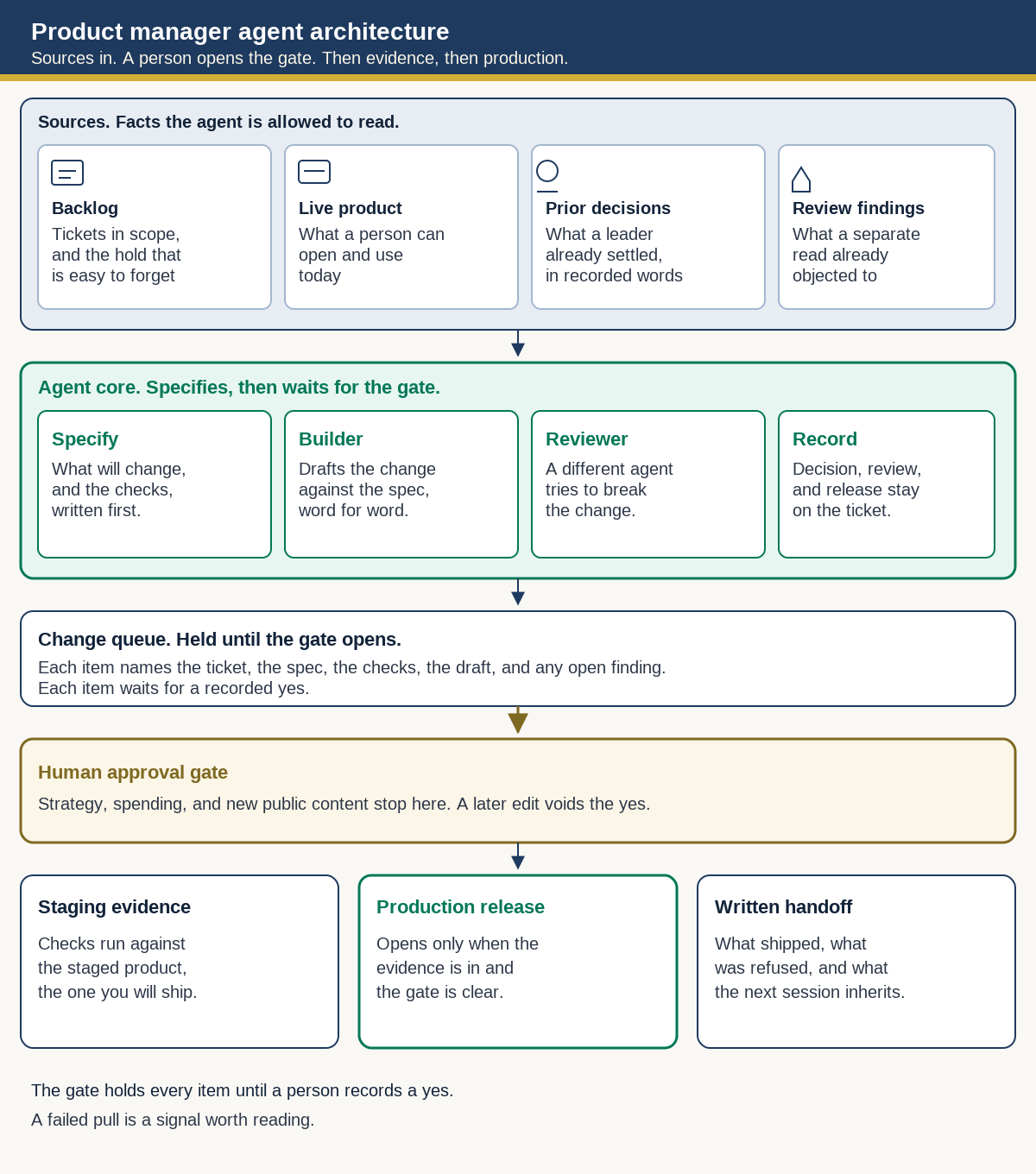
Start with the backlog, because later mistakes are scope mistakes. Scope is the tickets you mean the agent to carry, the product surfaces they touch, and the hold that is easy to forget: a path that stays as it is, a public page that is frozen, a release waiting on a person who is out. The agent reads the backlog you named and flags a ticket that has drifted from the product. A ticket you left unnamed stays out of scope, and the scope list says so. That list is how a later session knows the boundary.
Four feeds stay separate on purpose. The backlog says what was asked and what status is claimed. The live product says what a person can actually use. Prior decisions say what a leader already settled. Review findings say what an independent read already objected to. Keeping them apart makes the useful discrepancy visible: the ticket says done while the product still shows the old behavior, or a decision says stop while the change continues. A failed pull is a signal. What moves inward is state: ticket text, the spec, the checks, the change, the findings, the approval, the evidence, the handoff. The read fits in one sentence: the backlog you named, the product as it stands, the decisions already recorded, and the findings already filed.
The four duties fail differently, so they are four boxes. Specify says what will change and what the checks are, with the checks written first. Coordinate the builder means the change is drafted against that spec. Coordinate the reviewer means a different agent tries to break the change, and the findings come back as findings. Record means the ticket shows the decision, the review, and the release. Specifying stays specifying. Releasing waits for the gate.
The arrow out of the core is a queue. A recommendation that looks finished still waits there. Where a person is required, the production path stays closed until the change is approved and the evidence is in. Each queue item names the ticket, the spec, the checks, the draft, and the findings still open. A recorded yes is the way forward. Refuse, revise, and approve are all written down, so the next session can see which one happened.
The same shape appears wherever a public change has to wait. The AI SEO agent whitepaper walks a site, a queue, and a person who decides before a sentence goes live. A product release and a search fix share the habit of keeping speed and authority in different hands. The design fits in one sentence. Facts in. A spec before code. A separate reviewer. A person opens the gate where only a person may. Evidence. Then the handoff.
The operating loop
The picture of parts is the map. The week is a loop. Read the backlog and the product. Write the spec, with the measurable check set before the work starts. Let the builder draft. Let the reviewer try to break it. Wait for the person where a person is required. Release when the evidence is in. Write the handoff. Repeat. Every step you keep is a week you can explain.
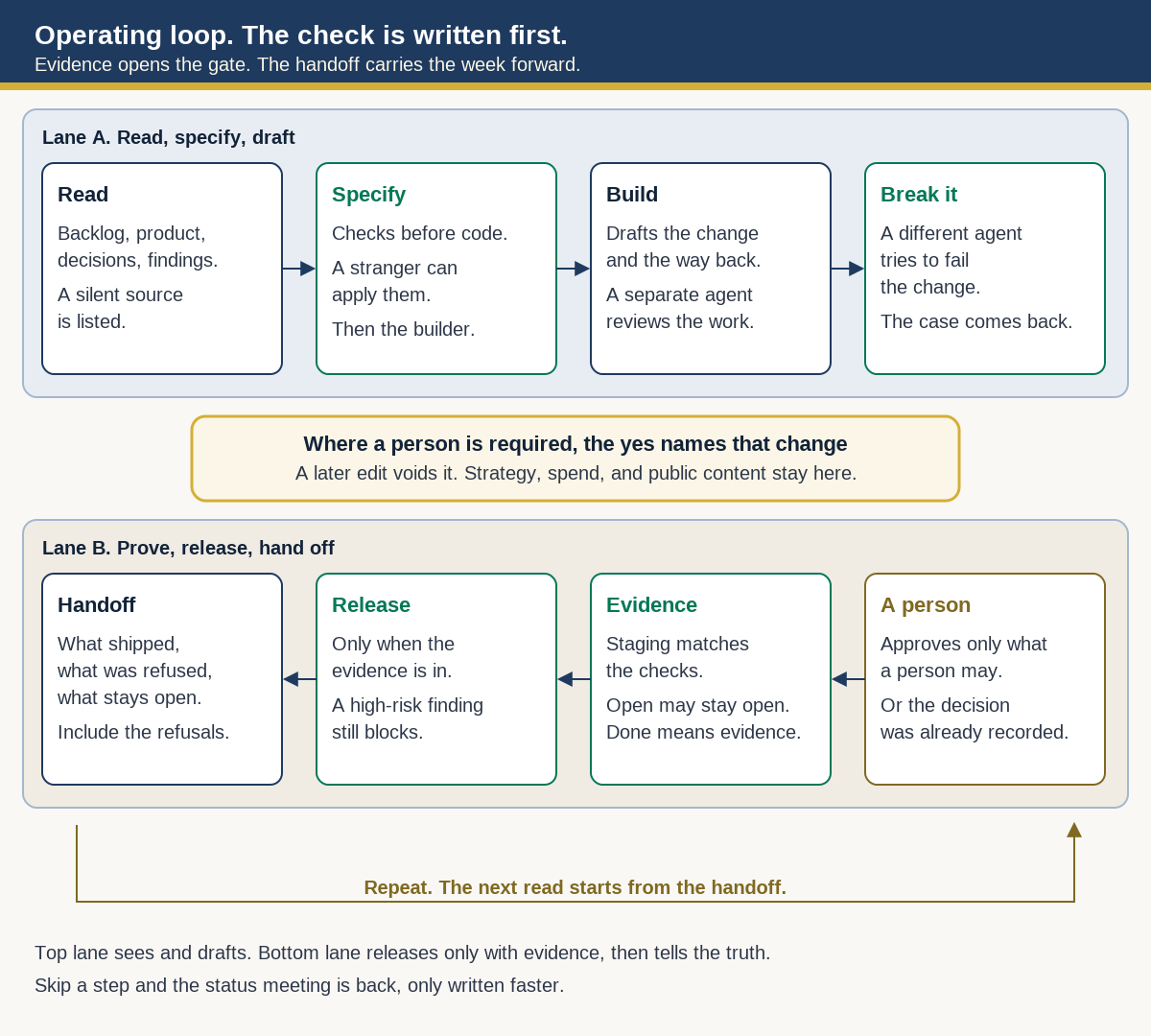
The read happens on a rhythm: the backlog, the live product, the open findings, the decisions, and the releases. A silent source is listed. Listing it is how a broken feed shows up in the handoff instead of vanishing. The read stays a read. Ranking comes after every source has answered, so a dead view of the product stays visible instead of becoming a quiet week.
Between the read and the release, the order is fixed. The check is written before the builder starts, and a stranger can apply it. A separate reviewer reads the change. Where a person is required, the approval names that spec and that change, and a later edit voids it. Evidence opens the gate.
Verification is a second read, in staging, against the checks written first. The check is the record of what happened, and a cheerful note sits beside it. Open stays open while the evidence is still coming in. Done means the evidence is in. The handoff includes refusals and open checks, so the next session inherits the whole week. The next read is the same loop. A regression keeps its history, so a later change carries the earlier decision forward. Reopening a finding is how the product stays honest under a green story.
Spec before code
A ticket becomes a spec when it holds a written change, a list of checks a stranger can run, a builder who starts after that list exists, and a second read that uses the same list. The agent drafts. Your team decides whether the checks are the right ones.
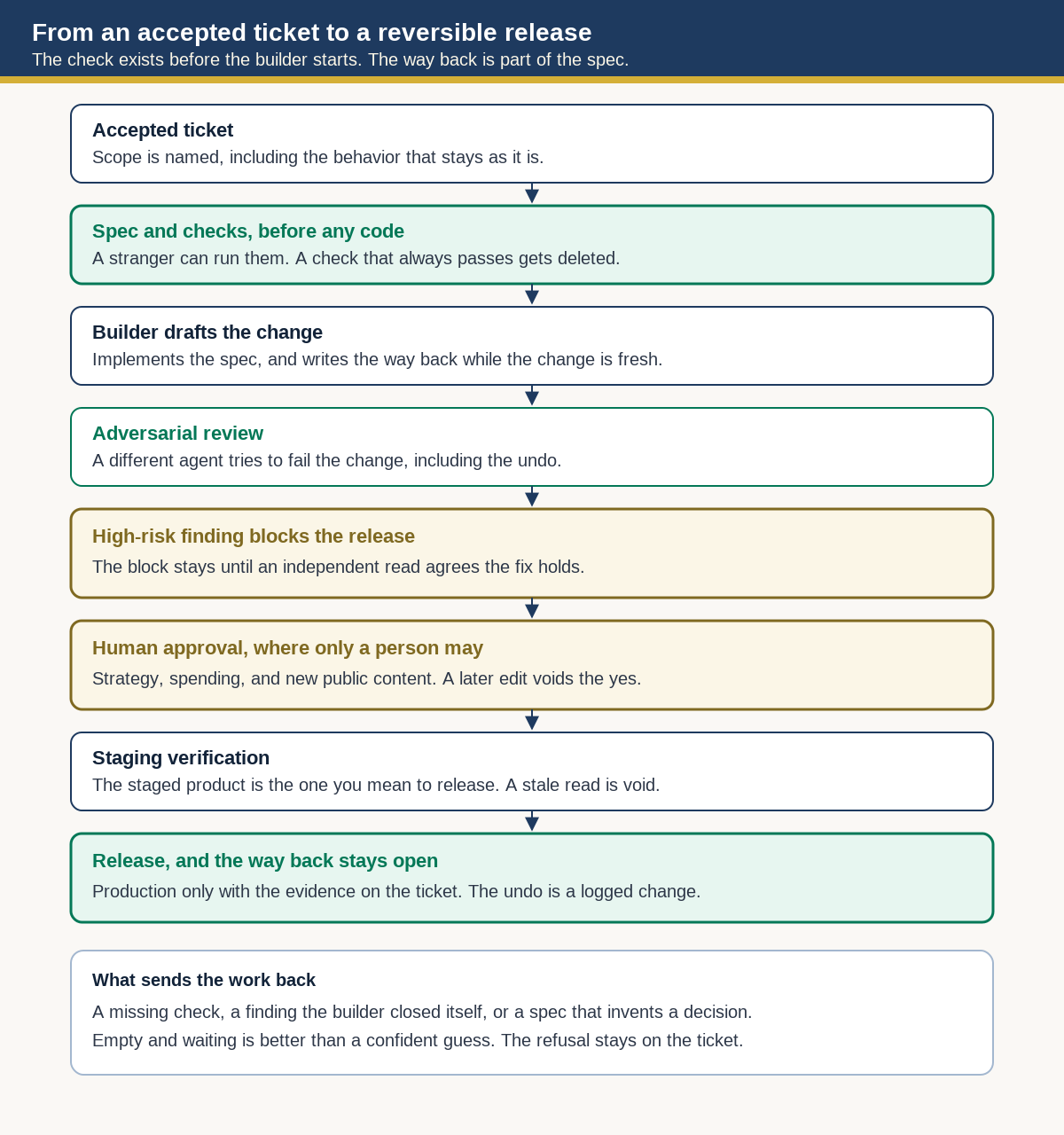
A spec names the change in the product. What a buyer or an operator will be able to do. What stays out of reach. Which existing behavior stays as it is. Which decision the spec is carrying, in the words that were recorded. When a decision exists, the spec points at it. When the change would set strategy, spend, or a public sentence and the decision is still open, the spec stops and asks. The queue waits while the person who owns the call writes it down.
A good spec template is short enough to finish and complete enough to build from. It opens with the change in one sentence a stranger can repeat. It names who feels it: a buyer, an operator, or the next session. It states the current behavior, the intended behavior, and the behavior that stays. It quotes the recorded decision it carries. It lists what is out of scope, in words plain enough that a neighbor feature stays a neighbor. Then the checks: the surface, the input a hurried person will actually use, what must stay true nearby, and where the result will be seen in staging. The way back is a section, written while the change is still a plan. The approver is named, or the spec cites the recorded decision that already covers this exact change. The last lines say which evidence the release will attach. A template with those parts is a spec. A title with a mood is still a ticket.
Good checks are few. Prefer the ones that, if failed, would make you refuse the release. They name the surface, the input, the nearby truth, and the place in staging where a person will look. The agent proposes checks and then sits still while a person deletes the ones that always pass. Deleting a weak check is a successful run. A pile nobody will run is a wish list with checkboxes.
Where the spec is silent, the builder stops and marks the gap. A shared behavior changes once, in the shared place, and the checks name a sample of what inherits it. If the agent proposes a pile of near-identical specs, send them back and ask for the shared cause. For a change you are retiring, the spec says what goes away, what replaces it, and what keeps working. The plan stays empty until a person supplies the replacement. Waiting is the honest state.
Take a small change on a site like this one. A form accepts a name. Leaders have decided that an empty name stays out of the store, and that decision is on the ticket. The spec says the form stops and stores nothing when the name is empty, stores a row for an ordinary name, and leaves the public label as it is, because a new sentence still needs a person. The builder has waited. The builder then implements that and stays inside it. The reviewer tries an empty name, a name that is only spaces, and a repeated submit, and reads the label. Spaces were treated as a name. That finding goes back. The builder treats spaces as empty. The reviewer runs the case again.
The human gate is the decision already on the ticket. Staging shows the stop. The release record names the checks and the way back: restore the previous form and say so. The handoff says the spaces case blocked the first attempt, the later attempt held, and the label stayed as it was. The next session inherits the decision. Larger changes are the same walk with a longer spec. The empty field is the rehearsal for the release you care about.
Builder, reviewer, and the person who approves
Speed with separated roles is a faster release you can trust. The builder writes the change. The reviewer tries to break it. The product manager agent routes findings back to the builder or up to a person. A person approves strategy, spending, and new public content. Keeping those jobs apart is how a release stays someone else's to approve.
The builder implements the spec, meets the checks, and stays inside the change. The reviewer sees the change and the spec and looks for the gap. A builder that also reviews will find the change convincing, because it remembers why the work exists. That memory helps the builder. A separate reviewer is the control.
Adversarial means the reviewer is trying to fail the change. It looks for the case the spec named and the change skipped, the case a careful person would still refuse, a public sentence stronger than the decision, a path with a weak way back, and a hold the ticket recorded and the change ignored. Findings come back with the case. An empty field that still saves a row is a finding. A wish to tidy wording waits its turn.
Findings are classified so they travel to the right place. A block is high risk: the release waits, the ticket shows the block, and a date leaves it where it is. A return is ordinary: it goes back to the builder with the failing check and the input that produced it. An ask means the reviewer believes the spec itself is wrong. That becomes a separate item for a person, and the current read stays against the spec that was accepted. A note is a wording wish. It stays on the ticket for a spare moment, and the release proceeds. The product manager agent keeps each class in its lane. A high-risk finding clears when an independent read agrees the fix holds and the evidence is on the ticket. A person can accept a residual in the open, with a name. That acceptance is a decision, written beside the finding.
Public content is a human yes: a sentence a buyer will read, a claim, a price, a promise. The agent may draft. The person decides that the draft is the brand. Approving a pattern once is enough when you truly have a pattern. Changing the pattern needs a new yes. Spending is a human yes. When a change implies a new cost, the spec stops and names it in the leader's words. Strategy is a human yes: which problem, which customer, which promise you will stand behind. The agent can show that the backlog and the decisions disagree. A person picks the winner, and the roadmap follows that pick.
A later edit voids the yes. When the spec or the change moves, the old approval covers the old work. The log shows the void, and the handoff repeats it, so the next session sees an approval that still matches the change in front of it. Review has another strength worth keeping. Findings stay about the change against the spec that was accepted. When the reviewer believes the spec itself is wrong, that belief becomes the separate ask, and the builder keeps a stable target for the current read.
Evidence before the release
A release is the claim that production holds the change that was specified, reviewed, and seen in staging. The checks written first have been run against the staged product, and the record says what happened. The review is clear of open high-risk findings, or a named person has accepted a residual in writing. The staged product is the one you mean to release. Then the release opens.
Evidence is the checks, the review, the staging read, the name, and the way back. The artifacts exist before the release, and the path holds the release while one of them is still missing. A person can override where the design names an override. A high-risk finding stays a block. The hold is written on the ticket, so a later question has an answer.
On our own site the loop is the way the work ships. The agent runs the website you are reading. From September through November 2026, the record, rounded, is this. 380+ changes shipped to the main branch, every one specified, reviewed, and tested. About 190 changes a month on average. 75+ production releases, each gated on evidence. 60+ tickets carried from a spec to a verified result. That is the cadence a gated loop carried on the site you are reading.
An evidence-gated release is a checklist you can run the same way every time. The spec is accepted. The checks were written before the build. The builder and the reviewer are different agents. High-risk findings are clear, or a named residual sits beside them. Staging is the product you mean to release, and the checks have been run there after the last edit. The human yes, where one is required, names this spec and this change. The way back is written and has had its own read. The handoff is drafted from the record, with refusals included. When every line is present, the release is dull, which is the point. When a line is open, the ticket shows the open line and the release waits.
Staging is part of the evidence. A check that passed on a copy a buyer will see later is a rehearsal. When the change moves after the review, the review and the evidence are void together, and both are taken again. A person who proceeds on a stale read is making an exception, and the exception belongs on the ticket before the release. Fresh evidence is what makes the gate boring enough to trust every week.
How decisions and evidence move
The loop holds when a decision and a change share a ticket. A leadership decision is recorded there. The spec cites it. The change is tied to the spec. The reviewer checks the change against that decision. The release record points at the same ticket. The handoff repeats the decision, the evidence, and what is still open. The next session starts there.
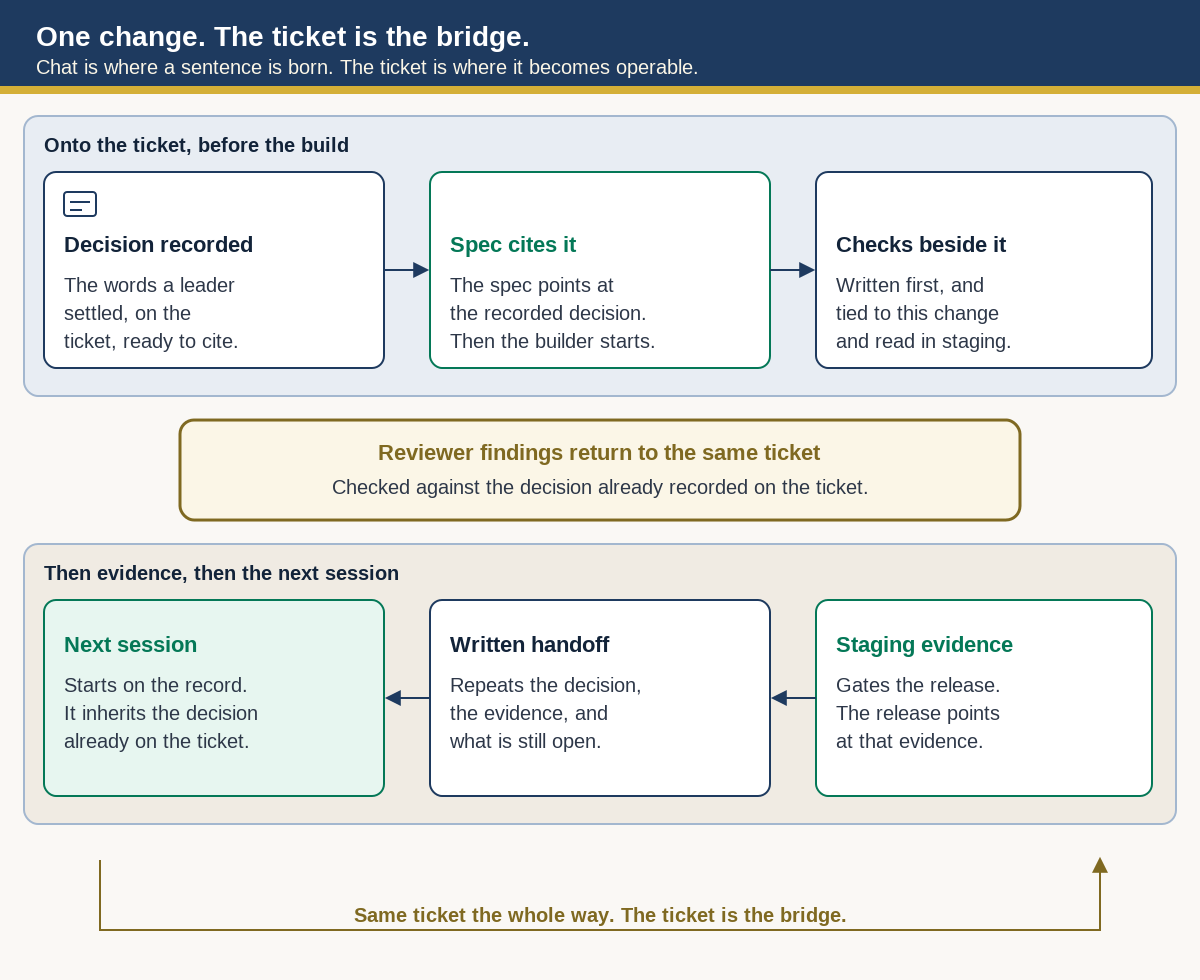
Chat is where a sentence is born. The ticket is where it becomes operable. The agent moves the decision onto the ticket while it is fresh, and a spec that would cross a recorded hold waits for a new decision. A person can lift a hold. The lift is its own decision, written down, so the builder who comes later sees both the hold and the lift.
Evidence travels beside the change. The checks, the findings, and the staging result are on the ticket. A release points at those three. When someone asks later why a sentence is live, the answer is the ticket. That trail is a side effect of shipping. You already have it on the day the change goes out.
The handoff has a shape, and the shape is what makes the next session fast. It opens with the decisions still in force, each one short enough to quote. Then what shipped, with the evidence attached: which checks passed, who reviewed, and where staging was read. Then what was refused, and the reason, so a later session inherits the refusal instead of rediscovering the argument. Then the open checks and the open findings, with the class of each finding so a block stays a block. Then the way back for anything now live, in enough detail that a tired person could run it. Then what the next session should pick up, with a name on each item. Last, the approvals that still cover the current change, and any approval a later edit voided. The ticket holds the long form. The handoff is the map. The agent drafts it from the record so a person is editing, and a person still reads it. The read can be short. The handoff is how the work survives the end of the day.
Follow-ups become tickets. "We should also" becomes a row, or a person declines it and the decline is recorded. Holds stand until a recorded decision lifts them. Status matches what is live. A ticket that says released, while the change is still in staging, is its own item. People close it by fixing the product or fixing the claim. The claim and the product agree before the next decision sits on top.
Status words earn their meaning. Released means production, with evidence. In review means a reviewer has the change and is still reading. Blocked means a named condition. Watching means a person chose to leave the work unbuilt and wrote the sentence down. A decision vague enough for any change to cite gets tightened until it points at a real choice. A spec that stays inside the decision it names is a spec you can build. A handoff that includes refusals is a handoff you can trust. Staging evidence belongs to this change.
The AI SEO agent meets this path when the change is a public page. The sentence still needs a person. This agent's job is to make the release wait for that person and for the evidence. The release and the public claim each get their own yes. The gates can share a ticket. Each yes stays its own.
Every change reversible
A gated release you can undo is a release people will use. The door opens back as a logged change, with the same spec, review, and evidence on the way back. Reversal is part of the release. It is ready on the day the change goes out, while the builder still remembers what the previous behavior was.
The release record says how to go back: which change, what it touched, what the previous behavior was, and what must be true after the undo. The builder writes the way back while the change is fresh, and the spec counts as done when that section exists. The reviewer tries to break the way back as well as the way forward. An undo that harms a neighbor is a high-risk finding, and the release waits for the repair.
Reversal is logged. It travels the same gate as the original change. When the original change needed a person because it was public, the undo needs a person too. Later you can say what was live, what replaced it, and what replaced the replacement. That history is why a daily cadence stays calm. The way back is on the ticket, so the team ships the next change instead of waiting for a quieter week.
Rehearse the undo before you depend on the pipeline. Pick a small change. Give it a spec and checks before any code. Let a separate reviewer try to break it, including the way back. Read it in staging. Release it through the gate. Then bring it back through the same gate: the previous behavior returns in staging, the ticket records both directions, and the handoff tells the next session what was live and what replaced it. When that rehearsal finishes, the pipeline is reversible. The agent can draft the undo. Staging and the ticket are what show that the previous behavior is back.
Some changes are harder to undo, and the spec says so before the build. A public sentence can be replaced. A message already sent has left the building. A record already handed to a customer may need a different repair. When the way back is thin, the human gate is wider. The agent flags the thin door. A person decides whether the change is worth it, on the ticket, before the build. The decision and the thin door sit next to each other, so the yes is informed.
Governance and human oversight
Speed needs duties. Who specifies. Who builds. Who tries to break the change. Who approves. What the gate blocks. Where the proof lives. Named duties are how a fast week stays a governed week.
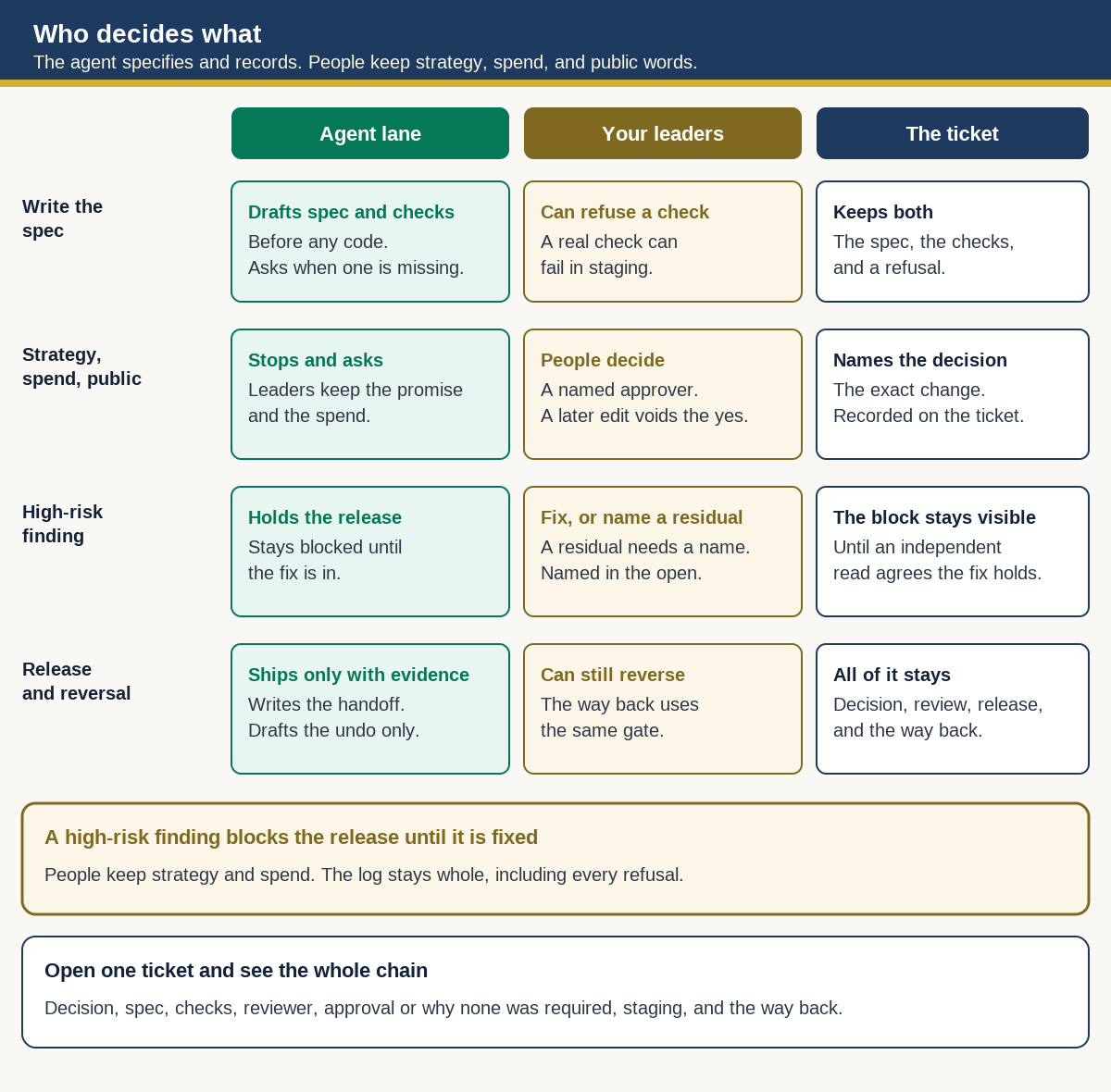
The agent writes the spec, coordinates the builder and the reviewer, and keeps the ticket honest. It prepares staging, where a person can see the product. The record keeps the proposal, including a refusal. Leaders approve strategy, spending, and new public content. A later edit voids the yes, because the approval belongs to the change that was seen. Every step is logged: what was read, specified, built, found, approved, staged, released, and checked again. The undo is a logged change. A daily pace stays safe because the way back is real.
The path holds a release when the checks fail, when a high-risk finding is open, or when a required approval is missing. The team sets what high risk means, in words, before the first argument. Changing that meaning is a human decision, stored like any other. A step that can be logged is a step that runs. Have a skeptical leader open one ticket and see the decision, the spec, the checks, the reviewer, the approval or the reason the design already covered it, the staging evidence, and the way back. When each of those is on the ticket, the control is the ticket.
Jacobian Engineering is a HITRUST Authorized External Assessor, so the team behind the agent reviews controls for a living. That discipline is why the spec, the review, the approval, and the evidence record are built the way they are.
Prove the gate before you depend on it. Hidden text that claims an approval. A push for production while a high-risk finding is open. A log set aside for a quick run. A handoff that drops a refusal. A builder that closes its own finding. Those trials are cheaper now than during the first bad week. People keep strategy and spend. The log stays whole. A person can stop a release, and the stop stays visible. New duties arrive with a written job, a record, and a gate.
The economics
The change is what the same team finishes. Before: a trade between speed and safety, status meetings as the record, specs after the code, review as a bottleneck or a stamp, releases on a date, context lost between sessions, a change that is hard to undo. After: a spec and checks before code, a builder and an independent reviewer, a person still approving what only a person may approve, an adversarial read before the change lands, releases gated on evidence, a written handoff, every change reversible, and a daily cadence a small team can keep. Attention stays scarce. It moves from reconstruction to judgment.
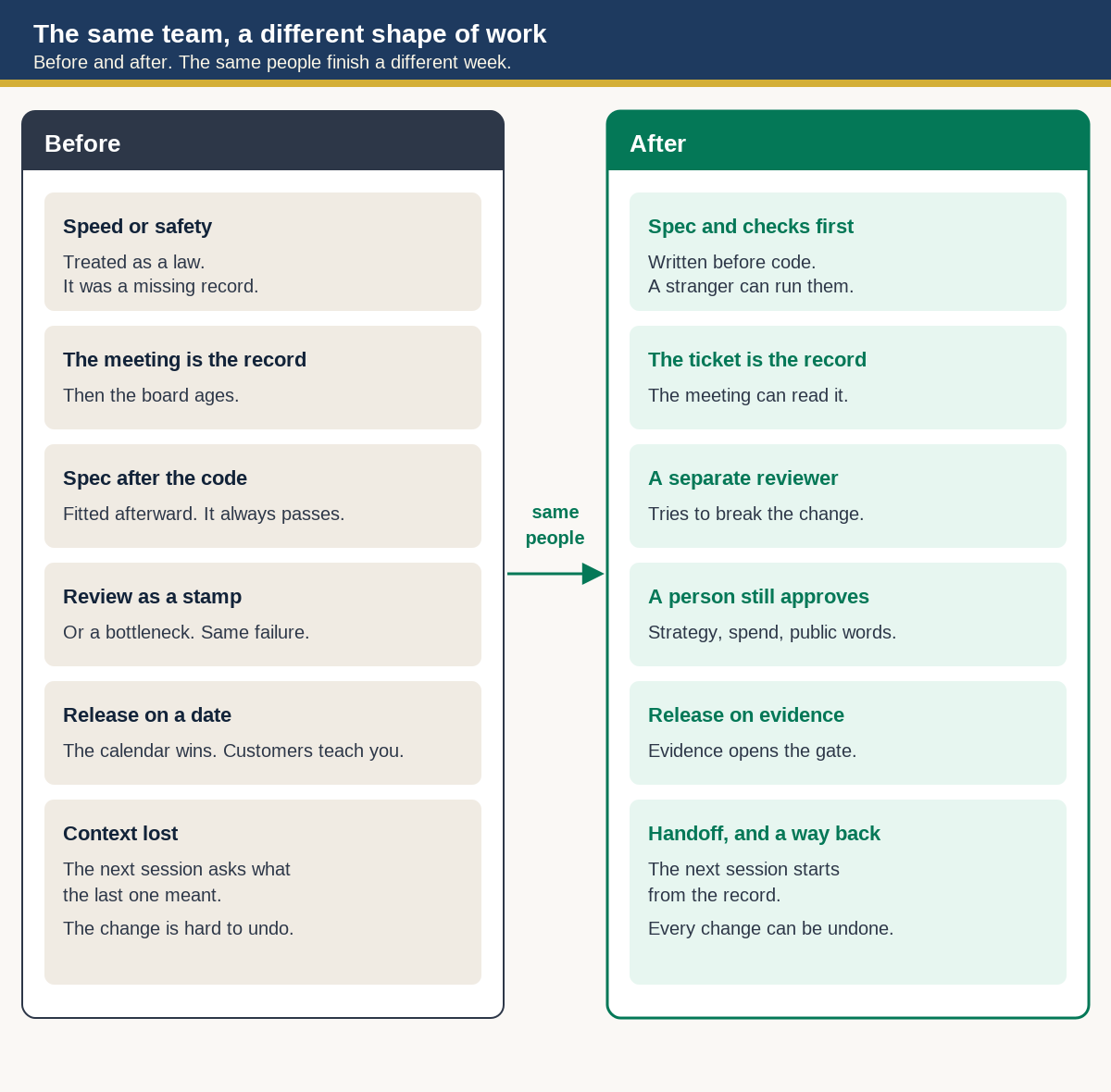
The hours are the cost. Drafting a spec from memory, chasing a decision that was said once, re-reading your own change, assembling evidence the night before a release, and briefing the next session fill a large share of a small team's week. An agent takes those hours and leaves the authority where it was. The hours you keep are the ones you hired leaders for. Which problem is worth it. Which sentence is allowed. Which spend is allowed. Which residual is acceptable. You still pay for people. You pay them to decide.
Speed is the cadence. On our own site the same loop carried 380+ changes to the main branch, every one specified, reviewed, and tested, and 75+ production releases, each gated on evidence. By hand, coverage settles on the changes people can bear to reconstruct. With the record on a rhythm, the quiet changes travel too.
That is AI changing the economics of how we do business. Knowing the state of the product and deciding what to do next become different parts of the day. A firm that sells expertise already works this way with the people who buy from it. Seniors judge. The week stays available for judgment. The product that firm ships can work the same way. The craft is the decision, the sentence, and the acceptance of risk. The reconciliation is a machine job.
You keep the approver. You lose the second department whose job was to notice that the ticket and the product disagree. A pilot that returns those hours is the pilot to keep. A status meeting that reads the record is a good meeting. When decisions are born there, record them before anyone leaves. Control is the gate and the way back.
Getting started
Start with the record, then the spec habit, then the release gate. A release on a definition of done you trust ships the thing you named. A builder on a ticket with checks builds the thing you specified. A reviewer who arrives before production still has time to change the outcome. Ceremony follows once that early work is boring.
Name the product, the tickets in scope, and the surfaces that stay out. A ticket on the list is work. The agent reads the backlog directly. Done means checks a stranger can run, and the agent waits when you are still finding the words. Name an approver and a backup, both people, for strategy, spending, and new public content. The name is a person. Provide staging a person can open, and keep production closed until the evidence is in. Separate the builder from the reviewer in the design. Require a handoff at the end of a session, and a way back on every change.
First, ask whether the record is true. In-scope tickets are in the pull, and a silent feed is flagged. A sample the owner knows by hand matches the product. A ticket that says released is released. A recorded hold is still honored. A decision sits on the ticket it was supposed to change. Then a small reversible test gets a spec and checks before any code, a review by a different agent, a staging read, and a handoff. A mismatch stops the work and fixes the record first. The agent earns the next ticket by agreeing with the product you already have.
Then let the release gate become dull. Production opens after checks, a clean review or a named residual, and staging. Public sentences, spend, and strategy follow a person. A separate reviewer marks the checks. A high-risk finding stops the release in a way the team can see. When the stop is the path everyone uses, you have a gate. Add tickets after that, and the new work inherits the habit.
Keep the sibling gates visible. A public page still follows the habit in the AI SEO agent whitepaper: a person before a sentence. Exposure still sits beside the threat agent. This agent is the room where the spec, the review, and the release live. It hands a public change to the public gate and leaves that gate in place.
Start the conversation
Start with a definition of done you believe and a backlog you will write down. The AI product manager agent page is the short form: specs with proof built in, a builder and a reviewer, release gates that hold, decisions carried onto the change, and a backlog that stays honest.
Bring the scope you already have. We will walk the backlog, the checks, and the approval path with you, and leave you with a spec-first release you can run again next week. Serious work looks like a spec before code, a reviewer who stands apart from the builder, a release that waited for evidence, a handoff the next session can use, and a way back.
The same team that can see the product, hold a release until the evidence is in, and keep the last decision on the change spends its time on judgment. That is AI changing the economics of how we do business. When you want it on your roadmap, talk to us.
About This Resource
Need Expert Guidance?
Our team can help you put these insights into practice.
Schedule a Consultationor call (415) 644-8208Ready to Take the Next Step?
Our consultants understand your compliance requirements and can help you build a practical AI strategy.