
The AI Podcast Production Agent Playbook
Executive summary
A business podcast dies in the chores, not in the conversation. The host can talk. The week cannot hold the rest. Guest research sits in a pile of tabs. Booking is an email thread that forks every time someone proposes a new time. The prep brief, if it exists, is a skim the night before. The recording happens, and then the file waits. Chapters, show notes, hero art, the episode page, the feed, and the video embed are separate jobs owned by whoever has a free hour. The release date moves. Listeners hear silence and decide the show is over. A producer, a booker, and an editor were the old answer, which is why most business shows stall after a handful of episodes. Headcount does not arrive. The host is already the person who sells, teaches, or runs the firm. The work waits.
An AI podcast production agent changes that shape of work. It researches guests and runs outreach, scheduling, and reminders, so the calendar fills with recordings instead of threads. It writes a briefing and suggested questions before the host sits down. It handles the logistics of the session: the time, the reminder, and where the file lands. From a finished script it produces a full narrated episode in 10 minutes or less. From a recording it drafts the edit, the chapter markers, the show notes, and the links, and it prepares hero art that follows the show's rules. The episode page, the feed, the structured data, and the video embed are one package, ready to go live together. Releases sit on a queue with a date. The agent does not put an episode in public on its own. A person approves every guest, every publish date, every paid production run, and every public release.
That is the economics. A show runs on the host's time, because the research, the thread, the brief, the first draft of the notes, and the assembly of the package happen at machine speed. People spend their hours on the calls that were always theirs: who is worth inviting, which question is fair, which sentence may be heard in public, which date the episode should meet an audience. That is AI changing the economics of how we do business. This paper is the operating picture behind the short version on the podcast production agent page.
The figures come from our own show, The New Math, and from the agent's own booking and production logs in 2026, rounded. 30 guests were booked in three weeks. 6 interviews were recorded in a single week. 7 episodes were produced, with releases scheduled months ahead. A full narrated episode, starting from a finished script, took 10 minutes or less. As many as three episodes can move at once, and each one ships with its page, its chapters, its feed entry, and its structured data on the same day. A human approves every public release. The logs show what this loop did on our show.
The pattern travels. Guest research, the host calendar, finished scripts, recordings, and the show's own rules feed an agent that researches, books, briefs, and produces a package. A queue holds the proposals. A human approval gate stops anything public. The episode page, the feed, the art, and a scheduled release come after a yes. Unreleased work, including the guest's name, stays private until the date the host approved. The agent can prepare on a steady rhythm. The host's judgment is what makes an episode real.
Why shows stall after the pilot
The pilot feels like the product. A host, a topic, a decent conversation, a file on a laptop. Friends say it sounds like a show. Then the second episode needs a guest who is not a friend, a time both people can keep, a brief that is more than the guest's job title, and a package the audience can actually find. None of that is the conversation. All of it is the job. The host does the job once, out of enthusiasm, and the calendar after that belongs to the firm. The show becomes a file and a promise.
Booking is where the weeks go. A name is suggested. Someone drafts a note. The note waits on a tone the host wants to check. The guest replies with a constraint. The thread grows. A time is proposed, then a different time, then a hold that is not a hold. Two people think the session is on a given morning. One of them is wrong. The reminder, if anyone sends it, goes out late, or not at all, because the person who would send it is in a sales conversation that actually pays the month. The interesting guest, the one the show needed, cools off. The host did not lack taste. The host lacked a loop that keeps a thread moving without borrowing the host's afternoon.
What a podcast production agent is
An AI podcast production agent assists the host who already owns the show, the guests, and the voice. It is not a replacement host, and it is not a studio you rent and forget. It proposes, prepares, and waits. Propose means it says who might be worth inviting, how the outreach should read, what the brief contains, and what the package should look like, with the check written before the work counts as done. Prepare means the draft is complete enough that the host's job is to approve or refuse, not to reconstruct. Wait means nothing public moves on a confident draft. A wrong question in a brief is a nuisance the host can cross out. A wrong sentence in public, in the host's voice, is the show.
It does not publish alone. Show notes, chapter titles, the episode page, the feed entry, the art, and the date stay drafts until a person says yes. The agent can make the draft so complete that the yes is a decision instead of a project. It cannot skip the decision because the draft looks obvious. A guest's name on a public page before the release date is not a preview. It is a leak. Unreleased episodes and guest names stay private until that date.
It is not a chatbot with a transcript pasted in. That produces a plausible summary and no custody. The next person cannot see what was omitted, whether a quote was smoothed, or whether the date was ever approved. The agent in this paper is wired to the guest list, the calendar, the scripts, the recordings, and the rules of the show. Notes come from the recording. Chapters come from the recording. A sentence that is not in the recording does not get a nicer version. Lines in the log come from what was booked, recorded, approved, and scheduled, not from a prompt typed in a hurry.
The jobs stay narrow, because a general instruction to handle the show expands until it touches a claim, a guest, or a spend someone thought was out of scope. The scope is guest research and booking, prep briefs, recording logistics, editing and chapters, show notes, hero art, the episode page and the feed, and a scheduled release. The host's opinions, the firm's offers, and any paid promotion are not smuggled in because the agent was already holding the recording.
There is a version of this category that is a text box beside a folder of audio. You upload a file and receive a summary. That is a writing aid. It does not book the next guest, block a bad date, keep an unreleased name private, or tie the page to the feed. If a demo centers on the paragraph, ask for the queue, the gate, and the log. Missing those, you are buying a narrator for the stall. Narration is cheap. A closed loop is what keeps a show on a cadence a host can survive.
Being found, once the page exists, is a different job. The AI SEO agent is how a page earns its place in search, with its own approval gate in front of anything public. The AI SEO agent whitepaper is the long form of that loop. A production agent can hand it a real episode page. It should not also pretend to be the search practice. One agent, one job, one gate.
Reference architecture
Read the picture from the sources, through the agent, to the gate, and only then to anything a listener can open. Guest research, the host calendar, finished scripts, recordings, and the show's rules hold the facts. The core researches, books, briefs, and produces a package. A queue holds the proposals. A human approval gate stops anything public. The episode page, the feed and the art, and a scheduled release are the path after a yes. A log closes the loop. The gate is a stop, not a caption.
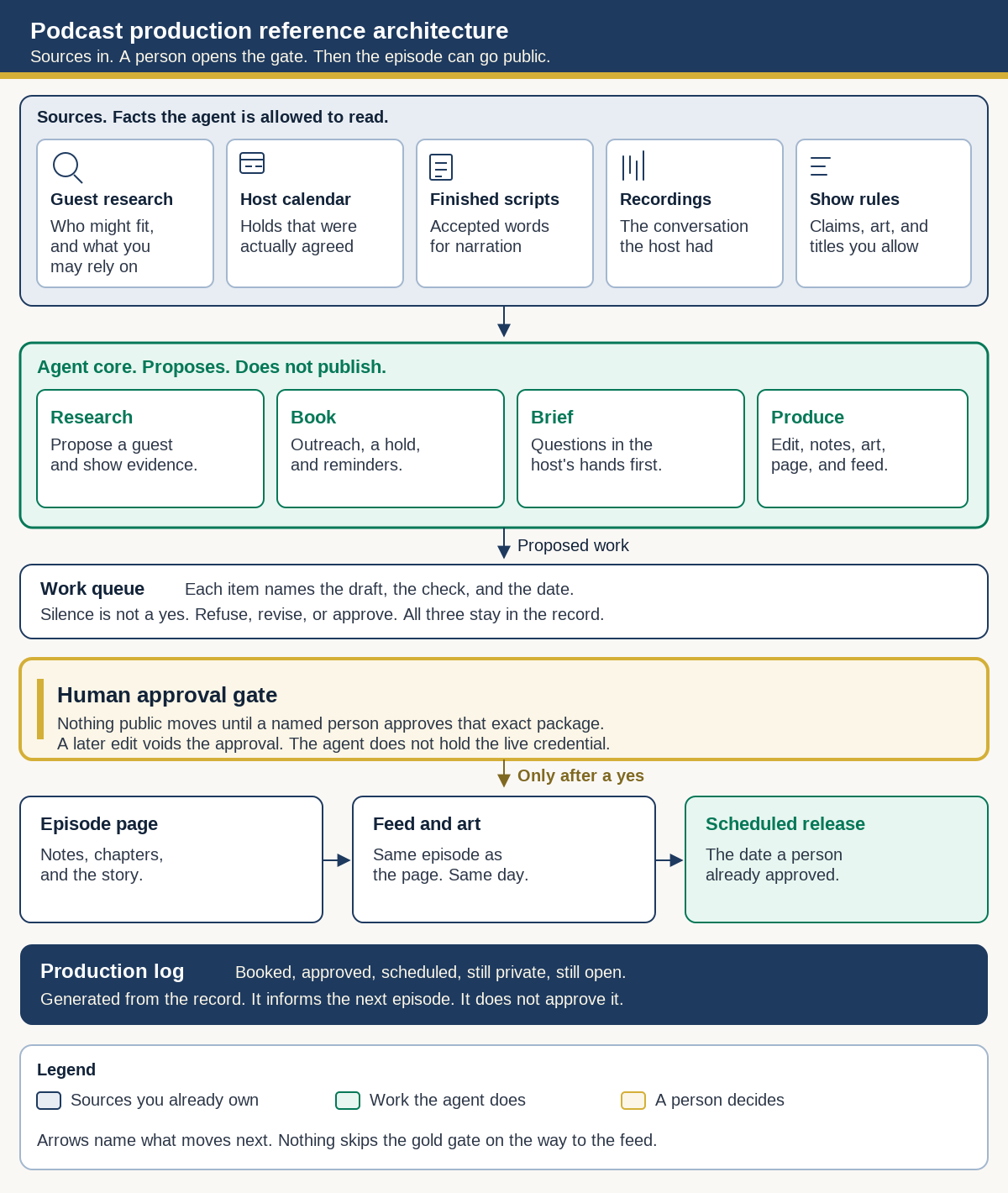
Start with the show's rules, because later mistakes are scope mistakes. Scope is which show, who the host is, what the show is allowed to claim, how a title should read, which art may be used, and what must never be said. The agent does not discover your company. It reads the rules you named and the materials you placed in reach. A guest who was never approved is not a surprise success. They are out of scope, and that should be written down before anyone is invited.
The sources stay separate on purpose. Guest research says who might fit and what they have already said in public that you are allowed to rely on. The calendar says what was actually held, not what a thread hoped. Finished scripts are the input for a narrated episode. Recordings are the input for a guest conversation. The show's rules say what the package must satisfy. Mix these and you hide the useful discrepancy: a session on the calendar with no file, a file with no booking, a script marked finished that the host has not accepted, a package that quotes a line the recording does not contain. A failed pull is a signal. Silence is not a quiet week.
The duties fail differently, so they are separate boxes. Research proposes a guest and shows the evidence. Booking moves a yes into a held time, with reminders, and records a decline as a decline. The brief puts questions in the host's hands before the session, and the host may cross them out. Production turns a finished script or a recording into a package: edit decisions, chapters, notes, art, page, feed entry, structured data, video embed. None of those duties includes the right to go public. Planning must not quietly become publishing.
The arrow out of the core is a queue, not a live episode. Do not blur that once the notes read well. If the agent holds a credential that can publish without a person, the gate is a policy sentence, and sentences do not stop a release. The live credential stays absent until that package is approved. Each queue item names the episode, the guest or the script, the draft, the date proposed, and the check that will decide whether the package is complete. Items do not age into a yes. Silence is not approval. Refuse, revise, and approve are all recorded.
The gate is the wide bar so nobody misses it. The host approves every guest before outreach, because an invitation is already a use of the show's name. The host approves every publish date. The host approves every paid production run before it starts. The host approves every public release, which covers the notes, the chapters, the art, the page, and the feed entry. A later edit voids the yes, because a feed can carry a wrong sentence after you have fixed it in a draft nobody shipped. A person can read and hear the package before anyone else can. Checks confirm that the page and the feed describe the same episode, that chapters fall inside the episode, that required art is present, and that the date is the date that was approved. A failed check does not ship on a shrug.
The operating loop
The picture of parts is not the week. The week is a loop. Research guests. Get a yes before anyone is invited. Book the session and send the reminders. Write the brief before the host sits down. Record, with the host in the chair. Produce the package. Wait for approval. Schedule the release. Repeat. Skip a step and you have a folder of raw audio and a promise, which is the pilot, forever.
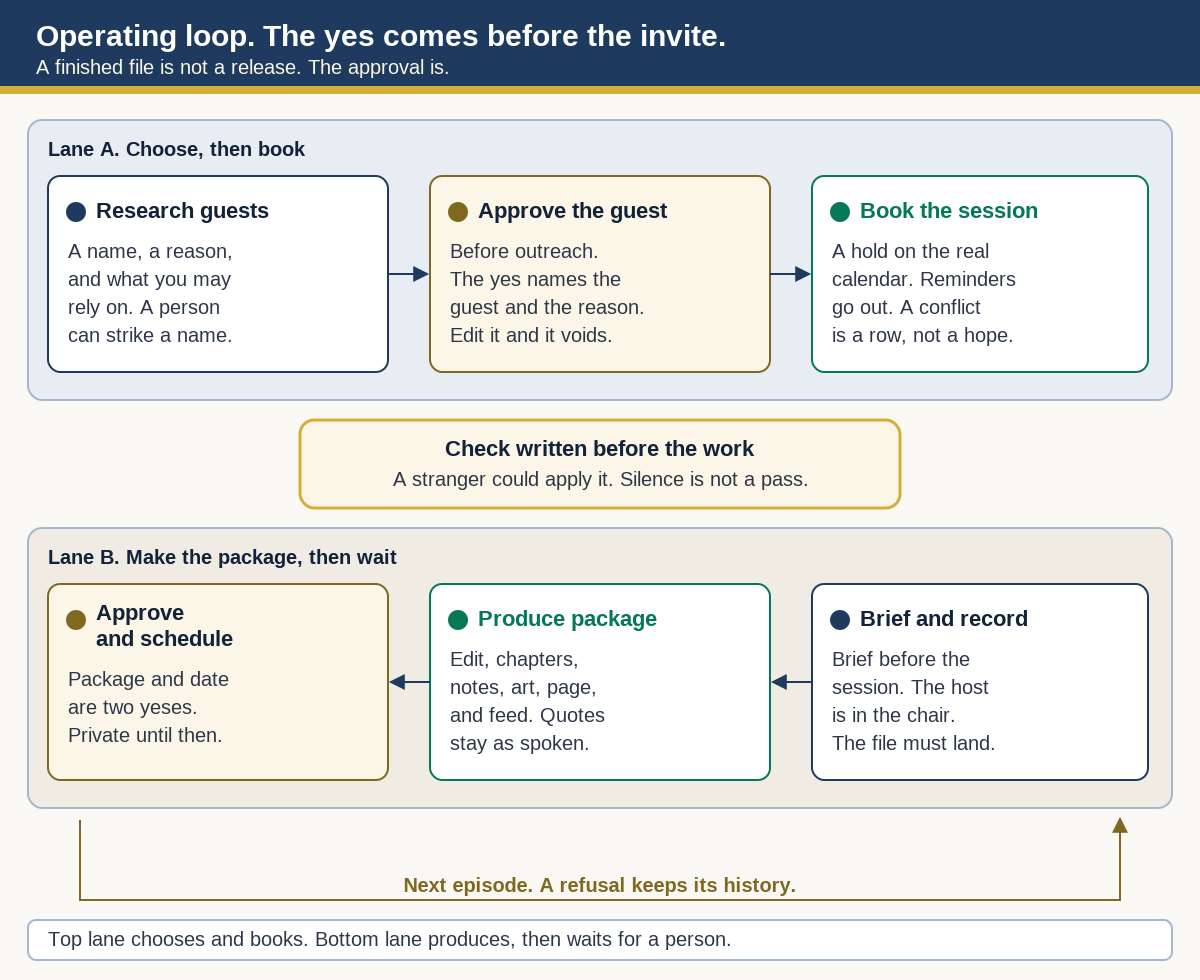
The yes comes before outreach. This is the step teams skip when they are proud of a pipeline. An invitation that the host has not seen is a public use of their name, even if the episode never records. The approval names the guest and the reason. Edit the reason and the approval is void. A decline later is not a failure of the loop. It is a row. The row stays. Re-inviting on a timer the host did not set is how a show becomes a nuisance.
Recording stays the host's. The agent handles logistics: the time, the reminder, the backup if the session fails, the place the file must land. It does not conduct the interview, steer the guest, or decide the conversation went well. Whether it went well is the host's sentence, stored if you want it stored. The file either landed or it did not. That check is blunt, and blunt is what you want. A cheerful note that the session happened, with no file, is not a recording.
Shipping waits. A complete package is not a release. The approval names the exact package and the exact date. Edit the notes and the approval is void. Move the date and the approval of the date is void. The agent does not get a softer rule because it types faster. On a small team the reader and the approver may be the same person. The act is still separate, and the log shows it.
Guest research and booking
Guest research is a process with a stop in the middle, not a list that grows until someone feels busy. The agent can see further than the host has time to click. That is useful only if the host still chooses. The flow is a candidate with evidence, a host approval, outreach, a held time and reminders, a prep brief, then the session. Anything else is a thread with optimism.
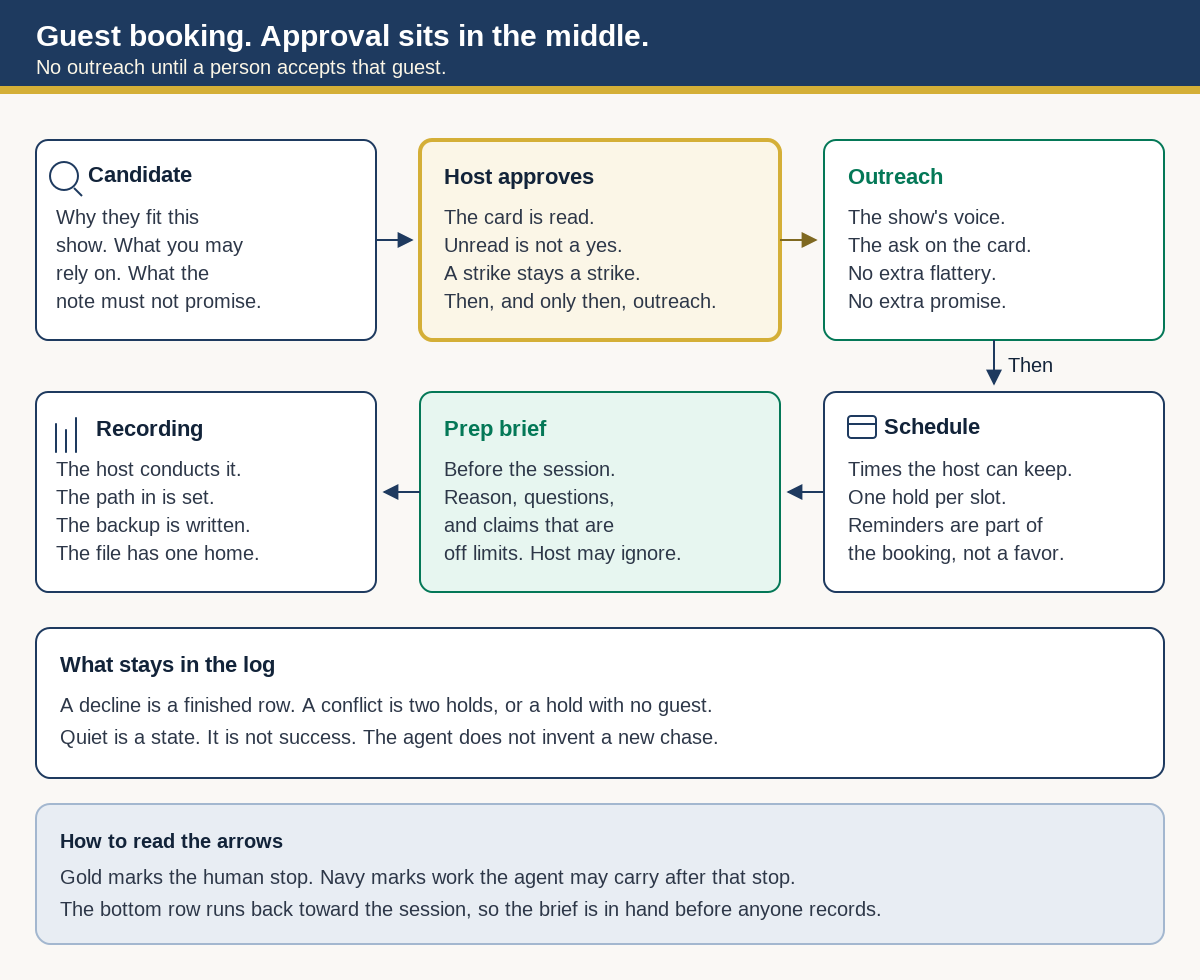
A candidate without evidence is a rumor. Evidence, here, is specific and dull. What the guest has said in public that the show may rely on. Why they fit this show rather than a show in general. Which topic the host actually wants, in a sentence. What the outreach must not promise, including a topic the guest does not cover and an outcome the episode cannot deliver. The agent drafts that card. The host accepts the card or strikes it. A card the host has not opened is not a soft yes. It is unread.
Outreach uses the show's voice and stays inside the card. The note says who the host is, what the show is, and what the ask is. It does not flatter the guest with a biography they did not live, and it does not dangle a benefit the host has not approved. Scheduling proposes times the host can actually keep. A hold is written on the calendar the team treats as real. A second hold for the same slot is a conflict, surfaced, not silently overwritten. Reminders are part of booking, not a courtesy someone might remember. The state of the thread is visible: sent, replied, booked, declined, gone quiet. Quiet is a state. It is not success.
On our own show the booking loop is what the logs describe. In 2026, rounded, 30 guests were booked in three weeks. That is a calendar filling with recordings instead of the host living in the threads. In the same logs, 6 interviews were recorded in a single week. A week with 6 sessions is only possible if the holds, the reminders, and the files are not a second job stacked on the conversations. Those two figures answer different questions. Booking is not recording. A booked guest who never sits down is not an interview. The log keeps them apart so a full pipeline cannot disguise an empty week of actual conversations.
Parallel work has a limit you should write down. Our show moves as many as three episodes at once. That is a cap, not a target. Three packages in flight are three gates, three dates, and three chances to confuse a file. The booking flow does not get to skip ahead of a package that is still refused. A new invitation, while two packages sit without a yes, is how the shelf becomes a pile. The host's sentence, when the queue is deep, is still approve, refuse, or hold.
From a script or a recording to a package
Two inputs, one package, and a gate before anything a stranger can open. A finished script can become a full narrated episode. A guest recording can become an edited episode with chapters and notes. Both end as the same shape of artifact: edit decisions, chapters, show notes, hero art, an episode page, a feed entry, structured data, and a video embed. Then a person. Then a date. Mixing the inputs up is how a narrated read gets treated like an interview, or an interview gets a script it never had.
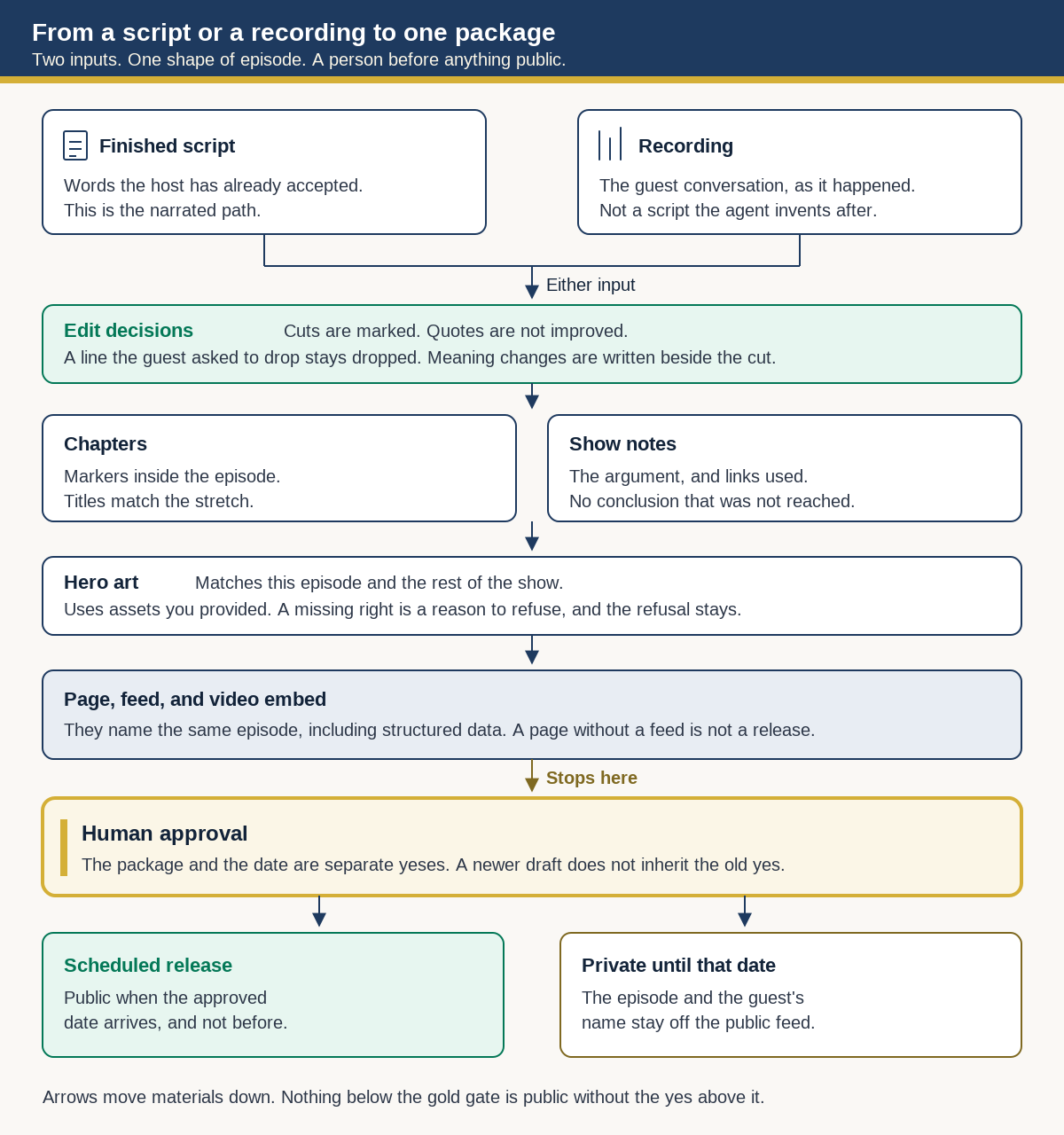
The narrated path is narrow, and the logs time it narrowly. From a finished script, a full narrated episode took 10 minutes or less. Finished means the host has accepted the script. It does not mean a rough outline, a list of bullets, or a transcript nobody has read. The agent does not get to declare a script finished because the clock is running. The figure covers the narration and the assembly of that episode once the words are settled. It is not a description of a guest conversation, which still takes the host's session and the guest's time. Treat the figure as a property of the narrated path. Use it to see whether that path is actually short. Do not use it to hurry a conversation that has not happened.
Edit decisions are proposals about the file you have. For a narration, the edit is pacing, a retake, a stumble removed. For a guest episode, the edit is the false start, the aside that repeats, the stretch where the guest asked not to be included, the moment that is the point and must stay even if it is messy. The agent may mark these. It may not improve a quote. A smoothed sentence that the guest did not say is a fiction in the host's feed. If a cut changes the meaning, the draft says so, in words, next to the cut. A person who cannot hear the change cannot approve it.
Chapters are a map of the episode a listener will actually hear. Each marker falls inside the episode. Each title matches the stretch it points at. A title that teases a claim the stretch does not make is an advertisement, and advertisements in the chapter list train listeners not to trust the map. The agent drafts markers from the recording or the script. The host can rename, merge, or delete. A deleted chapter stays deleted. It does not return because a template wanted a longer list. There is no correct count of chapters. There is a true map or a false one.
Show notes are the argument, the people on that episode only, and the links that were actually used. A summary that adds a conclusion the conversation did not reach is the failure mode to watch. So is a link inserted because it seemed helpful. Helpful and false are the same thing to a listener who clicks. Notes drafted from the recording can be long enough to be useful and still refuse to invent. The host is approving a representation of the episode, not a new essay. If the notes need a sentence the episode never supported, that sentence is a new claim, and it belongs in a script the host writes, not in a summary the agent polished.
Hero art follows rules you can check. It matches this episode. It matches the rest of the show. It uses assets you provided, or a treatment you have allowed, and it does not treat a guest's face as free to take because a page on the web displayed one. The agent proposes. A missing right is a reason to refuse, and the refusal stays. Art that is merely late is how releases slip. Art that is merely borrowed is how a show acquires a problem it did not need. The check is dull: the asset is one you are allowed to use, the title on the art matches the episode, and the shape is the one the feed expects.
The page, the feed entry, the structured data, and the video embed move together. A page without a feed entry is an essay the subscriber never hears. A feed entry without a page is a play button into nowhere. Structured data that describes a different episode, or an episode you have not approved, is a public fact you did not mean to state. The video embed, when there is one, is the same episode, not a neighboring file with a similar name. On our show, each episode ships with its page, its chapters, its feed entry, and its structured data on the same day. Same day is the check. A feed updated later in the week is the old stall, with better drafts.
What the logs show
The show is ours. The year is 2026. The source is the agent's own booking and production logs, and the figures are rounded. They are four facts, not one climb, and they do not share a unit.
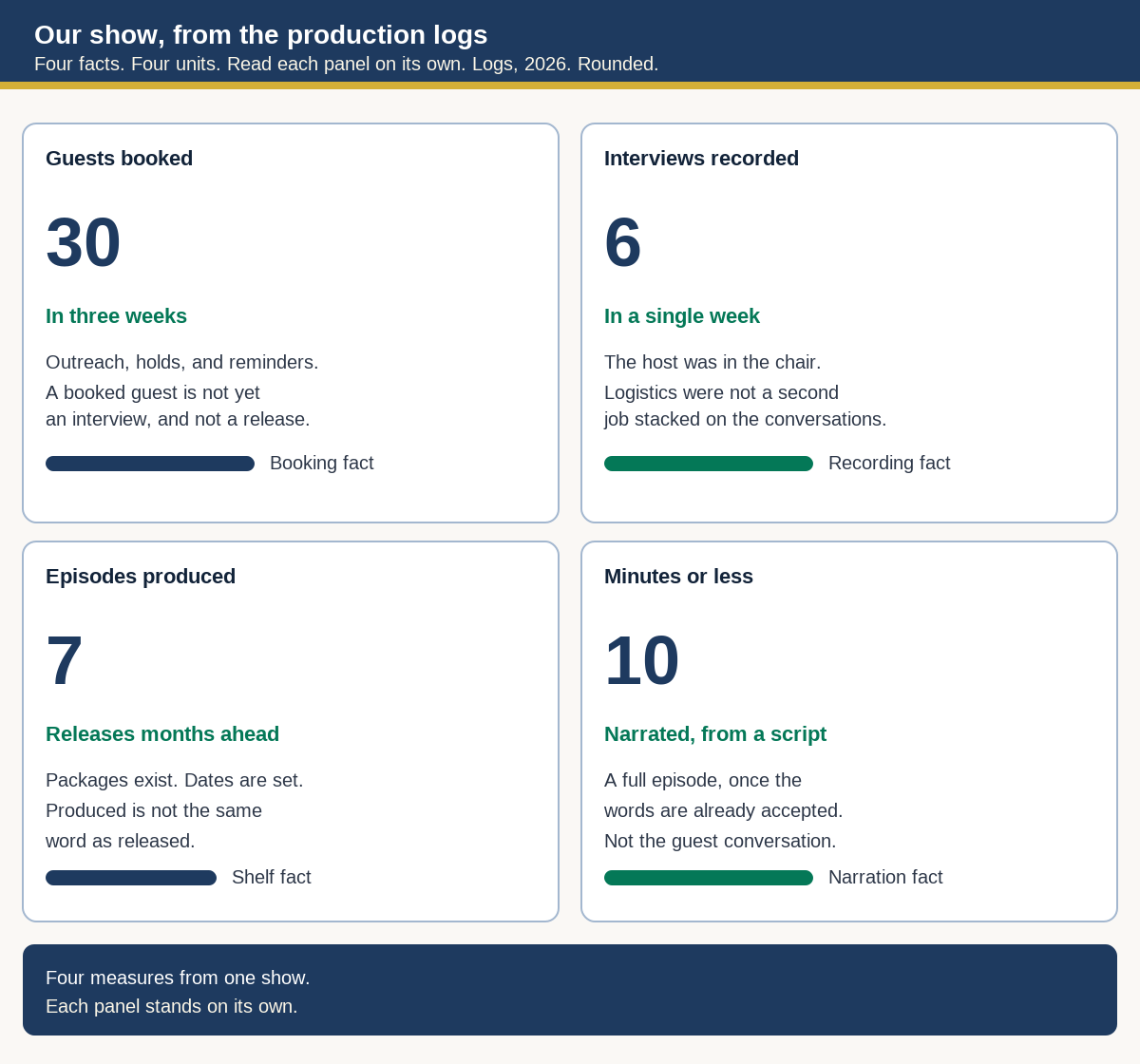
30 guests booked in three weeks is a booking fact. It says the outreach, the holds, and the reminders ran as a loop long enough to fill a slate. It does not say 30 episodes were published, and it does not say 30 conversations have already happened. A booked guest is a person who has a hold the host approved. Some of those conversations are still ahead. That is what a slate is for. Read the figure as relief from the thread, not as an audience.
6 interviews recorded in a single week is a recording fact. It says the calendar can hold a dense week when logistics are not the host's second job. It does not say every week looks like that, and it does not say a dense week is the goal. A dense week is possible. A show that needs one, for a season or for a burst of guests who are only free then, can have one without hiring a field producer for the occasion. The host still has to be in the chair 6 times. Nothing in the agent sits in for that.
7 episodes produced, with releases scheduled months ahead, is a shelf fact. Produced means the package exists. Scheduled months ahead means the dates are set far enough out that the show is not improvising the release on Friday. The public hears an episode when its date arrives and the approval still stands. The team can see the rest. That split, public versus shelf, is the difference between a cadence and a leak. Listeners get a steady show. The host gets room.
10 minutes or less, for a full narrated episode from a finished script, is a production fact about one path. It is the path where the words are already accepted. It shows that narration and assembly do not need an overnight edit once the script is done. It is the figure people will want to widen, and widening it is how a team lies to itself. A guest episode has a conversation in it. The conversation is the time you meant to spend. Those 10 minutes are not that conversation.
Read together, the four figures are what the same host finished. Booking ran at 30 guests in three weeks. Recording ran at 6 interviews in a single week. The shelf held 7 episodes with dates months out. Narration from a finished script fit in 10 minutes or less. The host's scarce hours went to the conversations and the approvals. The threads, the briefs, the assembly, and the feed did not take a second staff. That is what the logs show for our podcast in 2026. A different show, with a narrower field or a host who approves slowly, will post different counts. Slow approval is not a defect. A fast release the host did not mean is the defect.
A release date is a decision
Cadence is a choice the host makes in advance, not a mood the team rediscovers. The agent can queue. It can watch a date. It can assemble the package so that honoring the date is a small act. It cannot decide that this week is the right week. Every publish date is approved by a person. Moving it is a new approval. Leaving it is also a decision, and the log can show the decision standing, so nobody gets to say the date simply happened.
The private side of the date matters as much as the public side. Until the date, the episode is not a soft launch. Guest names stay private. The page is not previewed to a list that will capture it. The feed does not carry a placeholder. Teams leak by degrees: a title in a newsletter, a name on a draft page someone left open, an art square posted as a tease. The rule is simpler than a matrix. Not public means not public. The agent does not get a teaser exception unless the host approves that teaser as its own public act, with its own yes.
When the date arrives, the release is the approved package and nothing newer. If someone improved the notes overnight, the improvement is unpublished work. It does not ride along. This feels fussy until the improvement adds a claim. Fussiness is the control. A release that runs because a clock fired, carrying whatever is now in the folder, is an unattended public act with a timer in front of it. The timer is not the host.
Promotion is not this decision. Telling more people that an episode exists, and spending to do it, is a different approval from making the episode public on the feed. The paid marketing agent sits on that side of the handoff, once there is a real episode to point at. Folding a bid and a guest booking into one instruction would change spend and the show's voice in the same breath. Those are different yeses. The production agent can make the episode real. It does not get the budget because it was holding the file.
Governance and the host's yes
Speed needs a table of duties, not a slogan. Who proposes, who approves, what the gate blocks, where the proof lives. If the answer is the platform, nobody owns the episode.
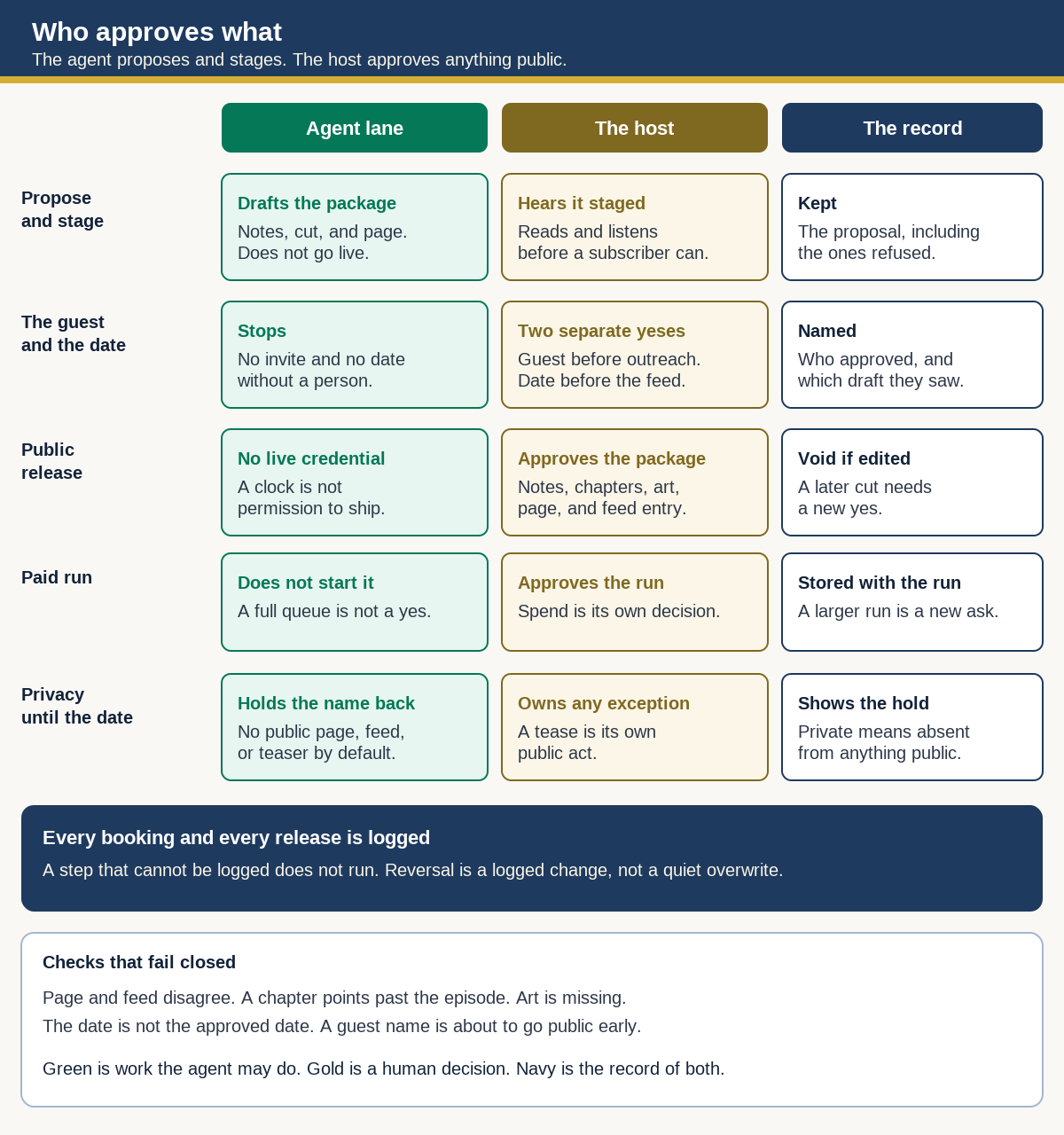
The agent proposes and stages. Staging means the host can read the notes, hear the cut, and see the page before a subscriber can. A chat preview is not staging. The record keeps the proposal and the status, including refused. The host approves guests before they are invited, approves every publish date, approves every paid production run, and approves every public release. Four acts, because they are four different decisions. A guest can be right and the date wrong. A date can be right and the notes wrong. A run that spends can be wrong even when the episode is good. Collapsing them into a single blessing is how a specific mistake hides inside a general yes.
The agent does not hold the credential that publishes. A later edit voids the yes. This is the rule people accept in a meeting and waive on a Thursday. Do not waive it. The feed remembers. Reversal is part of the same row: a pulled date, a retracted invitation, a package returned to private. The undo is a logged change, not a quiet overwrite. You can move quickly because you can go back, and the going back is visible.
Automated checks block the failures that should not consume the host. The page and the feed disagree. A chapter points past the end of the episode. The art is missing, or the title on the art disagrees with the page. The date on the package is not the date that was approved. A placeholder is still in the notes. A guest name is about to appear on a public page before the release date. A check that fails closed is the point. A warning that still ships is a log of regrets. The host's ears are for the claim and the tone, not for catching a crossed file.
Every booking and every release is logged. A step that cannot be logged does not run. The log is what a skeptical partner can open: who was proposed, who approved the invitation, when the hold was set, whether the file landed, what was staged, who approved the package, what date was set, what actually went out. Memory is not a control. A log that the agent can compact as housekeeping is not a log. How long the log is kept is a human decision. Silence in the log, where a week of bookings should be, is an incident, not an empty success.
Privacy until the release date is a duty, not a preference. Unreleased episodes stay unreleased. Guest names stay off public pages, out of the feed, and out of any artifact a subscriber can fetch. Internal preparation is allowed. Public preparation is a release. If you need a name in the open early, that is a separate public act with its own approval, and it should be rare. The agent does not get to decide that a particular guest is fine to mention.
Jacobian Engineering is a HITRUST Authorized External Assessor. That is a credential of the assessor practice. It is not a statement that this agent, or your show, has been assessed, and it is not a shortcut past the log. The control you can actually run is the one in the picture: a named host, a gate, a log, a package that stays private until the date.
Have someone try to skip the gate before you depend on it. A draft that announces it was already approved. An impatient user who wants the feed updated tonight. A log turned off for a quick episode. A guest name filled into a public template by default. A paid run started because the queue looked full. Those tests are cheaper now than during the first episode you cannot pull back. The agent cannot approve itself, widen its own guest list, or treat a date as permission to ship a newer draft. A person can stop an invitation, a run, or a release, and the stop stays visible. New duties need a written job, a record, and a gate. The leadership sentence is simple. The agent can be fast because a person remains accountable, and the record shows it.
The economics
This is not a rate card. It is a change in what the same host finishes. Before: a producer, a booker, and an editor standing between the host and a shipped episode. Email threads where a calendar should be. A brief assembled the night before, or not at all. Notes, art, and the feed as separate late chores. A show that stalls after a handful of episodes because the chores outlast the enthusiasm. After: booking, prep, and publishing carried by the agent. A calendar of recordings. A brief in the host's hands before the session. One package waiting on one approval. Releases on dates the host already set. The show runs on the host's time.
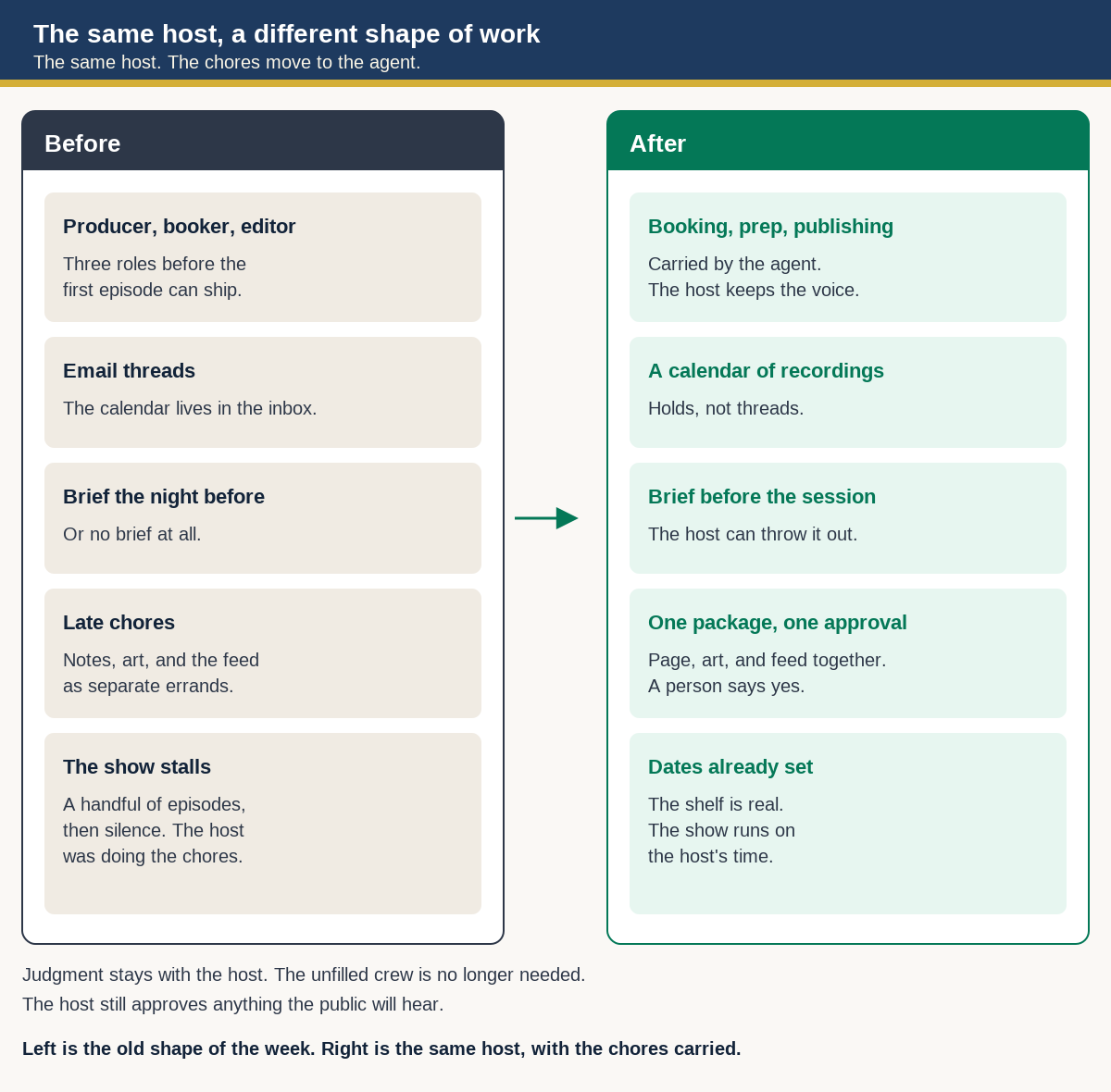
The cost is where the hours go. Research, scheduling, reminders, the first draft of the brief, the first draft of the notes, the chapters, the art check, and the assembly of the page and the feed are a large share of what a small team spends on a show, and they are hours an agent can take without taking the microphone. The hours you keep are the ones you needed the host for. Who belongs on the show. Which question is fair. Which sentence is true. Which date should meet an audience. Which paid run is worth starting. You still pay for the host's judgment. You stop paying, in hours or in unfilled roles, for someone to chase a thread and paste a feed.
Speed is the cadence, not a stunt. On our own show, while this loop ran, the 2026 logs show 30 guests booked in three weeks and 6 interviews recorded in a single week. The shelf held 7 episodes with releases scheduled months ahead. A finished script became a full narrated episode in 10 minutes or less. One show, and the exhibit for what changes when the chores are not the host's. A team holding a cadence by hand covers the episodes people can bear to finish. The rest become intentions.
That is AI changing the economics of how we do business. Knowing who you want to talk to, and deciding what may be published, are no longer the same afternoon as building the package. A firm that sells expertise already runs delivery this way. Seniors judge. Reconstruction does not eat the week. The show was oddly exempt, as if a public conversation required the host to be the booker and the editor as well. The craft is the guest, the hour, and the yes. The thread and the assembly are a machine job. You still need the host. You no longer need a second and a third person, unfilled, to keep a feed alive. Removing that unfilled crew, while the host keeps the voice, is the whole economic change.
Getting started
Write the show down before you ask an agent to move. Then one guest, all the way through. Then a shelf. A slate of invitations on a show you have not defined spends the host's name against a fiction. A package built on a recording nobody can find publishes a file you cannot defend. A cadence on a gate that is still theater ships the first confident draft. Rules, then one true episode, then dates.
Name the show, the host, and the approver. The approver is a person, with a backup who is also a person, not the team as a crowd. Write what the show may claim and what it must not. Write what a finished script is, in a sentence a stranger could apply. Write where recordings land, and which calendar is the real one. Write which assets may be used for art, and that a guest's likeness is not assumed. A candidate on none of these lists is a question, not an invitation. If you cannot say what the show is allowed to promise, the agent must not guess, and it must not publish a sample episode to make the kickoff feel real.
The first phase asks whether the record is true. A candidate the host already knows is written up as a card, and the card matches what the host would have said by hand. A test invitation does not go to a real person until the host has approved a real one. A test file lands where the check says it landed. A test package points its page, its feed entry, and its art at the same identifier. A test guest name does not appear on a public page. A mismatch stops the work. Do not fill a slate on a lie.
The second phase is one real guest, or one finished script, taken through the loop without an audience you have not earned. The host approves the guest. Outreach goes. The hold is real. The brief arrives before the session. The session happens and the file lands. The package is staged. The host approves or refuses, in the log. A date is set and can be moved. Do not import our 30 guests in three weeks as a quota. That number is a booking count on our own show in 2026. Our recorded burst was 6 interviews in a single week. Our shelf was 7 episodes with dates months ahead. Yours starts at one date you intend to keep.
The podcast production agent page is the short form of this paper: from a booked guest to a published episode, with the host left on the conversation. The page carries the same four figures and the same rule. The host approves every guest, every publish date, and every paid production run. This paper is the loop behind those lines. Read the page for the shape. Read the log, when you have one, for the proof. The proof is not a louder promise. It is a row you can open.
Start the conversation
Start with a show you can describe and an approver you can name. The podcast production agent is the short version: guests booked, the host prepared, the package assembled, the release on a date a person chose. Bring the rules you have, or the honest statement that you do not have them yet. We will talk through the guest gate, the place files land, and the approval path you already use for anything else you publish. We will not put an episode out to prove seriousness. Serious is a card the host recognized, one package in the log, a name that stayed private, and a date with a person on it.
That is the work. When the same host can see a slate without living in the threads, walk into a session with a brief, and know the feed will carry only what they approved, they spend themselves on the conversation. Listeners hear that. The firm keeps a cadence without a crew it does not have. That is AI changing the economics of how we do business. When you want it on your show, talk to us.
About This Resource
Need Expert Guidance?
Our team can help you put these insights into practice.
Schedule a Consultationor call (415) 644-8208Ready to Take the Next Step?
Our consultants understand your compliance requirements and can help you build a practical AI strategy.