
The AI Paid Marketing Agent Playbook
Executive summary
Paid media pays off when the brief, the ad, the page, and the lead are one motion. The offer stays current. The creative arrives in finished rounds. The campaign is built paused, and a person opens the spend. The first name reaches sales with the source ad attached, and the morning report is already written when the day starts.
An AI paid marketing agent runs that motion. It sets the strategy before a dollar moves. It writes the ad copy and keeps concepts in reserve, so a tired ad is replaced by the next approved line. It directs the creative through finished assets, and your team approves anything the public will see. It builds funnels and landing pages with your web team, including the thank-you step that books the sales call. It treats tracking as a launch gate: a browser conversion and a server conversion, deduplication tested, and a quiet path for the channels when a visitor declines advertising cookies. It puts the lead in the CRM, enriched, with junk filtered out, and it alerts your team at once with the source ad attached. Morning and end of day, it reports. It moderates comments. It pauses for a holiday and resumes when you say so.
That is the economics. The people you already have cover strategy, creative, tracking, and the lead path, because the drafts, the build, the match of a conversion to one record, and the first draft of the daily report happen at machine speed. People spend their time on the decisions that were always theirs: which claim may be said, which asset may run, which dollar may be spent, which lead a salesperson should call. That is AI changing the economics of how we do business. This paper is the operating picture behind the short version on the AI Paid Marketing Agent page.
The figures are from our own paid media program, October to November 2026. We wrote and tested 10+ ad copy concepts. We finished 20+ final creative assets across four directed rounds. We built 5+ audiences, from lookalikes to exclusions. A campaign was built in under 20 minutes from creative approval. The first lead arrived 2 hours after go-live. The lead path is 4,000+ lines of automation, backed by 20+ automated tests. Campaigns went live 23 days from onboarding, with zero spend until approval. Link click-through ran at 2.5%+ in the first days live. Qualified leads arrived on the first day live, and sales calls were booked the same day.
The pattern travels. A brief, a brand, Facebook and LinkedIn, the site, and the CRM feed an agent that plans, writes, directs, and builds paused. A human approval gate holds budget, creative, landing pages, and go-live. After a yes, the outputs are live campaigns, pages your web team has approved, enriched leads, alerts, and a report you can read as it stands. Channels are judged on qualified leads and booked calls. Spend waits for a person.
Why paid programs stall
A paid program used to live in the gaps between people. The brief sat in a deck. Copy sat in a document. Creative notes sat in a thread. The landing page sat in a sprint that was already full. Tracking showed up on launch morning. The lead sat in an inbox several people could see, and the source ad was a guess by the time sales had someone to call. The report, when it existed, was assembled the night before someone asked where the money went.
The brief felt like progress because a date was on the calendar and a deck existed. Then the page moved, and the ad still carried yesterday's claim. Copy either clung to one precious headline or arrived as a pile of lines, with the winner chosen by whoever spoke last in the room. The next month started from a blank page, and the brand paid for the argument again.
Creative rounds absorbed the weeks. Notes came back as a paragraph in a thread. The next cut answered a different note than the one that mattered. Covers and captions arrived the night before launch, so the frame a person actually sees was the frame reviewed last. Version names lived in filenames. The public saw the scramble.
The landing page belonged to another calendar. Ads were ready. The form asked for too little to qualify a buyer, or for so much that the serious buyer left. The thank-you step said thanks and stopped. Sales heard about the lead later, or heard about it as a name with a story attached. You had paid for a moment, and the calendar stayed empty.
Tracking, discovered at launch, taught the channel a muddy outcome. A tag spoke in some browsers and stayed silent in others. A retry counted again. The channel found more of whatever it had been shown. The team read that as the channel failing. What had failed was the goal the channel was given. Budget made the stall expensive, because the campaign went live so the calendar could say the program had started, and the corrections happened in public.
The care behind that hesitation is sound. A wrong claim, amplified, is a brand incident with an invoice attached. The answer is a person on every dollar, every public asset, and every go-live, with the preparation already finished. The agent writes the lines, directs the cuts, places the lead, and drafts the report. The person approves.
What an AI paid marketing agent is
An AI paid marketing agent assists the person who already owns the offer, the voice, and the budget. It proposes, builds behind an approval, and reports from the record. Propose means it names who the ads are for, which concepts should run, which should wait, and what a qualified lead is, with the check written before spend starts. Build behind an approval means the campaign exists paused and fully assembled, and live begins when a person says so. Report means the morning note and the end-of-day note come from the same record sales can open. Every result in the note ties back to a lead.
Every budget dollar waits for a person. Ads, covers, captions, and landing pages stay drafts until your team says yes. The agent makes the draft complete enough that the person's job is to approve or refuse. The approval is stored on its own. Saving a draft is a save. The yes is a separate act, and a later edit comes back for a new yes.
The agent is wired to the brief, to Facebook and LinkedIn, to the site, to consent, and to the CRM. Report sentences come from that record. Channels are judged on qualified leads. The agent shows the click, the lead, and the booking side by side, so a strong click has to earn its place next to a real conversation.
On a small team the drafter and the approver may be the same person. The approval is still its own stored act. A refused draft stays in the record, where the next round can see what was already settled. The jobs stay clear: strategy, ad copy, directed creative, funnels and landing pages with your web team, consent-gated tracking, lead automation into the CRM, alerts, daily reports, comment moderation, and holiday pause and resume. The agent clears the seams, so the offer you have gets a fair test while a person still holds the pen and the budget.
If you have seen an AI SEO agent keep a site findable, or a sales manager agent keep a pipeline honest, the habit will look familiar. An item is done when it agrees with the source. Here the source is the approved brief, the approved asset, the consent choice, and the CRM record. Search and paid are different jobs, and they share a standard: speed serves the approval, and the approval stays with a person. The longer account of the search side sits in the AI SEO agent whitepaper. The paid agent builds the campaign paused, proves deduplication before launch, and puts an enriched lead on the calendar with the source ad attached.
Reference architecture
Read the picture from the sources, through the agent, to the gate, and then to the live channels. The brief and the offer, the brand and the claims you will stand behind, Facebook and LinkedIn, the site and its landing pages, and the CRM hold the facts. The core plans strategy, writes copy, directs creative, builds audiences, checks tracking, and assembles a campaign in a paused state. A queue holds the proposals. A human approval gate holds budget, creative, landing pages, and go-live. Live campaigns, approved pages, enriched leads, alerts, and reports are the outputs. The gate is the stop the whole picture is built around.
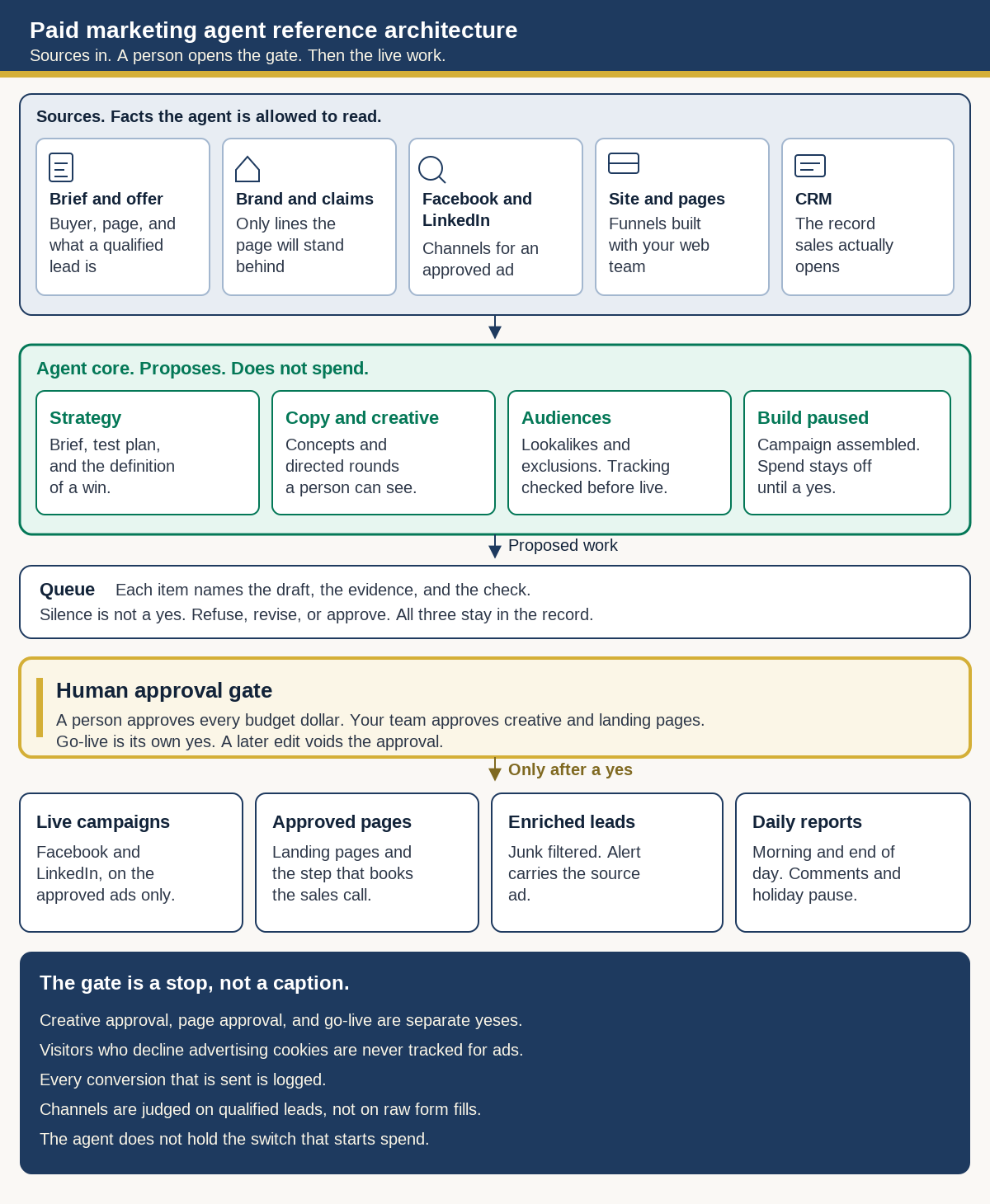
Start with the brief, because later strength is scope that was named early. Scope is the offer you are willing to make, the buyer you mean, the page they should reach, and the action that counts as a qualified lead. The agent reads the brief you named and checks each claim against the landing page that will carry it. A page named in the brief is a destination. Everything else stays written down as out of scope, before anyone assembles an audience.
Facebook and LinkedIn are where an approved ad can run. The goal that travels with the ad is the qualified lead. What moves inward is concrete state: the offer, the approved claims, the audiences, the consent choice, the conversion, the CRM record. A form that created a record shows up as a record. Sales can see that record before anyone needs a call to discover a gap.
Strategy says who the program is for. Copy and creative direction produce what a person can approve. Audiences and the tracking check decide whether a launch is ready to be asked. The build assembles the campaign and leaves it paused. The live switch stays with the approver until that campaign is accepted. Spend has one door, and a person holds the handle.
The arrow out of the core is a queue. Each item names the draft, the evidence, and the check. Refuse, revise, and approve are all recorded. A creative approval covers the asset. A landing-page approval covers the page. A person approves every budget dollar. Go-live is its own yes, on a campaign that already exists and is waiting. The report is generated from the record. The next day's spend still waits for its own yes. You can trust the picture when a draft carries the approval it received, a tracking check is visibly green or visibly red, and a refusal remains in the log.
The operating loop
The week is a loop. Set the brief and the test. Write the concepts and direct the creative. Build paused, with tracking proved. Launch after a yes. Read the leads. Report, and start the next round. Each step hands a finished object to the next.
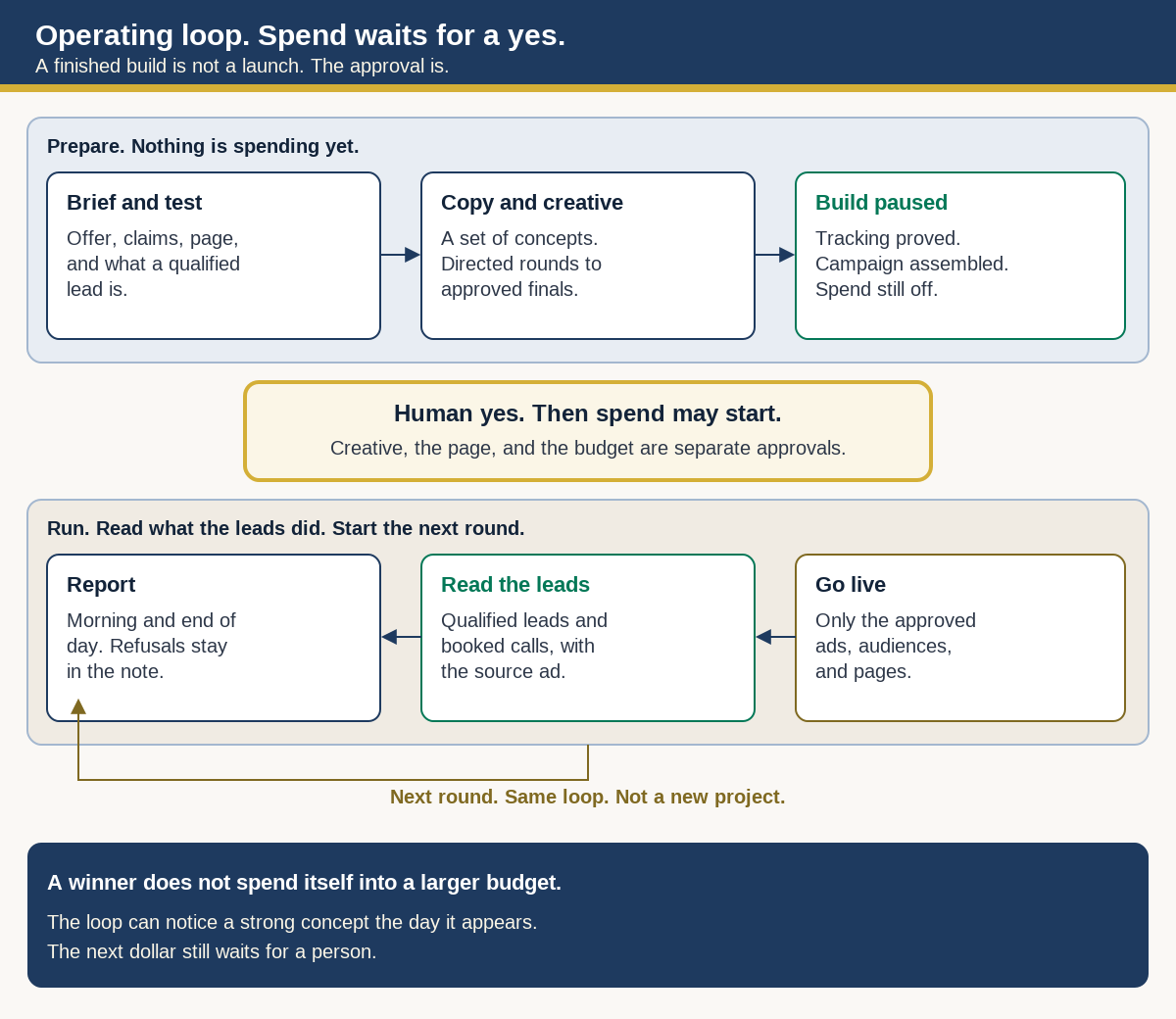
The brief is specific enough that a stranger could tell a win from a loss. Who the buyer is. Which offer. Which claims may be said. Which page. What counts as a qualified lead. Which of Facebook or LinkedIn, or both, may carry the ad. A brief that names the offer, the page, and the booking is a plan a team can run. The agent drafts it from what you already know, and a person accepts it. The accepted brief is the plan the rest of the loop follows.
Writing and directing come as sets. Concepts are written to be tested against each other. Creative moves in rounds, with a version, a note, and an approval, until the asset is final. The check is written before the round starts. The claim on the ad matches a claim on the page. The cover has been reviewed. The caption repeats the approved line.
The build waits on those approvals and on the tracking gate. On our own program, assembly took under 20 minutes, and the campaign sat paused. The approval names the exact ads, the exact audiences, and the exact pages. Edit any of them and that item returns for a fresh yes. On a small team the reader and the approver may be the same person. The act is still separate, and the log shows both the reading and the yes.
Launch is the switch. Zero spend until that switch. After it, the loop reads leads and bookings with the source ad attached, so a strong concept and a quiet concept both stay visible. The report carries the full day, including the ideas still in reserve. A concept that tires keeps its history, and the next dollar still waits for a yes. When a plan is ready, the queue offers a clear act: approve, refuse, or watch.
Strategy, copy, and directed creative
Strategy is a document with consequences. Early in a program the agent produces the brief, the setup plan, and the test plan, and it reads the pages the ads will point at. The claims on those pages are the claims the ads may make. A line the page supports gets a clear version in the ad. A channel earns a larger budget when the leads it produces are the leads you defined, and the conversation until then stays on the offer.
The test plan names which concepts launch and which sit in reserve. Reserve is a design, prepared on purpose. When a concept tires, the next one is already written, already checked against the brief, and already waiting on a yes. The week stays on the leads, because the next line was prepared while the current line was still earning its place.
Ad copy is a set of concepts, written and tested. On our own program that set was 10+ concepts. Hook-first lines earn the pause in the feed. The rest of the text has to survive a second reading on the landing page, where the buyer decides whether the hook was honest. The frame a person sees before they watch is an ad of its own, and it is reviewed as an ad. The agent proposes the working rule from what actually produced qualified leads. A person accepts the rule, and the next concepts follow it.
Directed creative is how finished assets get made. The agent directs. People make the pictures and the cuts. Each round opens with a brief a stranger could follow. The brief names the claim, the buyer, the offer, the page, the first frame, the words the cover must carry, and the caption that must repeat the approved line. It also names what the round is trying to learn: a sharper hook, a clearer offer, a cover that can stand alone in the feed. Notes come back against that brief, attached to a frame, a line, a cover, or a caption. The version has a name. The approval lands on the final of that round.
The round has a shape you can reuse. It opens with the brief, the references, and the check. The middle is the cuts, with notes on the frames rather than on a mood. It closes with the cover, the caption, and the approval stored against that version. The next round inherits the approved claim and starts from what the last round learned. People still make the pictures. The agent keeps the brief, the notes, and the version in one place, so the approved cut is the cut everyone can name.
On our own program the work finished as 20+ final creative assets across four directed rounds. Covers and captions arrived inside the rounds, as part of the asset, ready for the same yes as the cut. The next concept was drafted before the current round was exhausted, so a tired ad had a successor waiting. Your team approves the finals. The build accepts those approved assets and holds anything still in review until its own yes arrives.
Funnels are the second half of the ad. Higher-intent forms match the offer. Landing pages are directed and launched with your web team, so the sentence on the ad and the sentence on the page are the same sentence. The thank-you step books the sales call, and the qualified buyer lands on the calendar. Sales takes the conversation from there. Your team approves the page before it becomes a destination.
Audiences find the buyers you mean and keep the next dollar pointed at someone new. On our own program that was 5+ audiences, from lookalikes to exclusions. A lookalike starts from buyers you already trust, handled in a privacy-safe way. Exclusions hold current customers, recent submitters, and people already in a sales conversation.
The set stays current after launch, which is where most audience work used to stop. New customers join the exclusion. New buyers can refresh the lookalike seed. A person who booked a call leaves the prospecting set and stays in the customer set. The agent proposes each change as a named update: who joins, who leaves, which campaign will use the new set, and which approved brief the set still serves. A person approves who is in and who is out before the next dollar follows it. Lookalikes and exclusions live as that named set, reviewed on the same rhythm as the morning report, rather than as a file someone uploaded once and forgot. The pattern is a set, a round, and a yes.
From approval to a live campaign
The moment that used to take a chain of people is a path with a clock and a lock. Creative is approved. The campaign is assembled, paused. The tracking gate is green. A person gives an explicit yes. Then spend begins. On our own program the path from creative approval to a built campaign was under 20 minutes, and the path from onboarding to live campaigns was 23 days, with zero spend until approval.
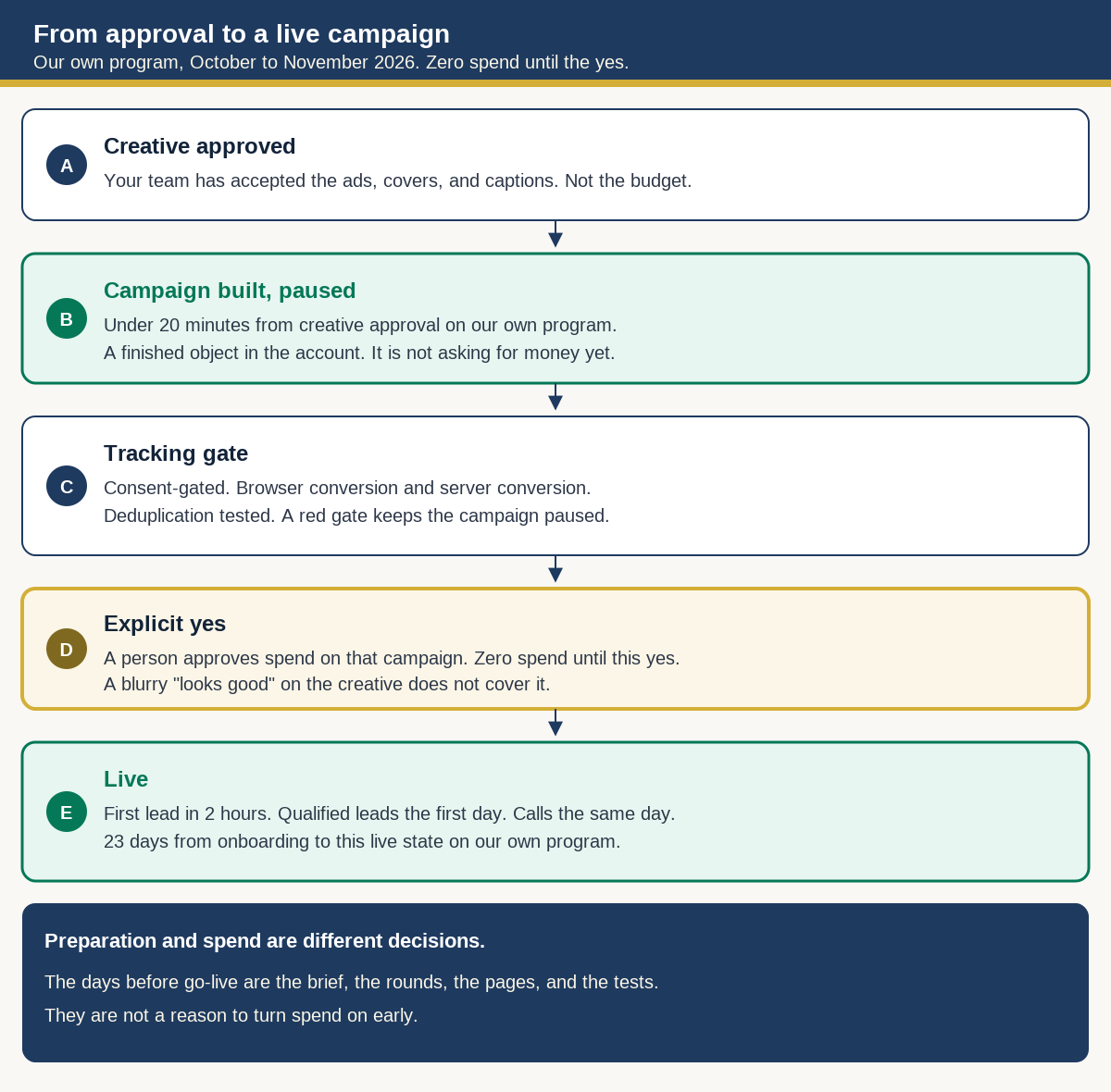
Under 20 minutes is the assembly. The concepts exist. The assets exist. The audiences exist. The pages exist. Assembly places approved pieces into a campaign that is waiting for a decision. Anyone opening the account sees a finished object. That is a different object from a draft in a document, and a different object from a live ad someone meant to finish in public.
The tracking gate sits in front of the yes on purpose. Consent-gated collection on the sites the ads point at. A browser conversion and a server conversion. Deduplication tested, so a retry remains the same buyer. When the gate is green, the yes is available. The agent keeps that order: prove the signal, then ask for spend. The order is what makes the first day teachable.
The yes names the campaign. Creative approval and landing-page approval have already happened, and each one is stored on its own row. Go-live is the decision to let dollars move. Zero spend until that decision is the rule we ran, and it is the rule the architecture enforces. On a small team the person who approved the creative may be the person who approves the spend. The second act is still stored. Each yes covers the decision it names.
Then the program is live. On our own program the first lead arrived 2 hours after go-live. The source ad is on the alert. The calendar holds the call the thank-you step booked, and sales takes it. The days in front of that moment hold the brief, the claims, the concepts, the rounds, the pages, the audiences, the tracking tests, and the approvals. Those days are preparation. Spend begins at the yes. A paused campaign with a named approver is a finished ask, and the queue stays readable because every item ends in approve, refuse, or watch.
What our own program delivered
The program is ours. The window is October to November 2026. The figures belong to the whole loop, the brief through the daily report. They are what the work produced when a person stayed on the gate and spend stayed at zero until that person said yes.
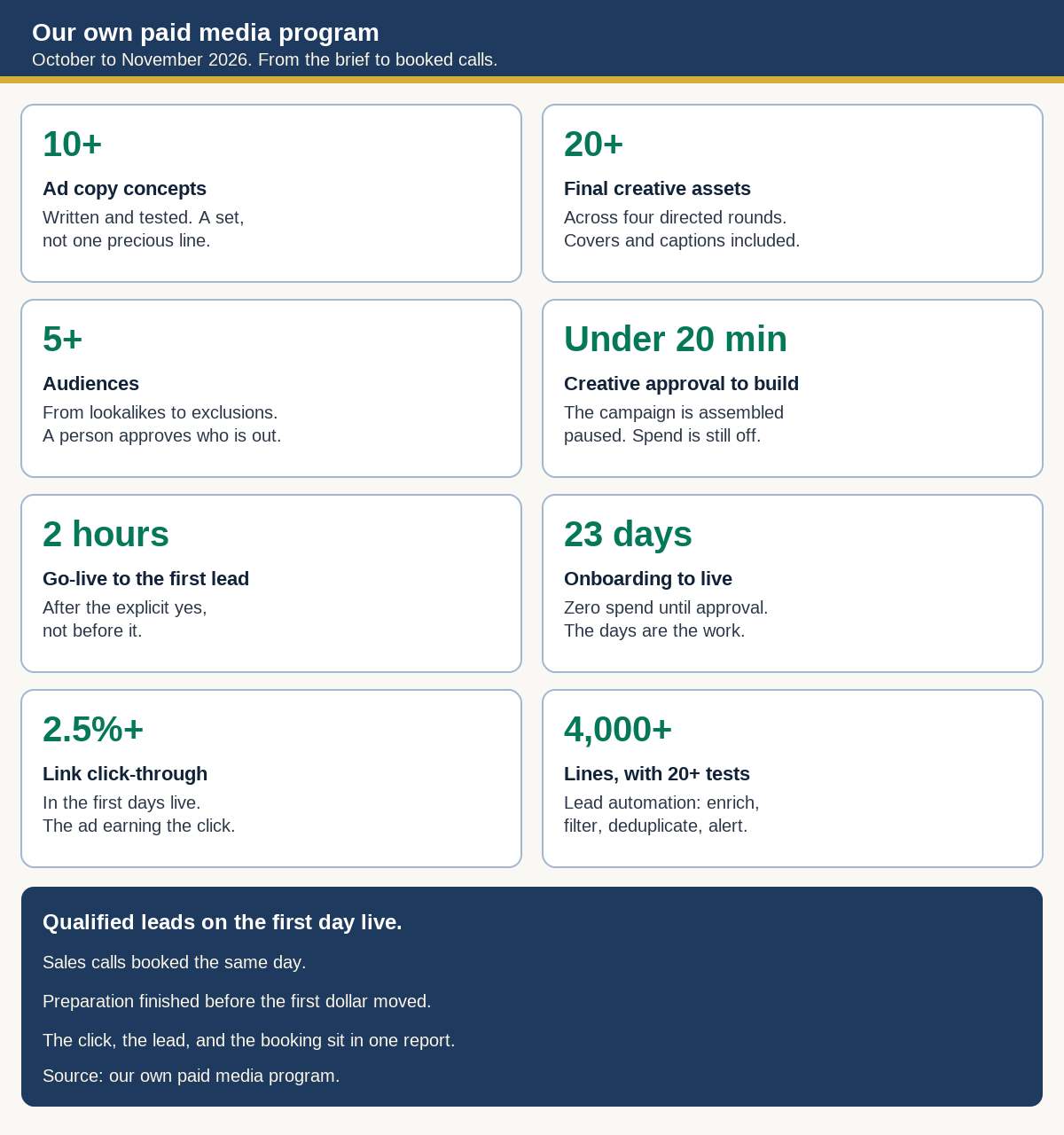
We wrote and tested 10+ ad copy concepts, so the program had a real set in market. We finished 20+ final creative assets across four directed rounds, so the channels had cuts, covers, and captions. We built 5+ audiences, from lookalikes to exclusions, so spend reached people who looked like buyers and stayed inside the audiences you approved.
Speed sits beside those counts. Under 20 minutes from creative approval to a built campaign is the assembly, paused. 2 hours from go-live to the first lead is the path after the yes. 23 days from onboarding to live campaigns is the front of the program, with zero spend until approval. Preparation and spend stayed in that order the whole way.
The market answered in the same window. Link click-through ran at 2.5%+ in the first days live. That is the ad earning the click. Qualified leads arrived on the first day live. Sales calls were booked the same day. The click-through and the calendar sit in the same report, so the click and the call are both part of the story you steer by. We had both.
Under the lead, 4,000+ lines of lead-automation code, backed by 20+ automated tests, keep enrichment, junk filtering, deduplication, and the alert steady. Steady is the goal. Taken together, the figures are one motion: preparation finished before spend, a fast build because the decisions were already made, and a first day that put a conversation on the calendar. The AI Paid Marketing Agent page is the short form of that picture.
How a lead moves
A campaign that launches cleanly, on a path that keeps the person, is the point of the build. The path is a visitor, a consent choice, a click or a submit, a browser conversion and a server conversion when consent allows, a deduplicated and enriched CRM record, junk removed, an instant alert with the source ad, and a sales call on the calendar. Deduplication keeps one person as one record. Consent decides whether the advertising signal leaves. Enrichment hands sales a record they can use on the same call the thank-you step just booked.
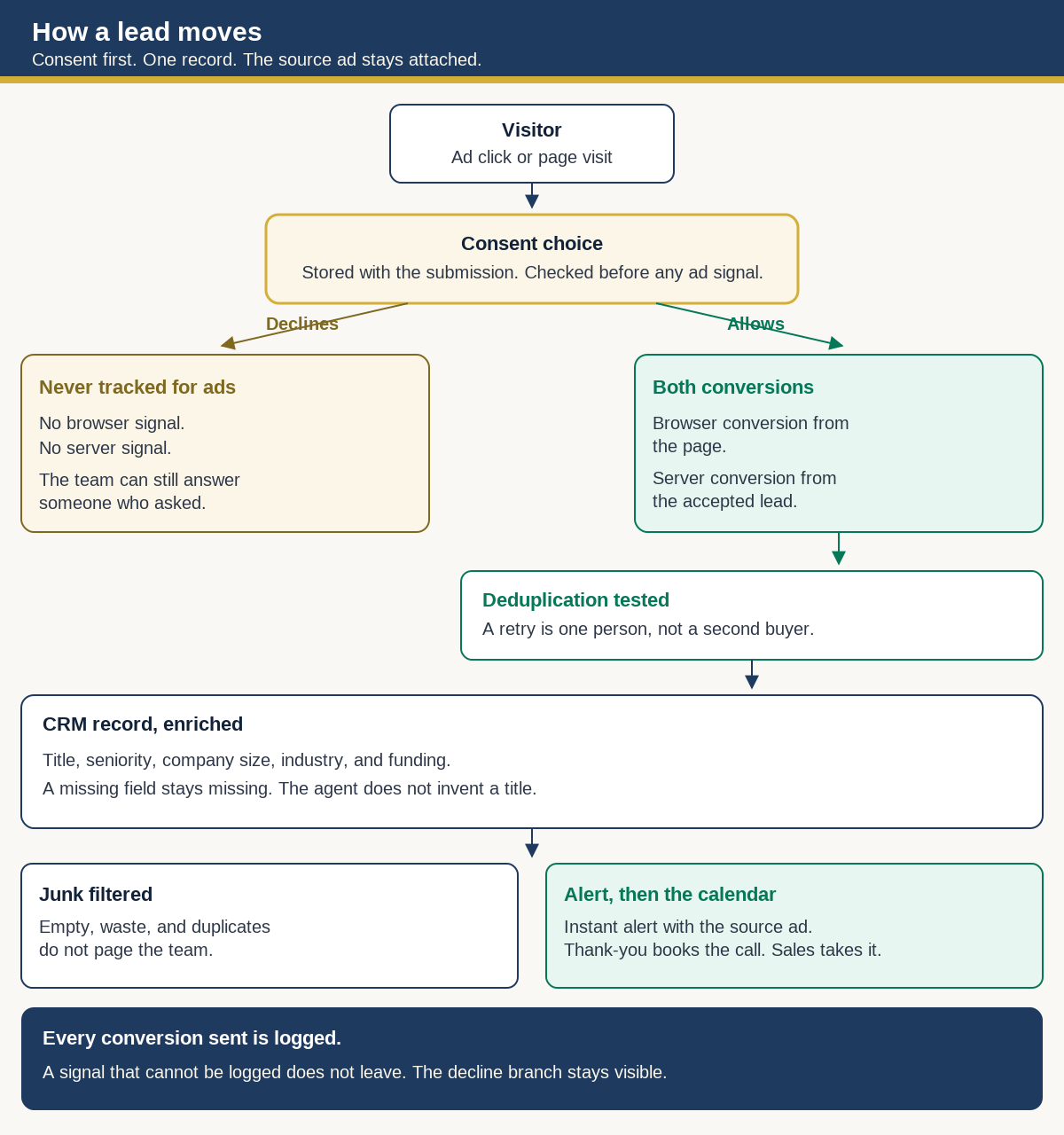
A lead starts at the action you defined, the form or the booking. The impression stays an impression. A quiet stretch is information: the concept, the page, or the offer is ready for a person to read, and the definition of a lead stays the one you approved. Consent is stored with the submission and checked before any advertising signal goes out.
The choice splits the path, and both branches are useful. A visitor who declines advertising cookies is never tracked for ads. The lead can still be stored, so your team can answer someone who asked to be contacted. The channels stay quiet on that branch, and the log shows which branch ran. Where the choice allows the signal, the browser conversion and the server conversion both fire. The browser conversion describes the visit in which the page could speak. The server conversion describes the lead you actually accepted.
The advertising signal leaves after a recorded choice to allow it. The banner asks. The visitor decides. An allow sends both conversions. A decline keeps the lead available to your team and leaves the ad channels quiet. That is the launch gate working in ordinary traffic, the same gate that had to be green before the first dollar moved.
Deduplication is tested before launch. A refresh or a retry becomes one record and one signal. The collapsed copies stay in the log, so the match is visible to anyone who opens the lead later. When the browser path and the server path disagree, the disagreement is a finding the team can read, and the record you accepted is the one that stands. Enrichment makes that record usable the moment it arrives: title, seniority, company size, industry, and funding. A salesperson can tell a buyer from a mismatch before the call. A field that arrived empty stays empty, and the blank is what the salesperson sees.
Junk is filtered before the alert becomes noise. An empty email, a pattern you have marked as waste, a duplicate of a lead already being worked: those stay in the log and off the page. The real lead gets the alert, and the alert names the source ad. That is the difference between a form fill and a concept that produced a person.
4,000+ lines hold the consent branch, the server conversion, the deduplication, the enrichment, the junk filter, and the alert. 20+ automated tests hold the cases a later change still has to pass. Follow-up stays with your team. The thank-you step books the call, and a person in sales takes it. The sales manager agent is the natural next reader of that handoff. Every real lead is counted once, with consent still attached and the source ad still attached.
The day after launch
Launch is a moment. The program is the days after it. Each morning the agent reports. At the end of the day it reports again, because a day of delivery changes what you believe about the set. Both notes are generated from the same record sales can open.
The morning report has a fixed shape, so a reader knows where to look before the coffee is finished. It opens with program status: which campaigns are live, which are paused for a reason you approved, and which proposals are waiting on a yes. It then splits by campaign and by ad. For each ad it names the leads and the bookings since the last note, with the source ad attached, and it names the concepts still sitting in reserve. The decline branch is listed beside the allows, so consent stays visible next to performance. The note closes with the asks. A creative ready for approval. An audience update. A budget move from a quiet concept toward a strong one. Each ask names the object and waits.
The end-of-day report uses that same shape and reads the day that actually ran. It marks which ads earned calls, which ads earned attention that has yet to become a conversation, and which comments were escalated to a person. It proposes the moves for the next morning: retire a concept with a reason, promote a reserve line that already matches the brief, refresh an exclusion with the customers who arrived today. The proposals sit in the queue. Tomorrow's spend still belongs to the approver. A quiet ad stays in the note. The full day is the day you steer, and the note is how the full day reaches you while the details are still fresh.
Reading the pair is a short habit. The morning note tells you what is already true and what is waiting. The end-of-day note tells you what the delivery changed and what the agent recommends next. You approve, refuse, or watch. The agent carries the decision into the next build. Over a week, the two notes become the memory of the program: which claim earned the call, which audience stayed sharp, which creative round is next. The meeting that used to reconstruct the week from exports now starts from a record that was written as the day happened.
Comment moderation runs against rules you set before the first ad is public. The list is short, and the approver owns it. The outcomes are answer, hide, and escalate. An answer uses claims already on the approved page, in the voice the brief named, so a reply in the feed matches the page the click will reach. Hiding covers abuse and the spam patterns the team has already marked. Escalation covers a comment that asks for a promise, a price, or a claim past the approved page, and a person writes that reply. The agent applies the list as comments arrive. The offer stays the offer you approved.
When a new pattern shows up, the agent proposes one new rule: the pattern, the outcome, and a sample of the comments it would have caught yesterday. A person approves the rule before it is live. Junk-lead rules sharpen the same way. A real submit teaches the filter what waste looks like now, the agent proposes the tighter rule, and the alert changes only after the yes. The comment list and the junk list live next to the brief, so the public voice and the lead definition move together.
Holiday pause and resume follows the calendar your business already keeps. You name the window. The agent pauses when that window opens and resumes when you open the door again. The campaigns and the approved ads remain in place, ready. Spend rests with the window and starts again on a yes, so a week when your team is away stays a week when the phone can rest too. A concept that earned the call becomes a pattern for the reserve. A concept that stayed quiet is retired with a reason, and that reason is the first line of the next brief.
Governance and human oversight
Speed has a table of duties. Who proposes, who approves, what the gate holds, and where the proof lives. The table is why the program can move quickly. Every fast step has a named owner, and the owner of the dollar is a person.
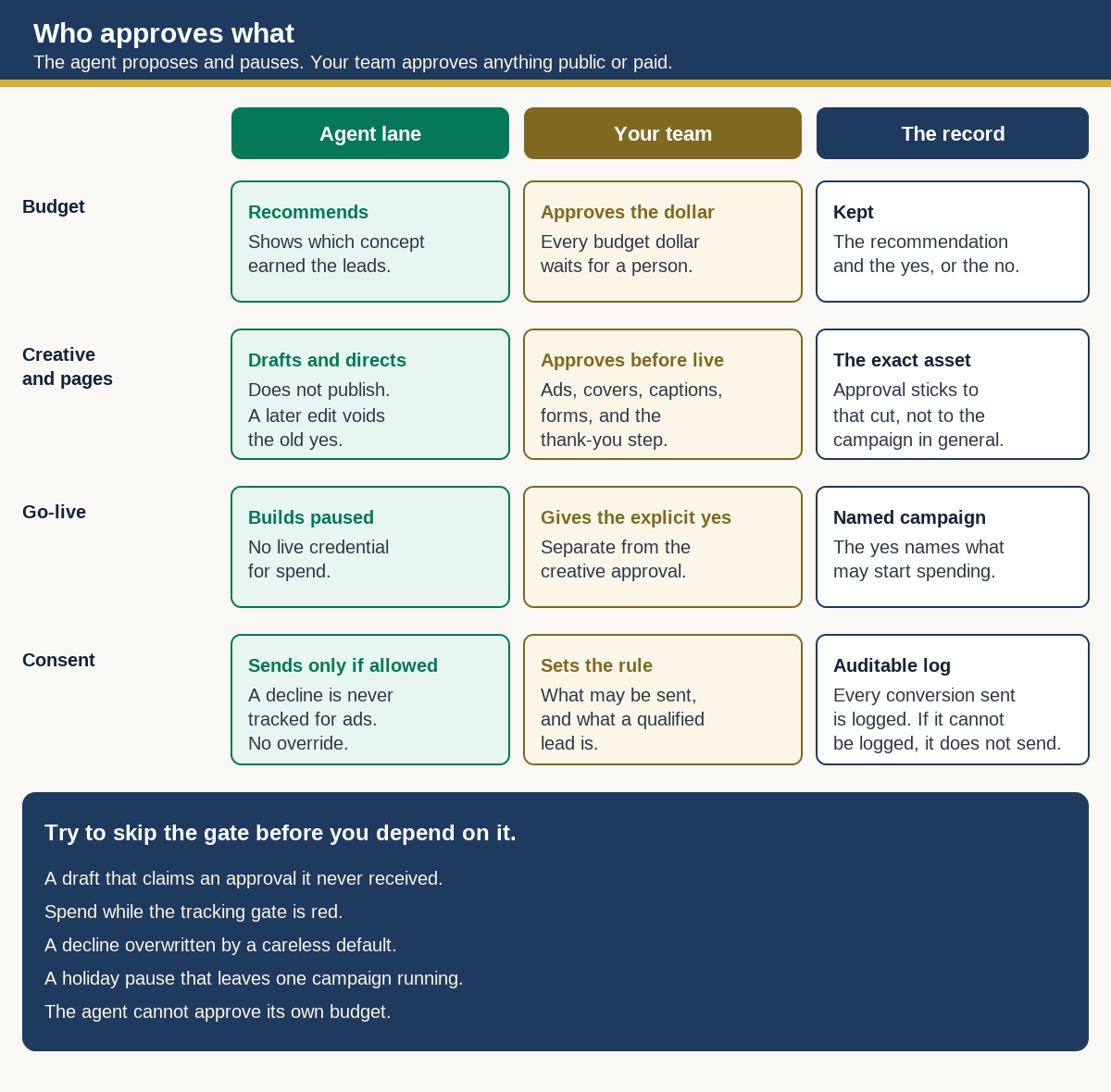
The agent proposes and assembles. It writes the brief, the concepts, the direction, the audience plan, and the paused campaign. A person holds the switch that starts spend. The record keeps the proposal and the status, including what was refused, so the gate is still visible after the decision. A refusal is a finished run. It means the program kept its standard and moved on to the next approved idea.
Your team approves landing pages and creative before anything goes live: the ad, the cover, the caption, the form, and the thank-you step. Approving a pattern lets a round move. A later edit comes back for a new yes, stored against the new version. A person approves every budget dollar. The agent recommends a shift from a quiet concept to a strong one, and the shift happens when that person accepts it. On our own program that approval was the front of the work: zero spend until the yes, and live campaigns 23 days from onboarding.
Consent is a strength of the launch, built in before the first ad runs. Visitors who decline advertising cookies are never tracked for ads. Every conversion that is sent is logged and auditable, and the log is written as the signal goes. A pause, a creative pulled from rotation, and an audience tightened are logged changes your team can open later and read in order.
Jacobian Engineering is a HITRUST Authorized External Assessor, and that governance discipline is the standard behind this work. A named person approves every dollar. A visitor's decline keeps the ad channels quiet. Every conversion that leaves is in the log, where your team can read it.
Walk the gate before you depend on it, the way you would walk a lock. The draft you open carries the approval it received. Spend begins with tracking green and a named yes on the campaign. The consent choice in the log is the choice the visitor made. A holiday pause covers the campaigns in the window you named. A person can stop a campaign, and the stop stays visible beside the original yes. The agent moves quickly because a person remains accountable for the dollar, the lead, and the record.
The economics
The change is what the same team finishes in a week. Before, the work moved through an agency, a developer, and a chain of handoffs. Spend started while approvals were still open. Leads thinned out between the form and the CRM. Follow-up waited on an inbox. The report was assembled by hand the night before the meeting. After, one agent carries the brief through the day. Campaigns are built paused and launched on a yes. Zero spend until approval. Consent-gated tracking, with deduplication tested. Every lead enriched, and alerted with the source ad. Morning and end-of-day reports are waiting when you sit down. Attention stays on the offer, the asset, and the lead.
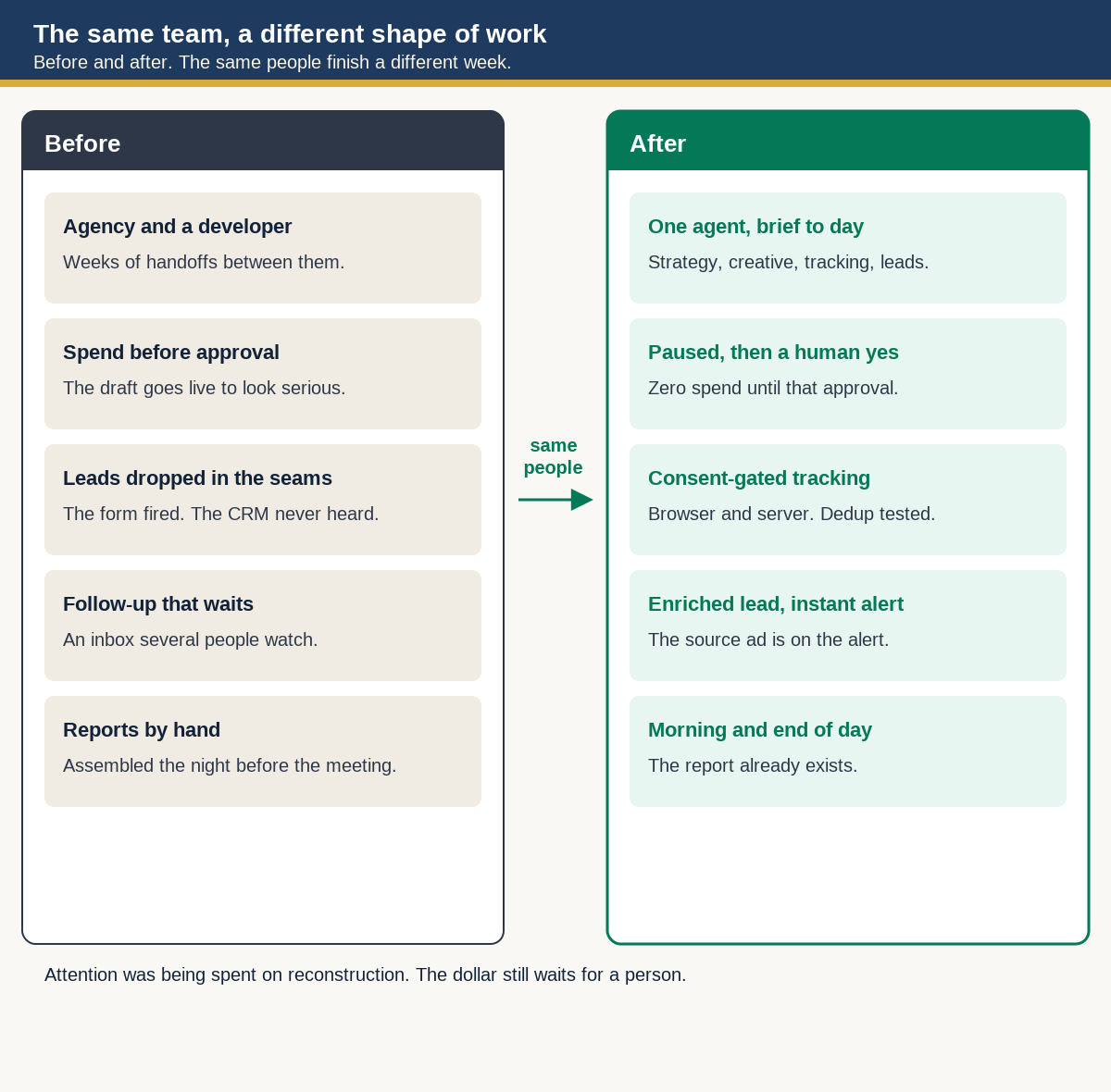
The agent takes the briefs, the rounds of notes, the tag checks, the audience updates, and the first draft of the report. You keep the claim, the asset, the next dollar, and the real lead. The pace on our own program shows the shape of that trade. Under 20 minutes from creative approval to a built campaign. 2 hours from go-live to the first lead. 23 days from onboarding to live campaigns, with zero spend until approval. A small team holds that pace because the preparation is on the calendar and the spend stays locked until the yes.
That is AI changing the economics of how we do business. Knowing the offer and deciding what may be spent are separate acts, and both of them happen while the work is still fresh. The craft is the offer, the sentence, and the decision. The reconciliation is a machine job. You keep the approver, and you keep sales. The cut, the lead, and the signal move as one path. Every part of the budget earns its place in the open. A concept earns it with qualified leads and booked calls. Facebook or LinkedIn earns it on the same rule. A person decides what that earning is worth, and the dollar moves on that decision.
Getting started
The brief and the gate come first, and scale follows the gate. You trust the lead definition because you wrote it. The claim on the ad is a claim the page already makes. Tracking is green before go-live. Copy and budget move once those three are steady. Steady is what readiness feels like.
Your team provides the offer, the claims you will stand behind, and a named approver. You name Facebook, LinkedIn, or both, and the program runs on that named list. You define a qualified lead: the form, the booking, the consent choice, and the CRM fields you want, among them title, seniority, company size, industry, and funding. You provide a CRM sales will open, and a path for landing pages your web team approves alongside the agent. You name who approves creative and who approves every budget dollar. Those names are the operating system. Everything else is preparation for their yes.
A test submit creates one CRM record, collapses a retry, stores the consent choice, and sends an advertising signal when the choice allows it. A declined choice stays in the log, with the channels quiet. You can open the paused campaign and see it waiting, spend still at zero. The concepts, the directed assets, and the audiences from lookalikes through exclusions are the set behind that campaign. On our own program the build after creative approval took under 20 minutes, and live campaigns arrived 23 days from onboarding, inside October to November 2026, with zero spend until the yes.
The standard after that yes is the one we ran. A first lead while the day was still young. Qualified leads on the calendar. Sales calls booked the day the program went live. Morning and end-of-day reports in the shape above. Comment moderation under rules you approved before the first public reply. A holiday pause that covers the window you named. The AI SEO agent keeps the destination page findable, and paid sends people to the page your team approved. Start with one offer the owner can say out loud. You should be able to tell a skeptical partner, from memory, that a test lead landed once, that a declined choice stayed quiet, and that a named person is the one who starts spend.
Start the conversation
Start with an offer you can say out loud and a gate you will use. The AI Paid Marketing Agent page is the short form: strategy, creative, and qualified leads on your calendar, with every dollar approved by a person. This paper is the long form. The loop, the gate, and the results from our own program.
Bring the offer. We will walk through Facebook and LinkedIn, the lead definition, the landing pages, and the approval path you already have. What you see first is a paused campaign, an enriched lead with the source ad attached, and a name on the creative. Spend starts when you say so.
That is the work. The same team sees the program every morning, watches a qualified lead reach the calendar with the source ad attached, and walks into a budget conversation with a conversion that matches a record. They spend themselves on judgment. That is AI changing the economics of how we do business. When you want it on your channels, talk to us.
About This Resource
Need Expert Guidance?
Our team can help you put these insights into practice.
Schedule a Consultationor call (415) 644-8208Ready to Take the Next Step?
Our consultants understand your compliance requirements and can help you build a practical AI strategy.