
The AI Accounting Agent Playbook
Executive summary
The month-end close stalls for a boring reason. Activity arrives all month, and the people who can decide are busy reconstructing it in a pile at the end. Uncategorized lines sit until someone has a long sitting. A deposit is applied to the wrong invoice, or applied twice, or left open because the amount did not look exact. Recurring invoices are rebuilt from last month's file when someone remembers. The statement is tied out under a deadline, and the numbers the business runs on are weeks behind the work that created them. Headcount does not arrive. The crunch does.
An AI bookkeeping agent changes that shape of work. It categorizes bank and card activity as it lands. It matches each deposit to the invoice it pays, with no partial application and no second application. It reconciles statements to the penny before anyone calls the books closed. It prepares recurring invoices every month, trued up for usage, and queues them for a person to send. Ambiguous lines wait in an exception queue. The agent does not guess a category it cannot support. A person approves anything that moves money or files with an authority. The agent proposes, posts what a stored ruling already supports, and leaves the rest visible.
That is the economics. A small finance team covers the books it actually has, because categorization, matching, the tie-out, and the first draft of the invoice happen at machine speed. People spend their time on the calls that were always theirs: which ruling is right, which invoice may go out, which payment may leave, which filing a person will sign. That is AI changing the economics of how we do business. This paper is the operating picture behind the short version on the AI bookkeeping agent page.
The figures come from the agent's own run logs on our books, 2024 through November 2026, rounded. 400 deposits were matched to invoices, with zero partial or double applications. 1,600+ card charges were booked in a single catch-up session. 99% of uncategorized bank lines were cleared in one session, from about 300 down to 2. 100% of recurring invoices were prepared every month, hands-off since September. They show the loop can close on a real set of books. They are not a forecast for yours.
The pattern travels: bank and card activity, invoices, receipts, and the rulings you have already made, feeding an agent that categorizes, matches, reconciles, and prepares, then an exception queue, a human approval gate, and an audit trail. The agent reads activity as it arrives. It does not wait for the month to end to discover the month.
Why the month-end close stalls
The close feels responsible. A date is on the calendar, someone produces a package, and leadership can say the books were looked at. Then the package ages in the other direction. The work of the month happened in the days before that date, and the package is the first time anyone lined the activity up. By the time the package is trusted, the business has already made the next set of decisions on older numbers. The gap is not laziness. A project cadence cannot describe activity that arrives every day.
The uncategorized list makes the gap look like a system. Each row is a line the feed delivered and nobody named. The owner column stays blank, or it names the bookkeeper rather than a person who can rule. Status sits open for the life of the sheet. The sheet is copied forward. Nothing in it re-reads the line against a prior ruling. A row can say done because someone believes a category was typed. The line is still sitting in the clearing account. The statement still does not tie.
Chasing the line is where the weeks go. A charge is assigned. It waits on a person who is already full of something louder, usually a customer question or a payroll morning. The row closes because the sitting ended, or the assignee changed roles, or someone marked it done without opening the statement. The next close finds the same merchant in the same unnamed pile. The firm has paid for the finding twice, and the books were late the whole time. The stall is not a missing list. Nothing in the list is tied to a fresh read.
Matching stalls next door. Cash arrives. The open invoices are in another view. A person applies the deposit to the invoice that looks close, or splits it because the amounts are not identical, or applies it twice because yesterday's sitting and today's sitting did not share a record. The customer shows a credit they do not understand. Sales says the invoice was paid. The books say it is open, or say it was paid twice. The argument is the system. Guesswork is what remains when the deposit and the invoice do not share a check that a stranger could apply.
Invoices disappear into memory. The recurring ones are "the same as last month," until usage changed, a customer paused, or a price was agreed and never written into the draft. Someone builds them the night before they should have gone out. A few go late. A few go wrong. The cash that should have funded the month arrives in the following one. You cannot manage a receivable you never prepared, and you cannot manage a draft that a person has not seen.
Some teams refuse to automate because they have seen a wrong category post, or a payment leave, or an invoice go to a customer with the wrong amount. That fear is correct. An unattended movement of money is not a nuisance. It is a cash event, and a filing with an authority is not a draft you can shrug back. The mistake is treating "a person must approve" as "a person must also collect, compare, copy, and key." The person is scarce. The collection is not.
Founders meet this as a hiring argument. The board asks why the numbers are late. Cash and the books disagree, and invoices go out when someone remembers. A hire is proposed. The hire inherits the same pile and the same month-end project. The economics do not move, because the shape of the work does not move. A retainer moves the reconstruction onto someone else's calendar and then waits on a file. A running record does not ask the partner to become a keyer. It asks the partner to stay the approver.
What an AI bookkeeping agent is (and is not)
An AI bookkeeping agent assists the person who already owns the books, the invoices, and the decision to pay or to file. It is not a replacement, and it is not a close you buy and forget. It proposes, posts behind the rules you already set, and queues the rest. Propose means it says what it read, which category or invoice it suggests, and which evidence it used. Post means a supported category or a full match lands in the books, where a later reader can see why. Queue means an ambiguous line, an unequal amount, or a difference that does not tie stays visible until a person rules. A posting that cannot be explained is a hope.
It does not move money. It does not file with an authority. It does not send an invoice. Those stay with a named person, on the exact item, and the approval is stored. The agent can make the draft so complete that the person's job is to approve or refuse. It cannot skip that step because the draft looks obvious. A wrong category on one line is a nuisance. The same wrong category across a merchant is a month of cleanup, and a payment that left because a draft was treated as a yes is not cleanup. It is cash.
It is not a chatbot with an export pasted in. That produces a plausible paragraph and no custody. The next person cannot see which lines were omitted or whether the paragraph was edited later. The agent in this paper is wired to the activity, to the invoices, to the receipts, and to the rulings you have stored. Report sentences come from the record, not from a prompt typed the night before the meeting.
It is not a score you pursue. Two lines from the same merchant are different problems if one matches a prior ruling and the other has a memo that contradicts it. Lines that share a payee are one ruling, not a stack of emergencies. The agent groups and explains. People rank, in words: is the category supported, does the amount agree, has this cash already been applied, will a customer see an invoice. The agent does not invent a numeric priority and call it the decision.
The jobs stay narrow, because a general instruction to "handle the books" expands until it touches a payment or a filing someone thought was out of scope. The scope is categorization, deposit-to-invoice matching, reconciliation, recurring invoices, the exception queue, and the audit trail. Paying a vendor, sending an invoice, and filing with an authority are not smuggled in because the agent was already in the books.
If you have seen a sales manager agent keep a pipeline honest, the habit will look familiar. An item is done when it agrees with the source, not when the board looks finished. A deposit's source is the cash received and the invoice that asked for it. A wrong application is worse than a wrong forecast column, so the gate in front of money is harder. The invoice the books must match often began as a sale that team already recorded. Two stories about the same customer is how the close becomes an argument.
There is a version of this category that is a dashboard beside a chat box. You upload an export and receive confident prose about the month. That is a writing aid. It does not re-read the activity on the next run, block a partial application, or tie a statement to the penny. If a demo centers on the paragraph, ask for the queue, the gate, and the re-check. Missing those, you are buying a narrator for the stall. Narration is cheap. A closed loop is what changes the month.
Reference architecture
Read the picture from the sources, through the agent, to the gate, and only then to the books. Bank and card activity, invoices, receipts and statements, and prior rulings hold the facts. The core categorizes, matches, reconciles, and prepares invoices. An exception queue holds what is not yet a posting. A human approval gate stops anything that moves money or files with an authority, and stops the send on every invoice. The books, the queued invoices, and the audit trail are the path after a supported posting or a yes. The gate is a stop, not a caption.
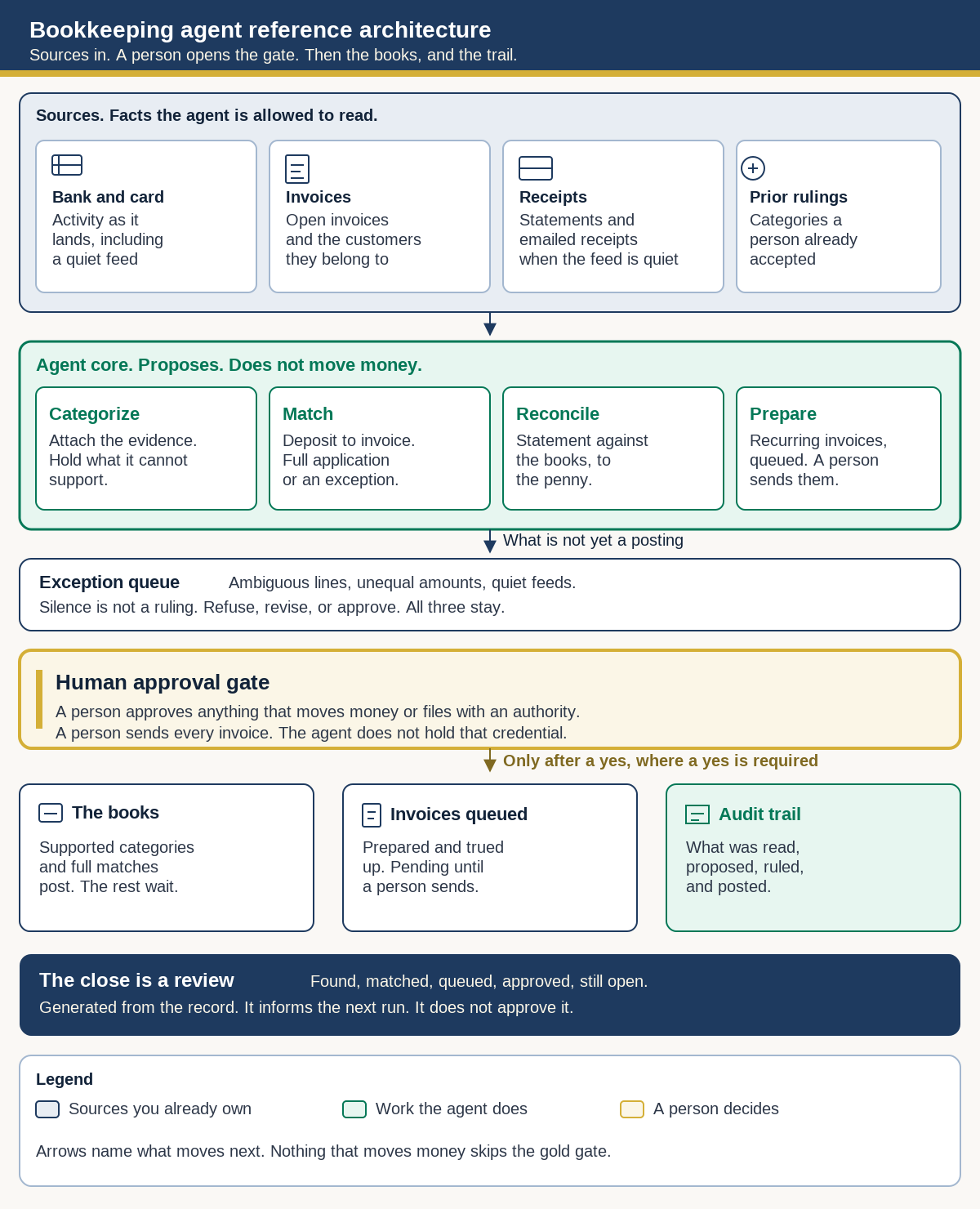
Start with the activity you named, because later mistakes are scope mistakes. Scope is the accounts a person can open, the cards the firm uses, and the easy-to-forget stream: a dormant account, a card a founder still carries, a customer who pays by a mailed check. The agent does not discover your company. It reads the activity you named and flags a named stream that stops arriving. A stream never named is not healthy. It is out of scope, and that should be written down.
Four feeds stay separate on purpose. Bank and card activity says what moved. Invoices say what was asked of a customer and what is still open. Receipts and statements say what a person or a merchant asserted, including the statement you will tie. Prior rulings say which categories a person has already accepted for a payee, and which lines were refused. Mix the four and you hide the useful discrepancy: activity shows cash the invoices never asked for, or a statement lists a charge the books never categorized. Pulls run as the activity arrives. A failed pull is a signal. Silence is not health.
The four duties fail differently, so they are four boxes. Categorize says where a line belongs, with evidence, or says it does not know. Match says which invoice a deposit pays, in full, or says the amounts do not agree. Reconcile says whether the statement and the books are the same to the penny, and names the difference if they are not. Prepare writes the recurring invoice and the usage true-up, and leaves it pending. Preparing must not quietly become sending.
The arrow out of the core is a queue, not a payment. Do not blur that once recommendations look good. If the agent holds a credential that can pay or file without a person, the gate is a policy sentence, and sentences do not stop a model. The payment credential and the filing credential stay absent. Each queue item names the line or the invoice, the reason, the draft, and the check that would make it done. Items do not age into a yes. Silence is not approval. Refuse, revise, and approve are all recorded.
The record tells the owner what was found, posted, queued, approved, and still open. It is generated from the run. It does not approve the next run. You can adopt the picture without replacing the books your team already keeps, as long as the activity is readable on a schedule, invoices can be drafted into a pending state, and a person can see the queue. Test it by trying to break the gate. Can a memo claim a line was already approved? Can a failed feed look like a healthy empty month? Can a refusal vanish from the log?
The same shape appears in growth work, for different jobs. The AI SEO agent whitepaper walks a site, a change queue, and a person who decides before anything public ships. A category is not a title tag. What they share is the refusal to let speed become authority. If a design cannot be told in one sentence — facts in, queue, a person opens the gate for money and filings, then the trail — it is hiding a shortcut, and the shortcut is the gate.
The operating loop
The picture of parts is not the month. The month is a loop. Pull activity. Categorize. Match deposits. Reconcile. Queue what is not supported. Wait where a person must approve. Log the run. Repeat. Skip a step and you have the month-end package again, written faster.
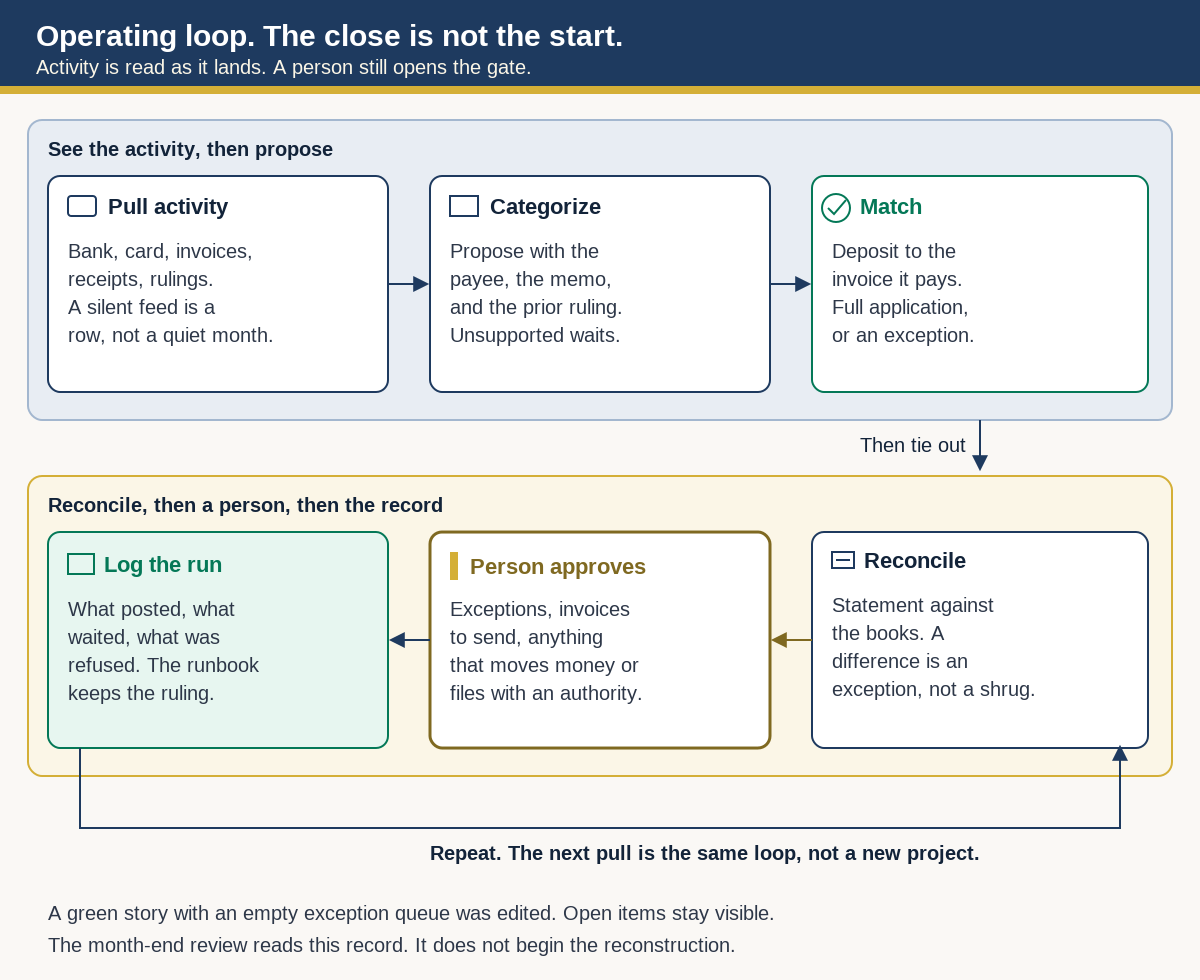
The pull happens as activity arrives: bank lines, card charges, open invoices, receipts, statements, and the rulings already stored. A silent source is listed, not omitted. Omission is how a broken feed survives every close. The pull does not rule yet. Ruling early teaches the system to trust whichever source answered first, which is how a dead feed becomes "a quiet month" and the statement later arrives full of lines nobody categorized.
Categorizing should look boring. The payee against prior rulings. The memo against the category those rulings used. A receipt against the charge it claims to support. An unsupported line is not a vibe and it is not a guess. It is a line with no ruling that covers it, or a memo that contradicts the ruling. The agent proposes the group and shows the members. A person can split it. Splitting is cheap now and expensive after the group has posted.
Reconciliation is a second read, not a fresh story. A cheerful note that the month looks fine is not the check. The statement and the books either agree to the penny or they do not. A difference stays open with a name. Calling the difference a plug so the package can ship is the failure mode the loop exists to stop. Open is allowed. Calling open done is not.
Where a person must act, the loop waits. The approval names the exact line, the exact invoice, or the exact filing. Edit the draft and the approval is void. The agent does not get a softer rule because it types faster. On a small team the reader and the approver may be the same person. The act is still separate, and the log shows it. Sending an invoice is one of those acts. Moving money is another. Filing with an authority is another. They are not implied by a category that posted yesterday.
Categorization and the exception queue
Categorization is usually a memory and a hurry. The useful version is a line with evidence, a proposed category, a check, and a place for the lines that fail the check. The agent reconstructs. Your team decides what the unsupported lines mean.
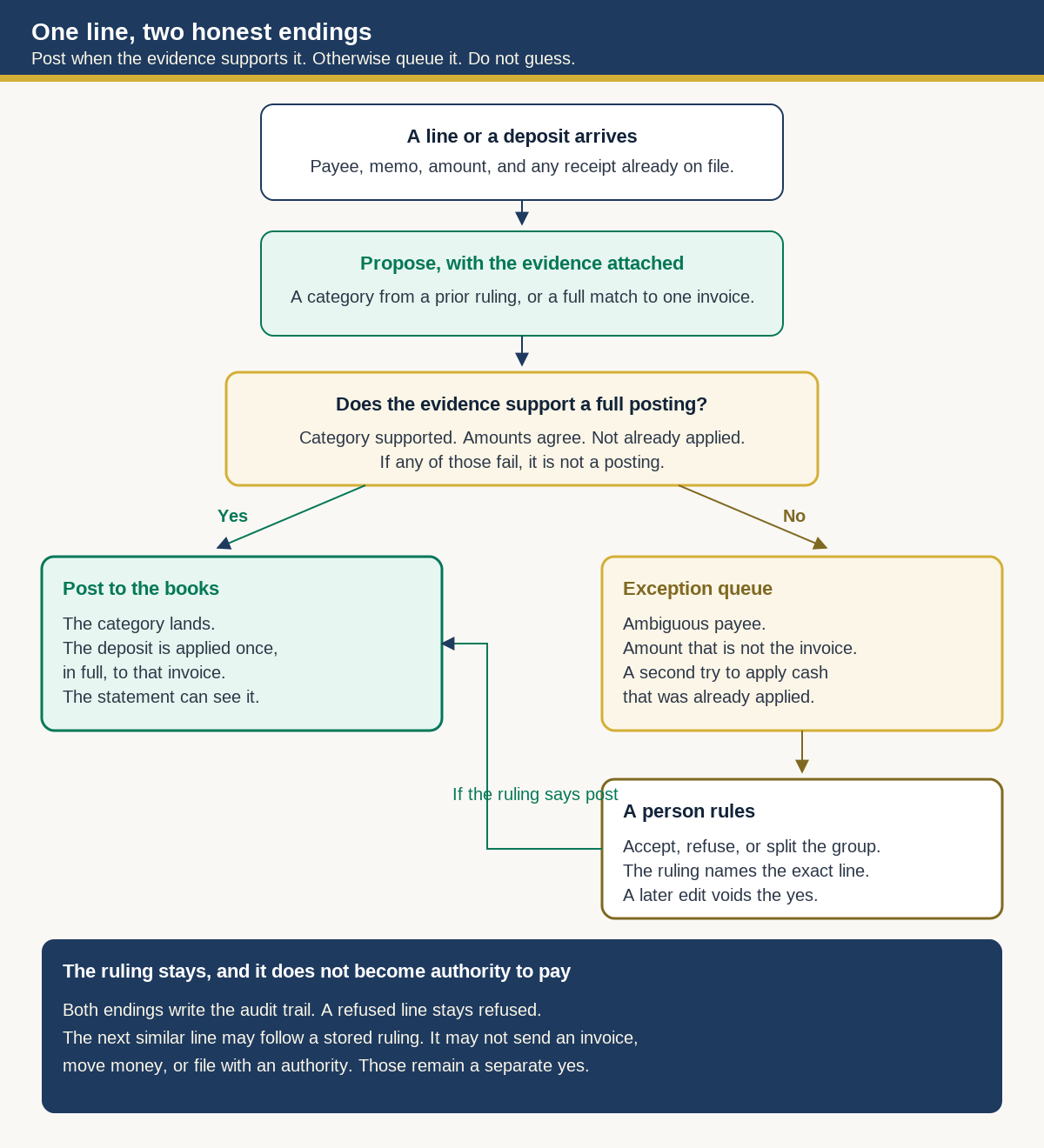
A line is a specific fact. The payee. The memo, if there is one. The amount. The date it posted. The account it landed in before anyone ruled. A receipt, if one was swept. A prior ruling for that payee, if one exists, including a refusal. Evidence is attached, or the queue fills with rumors. The record keeps which condition fired. A false alarm can be refused, and the refusal stays. That is a successful run.
The proposal is not a guess dressed as confidence. If a prior ruling covers the payee and the memo does not contradict it, the agent proposes that category and shows the ruling it used. If no ruling covers it, the line waits. If the memo says the charge was for something the ruling does not cover, the line waits. The agent does not invent a new account to make the proposal look complete. A new account is a human decision about the chart you already keep. Empty and waiting is better than a confident new bucket.
The exception queue is the product, not the leftover. It is where ambiguous items wait for a human ruling. It is also where a group that should have been split is sent back. If the agent proposes a pile of near-identical charges and one of them is different, the person splits the group and the split stays. That refusal is the system working. The queue should be readable by someone who was not in the run: which lines, why they waited, what evidence was missing, what a yes would post.
On our own books, 99% of uncategorized bank lines were cleared in one session, from about 300 down to 2. The interesting number in that pair is the 2. They stayed. They were not forced into a category so the session could claim a clean sheet. A session that ends at zero by guessing has failed, even if the sheet looks finished. The 99% is the work the loop took off the person. The remainder is the work the person was for.
A ruling, once stored, is how the next run gets faster. The runbook records what was learned: this payee, this category, this exception if the memo looks like the one you refused. The next similar line can follow that ruling. It cannot widen the ruling on its own. A new memo, a new amount pattern you have described in words, or a contradiction sends the line back to the queue. Speed comes from not re-deciding the settled payee. Safety comes from not letting the settled payee swallow a different fact.
Card charges are the same mechanism at a different volume. 1,600+ card charges were booked in a single catch-up session on our books. Catch-up is the pile that accumulated before the loop was the habit. A backlog can be read in one sitting when each charge is a proposal with evidence rather than a keystroke. The steady state is the next charge, categorized or queued, before it becomes a pile. A catch-up that posts everything and queues nothing was told to prefer a clean sheet over a true one.
When the activity feed goes quiet, categorization does not stop and it does not invent lines. Emailed receipts are swept so a charge that will appear later, or a charge the feed missed, still has evidence waiting. The receipt proposes. It does not post a second time if the charge is already in the books. Duplicate evidence is a match to collapse, not a second expense. The statement, when it arrives, is still the tie-out. A month kept current from receipts and then tied to the statement is the design. A month kept current from receipts and never tied is a story about the inbox.
Deposits, reconciliation, and the tie-out
A set of books that categorizes cleanly and then applies cash loosely is a more expensive disappointment. The customer balance is wrong in a direction that creates calls. The path is: cash arrives, open invoices are read, amounts are compared, a full application posts or the pair waits, and the statement later proves the cash was real. Skip the "already applied" check and the same deposit pays the same invoice twice. Skip the amount check and a partial application hides inside a confident match.
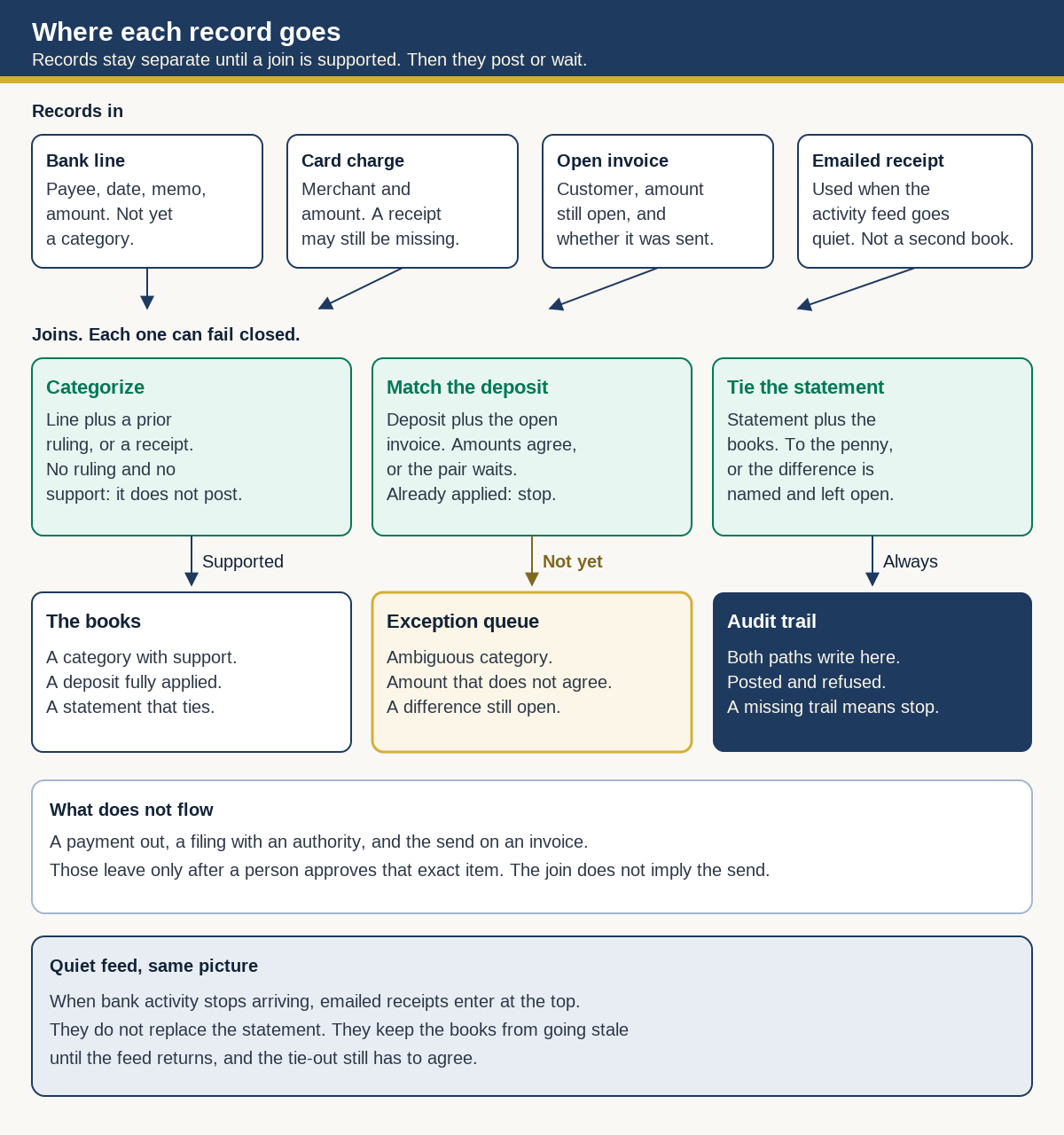
A deposit is not revenue by itself, and the agent will not promote one to brighten a quiet month. It is cash to apply, or cash that does not yet have an invoice, or cash that is not a customer payment at all. Those three are different endings. The first posts as a full application. The second waits, because inventing an invoice to absorb the cash is worse than an open deposit. The third is categorized like any other inflow, under a ruling, or queued. Quiet differences are information.
The match should carry the invoice identifier the books already use, and it should not live only in a person's memory of "the big one." Memory fails on the ordinary ones. Record the application against that invoice, once. If a later run sees the same deposit, it stops. The stopped copy stays in the log. The report may mention the retry. It may not pretend the retry was another payment.
Partial application is not a kindness the agent offers. If the cash does not equal the open invoice, the pair waits. A person may decide that the difference is a short pay, a credit, or a different invoice. That decision is a ruling, stored, on those amounts. The agent does not split the deposit to force a match, and it does not leave a remainder posted to a clearing account so the match can look full. On our books, 400 deposits were matched to invoices with zero partial or double applications. Zero is the design, not a lucky month. The count is the work. The zero is the control.
Reconciliation is the read that keeps the other reads honest. Every bank and card statement is tied to the books before those books are called closed. Tied means to the penny. A difference is an item with a name: a charge in the statement and not in the books, a line in the books and not in the statement, a timing difference a person has accepted and described. An unnamed difference is not a timing difference. It is a plug waiting for a label. The agent lists it. A person accepts it, explains it, or leaves it open. The agent does not write the plug.
A full fiscal year across the accounts we keep was re-verified by a team of parallel checking agents, and every statement tied to the penny. That re-read is the same check, run across the year rather than across the latest month. It asks whether the months that were called closed still tie when read again together. When a feed had gone dark, the books were kept current from emailed receipts, and the tie-out remained the bar those receipts had to meet.
The sales manager agent is the natural upstream of a clean invoice. This paper stops at the books: the invoice exists, the cash arrives, the application is full or it waits. Forecasting the customer is a different job. Mixing them would let a hopeful pipeline close an invoice the cash does not pay. Those are different records. Keep them separate, and let the deposit be the fact.
Recurring invoices, prepared and not sent
Recurring invoices drift the way uncategorized lines drift. Last month's file is copied. Usage has changed. A customer who paused is invoiced anyway. A customer who added a seat is invoiced the old amount. The team concludes invoicing is a chore. Often the chore is the reconstruction, not the decision. The fix is a draft prepared every month from the agreement you already stored, trued up for the usage you can read, and left pending until a person sends it.
Prepared means the draft exists, the usage true-up is visible, and the differences from last month are named. It does not mean the customer has it. Hands-off, since September, describes that preparation on our books. 100% of recurring invoices were prepared every month. The percentage is the habit. The gate is unchanged: every invoice goes to pending approval, and a person sends it. A draft that sends itself because the preparation was complete has skipped the only step the customer will feel.
The true-up is a comparison, not a surprise. If usage is readable, the draft shows last month, this month, and the difference, in the units you already bill. If usage is not readable, the draft says so and waits. The agent does not invent usage to keep the streak of prepared invoices perfect. A perfect streak of invented amounts is a failure. An invoice held because usage was missing is a success, and the log should say why it was held.
If you later want the same discipline on the work that creates the thing you invoice, the product manager agent is the neighboring habit: verified slices, not a date on a calendar. An invoice run is a slice. It has a check a person can apply. Shipping the invoices because the month ended, while usage is unread, erodes the gate. The agent does not mark its own checks passed.
Our own books, as the worked example
The books are ours. The window is 2024 through November 2026. The figures are rounded, from the agent's own run logs. The result belongs to the whole loop, not to a single clever match. The work was the work above: lines read, categories proposed, deposits applied in full or queued, statements tied, invoices prepared and left for a person.
400 deposits matched to invoices, with zero partial or double applications. 1,600+ card charges booked in a single catch-up session. 99% of uncategorized bank lines cleared in one session, from about 300 down to 2. 100% of recurring invoices prepared every month, hands-off since September. Each figure answers a different question. One axis would flatten the remainder under the catch-up and pretend four facts were one.
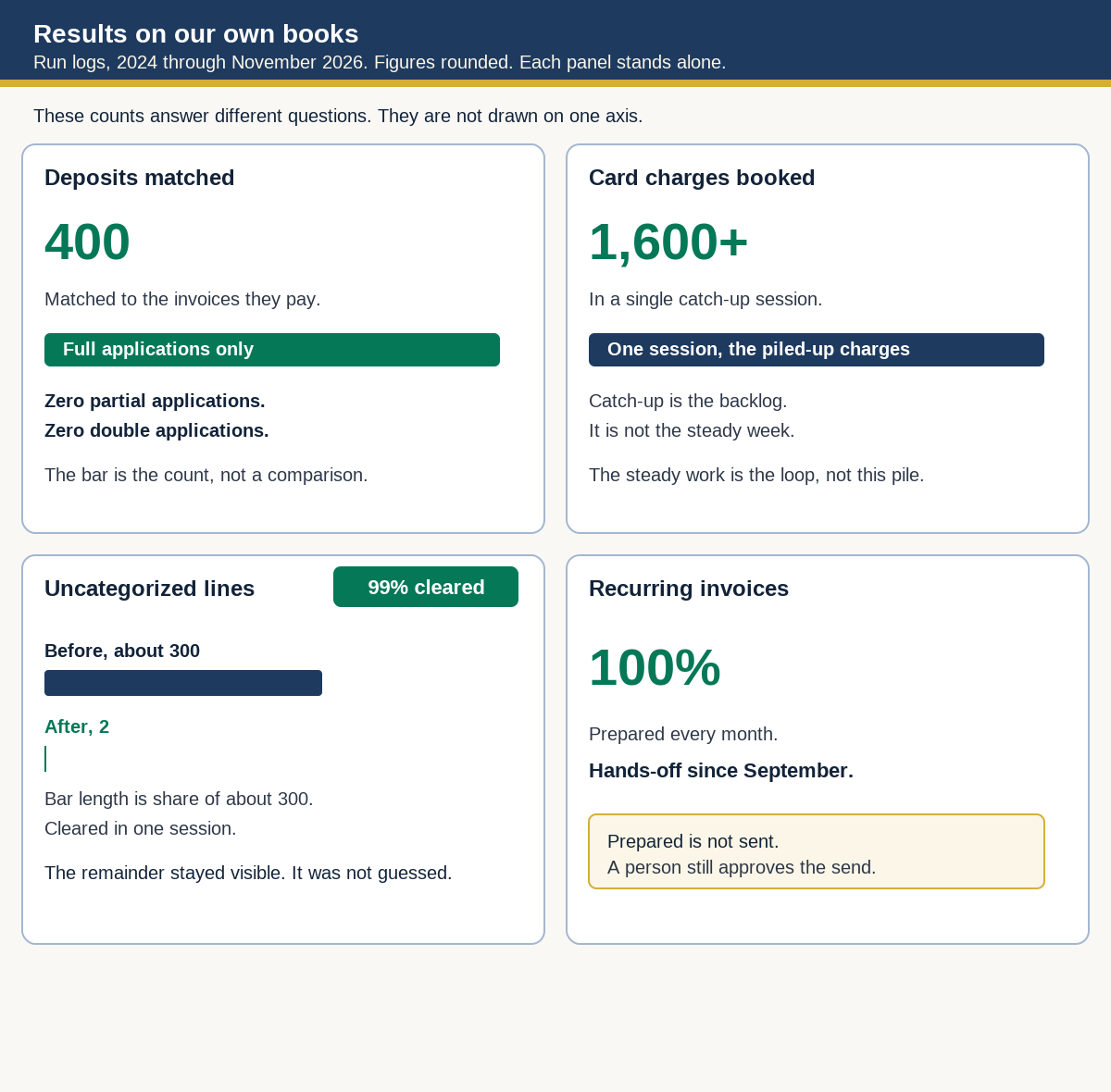
Read them as controls, not as a trophy. The 400 is a count of full applications, and zero partial or double applications is what makes the count meaningful. The 1,600+ is a catch-up, not a weekly target. The 99% is a clearing, from about 300 down to 2, and the 2 are lines that were not supported. The 100% is preparation, every month, hands-off since September, with the send still on a person. A later session may reach an empty queue because every remaining line was ruled. It cannot get there by reclassifying the 2 into a clearing account.
Governance and human oversight
Speed needs a table of duties, not a slogan. Who proposes, who approves, what the gate blocks, where the proof lives. If the answer is "the books," nobody owns the decision.
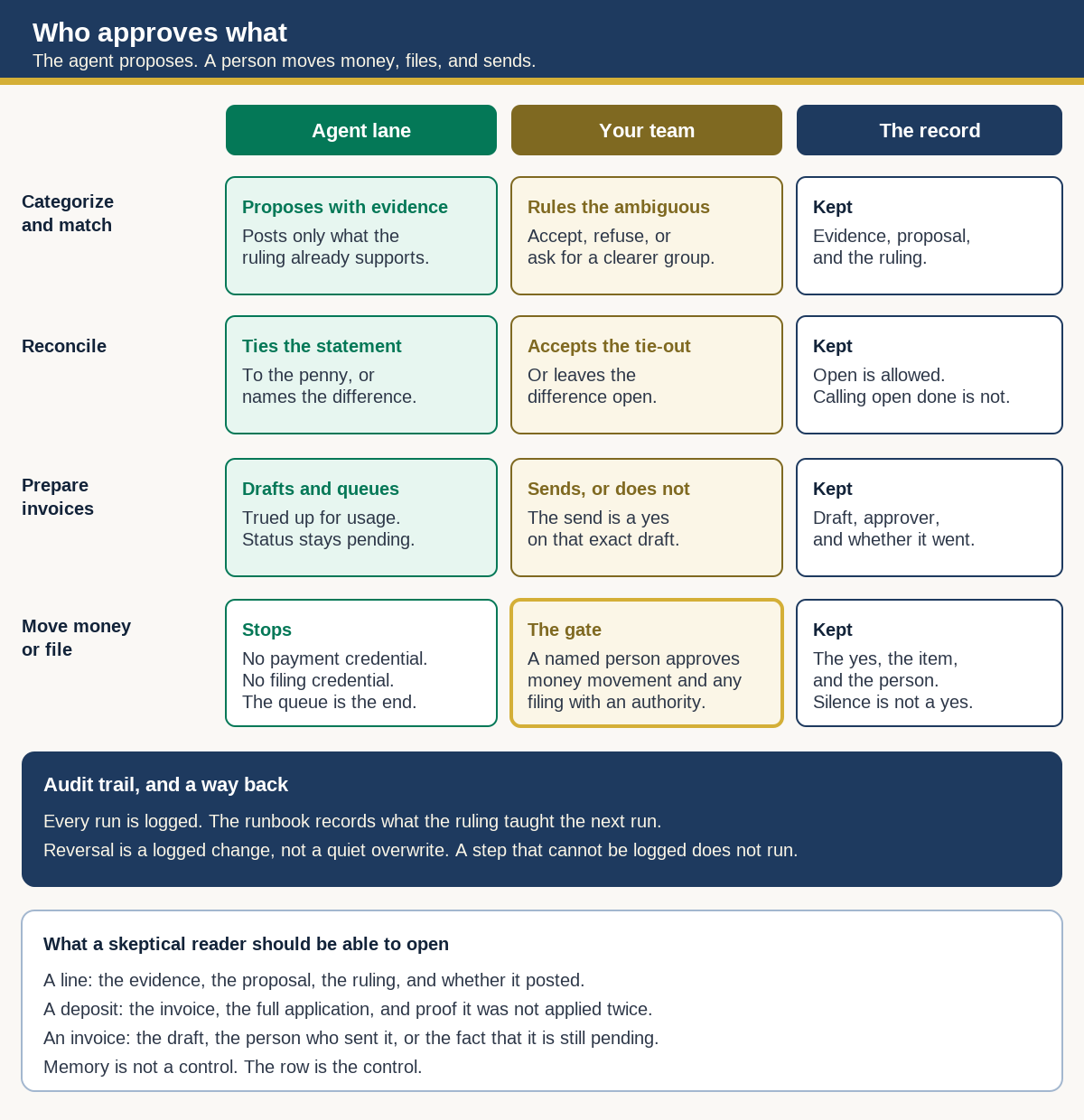
The agent proposes categories, matches, tie-outs, and invoice drafts. A supported posting uses a ruling already stored. A first-time payee, a contradiction, an unequal amount, and every send wait in the queue. The record keeps the proposal and the status, including refused. Your team approves anything that moves money or files with an authority, and approves the send on an invoice. The agent does not hold those credentials. A later edit voids the yes, because a payment remembers the amount after the meeting is over.
Automated checks block the failures that should not become the approver's puzzle. A deposit already applied cannot be applied again. An amount that does not equal the open invoice cannot post as a full match. A statement that does not tie cannot be marked closed. A draft invoice with missing usage cannot mark itself ready. A check that fails closed is the point. A warning that still posts is a log of regrets. Your team sets what "supported" means, in rulings and in words. The agent does not loosen a check to let a session finish. Changing a check is a human policy change, stored like any other.
Every step is logged: what was read, proposed, checked, approved, posted, sent, or refused. A step that cannot be logged does not run. Reversal is part of the same row. The undo is a logged change, not a quiet overwrite. A weekly rhythm is safe because you can go back. Without that, everyone waits for the month-end package and then discovers the plug.
The audit trail is the row a skeptical partner opens. For a line: evidence, proposal, ruling, whether it posted. For a deposit: the invoice, the full application, and proof it was not applied twice. For an invoice: the draft, the person who sent it, or the fact that it is still pending. For a statement: the tie to the penny, or the named difference still open. Memory is not a control. The runbook sits beside the trail. It records what a ruling taught the next run, so the next close is faster without becoming looser. A runbook entry is not itself an approval to pay.
Have someone try to skip the gate before you depend on it. A memo that claims an approval. An impatient user who wants the invoices to send. A log disabled for a "quick" catch-up. A partial match forced because the customer is waiting. Those tests are cheaper now than during the first payment that left. The agent cannot approve itself, widen its own definition of a match, or compact the log as housekeeping. A person can stop a run, a send, or a feed, and the stop stays visible. New duties need a written job, a record, and a gate.
Jacobian Engineering is a HITRUST Authorized External Assessor. The audit trail is what makes the books reviewable.
The economics
This is not a rate card. It is a change in what the same team finishes. Before: a month-end crunch, uncategorized lines, deposits matched by hand, invoices built when someone remembers, a close that is a project. After: activity read as it lands, supported categories posted, deposits matched in full, a standing exception queue, invoices prepared every month, a close that is a review. Attention was the scarce resource, and it was being spent on reconstruction.
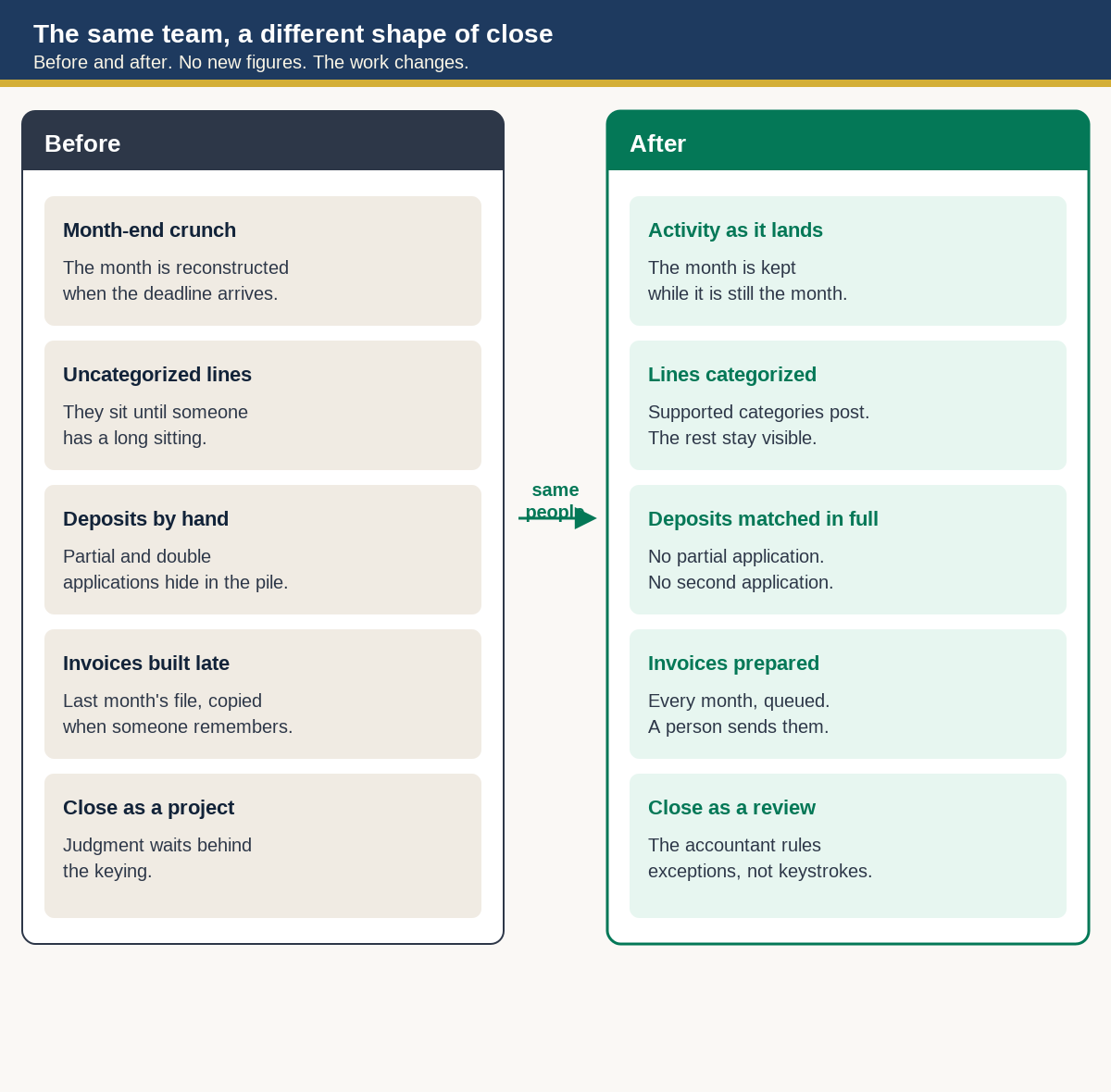
The cost is where the hours go. Collection, comparison, the refusal of a partial match, the tie-out, and the first draft of the invoice are a large share of a small team's hours, and they are hours an agent can take without taking authority. The hours you keep are the ones you hired the owner of the books for. Which ruling is right. Which invoice may go to a customer. Which payment may leave. Which filing a person will sign. You still pay for people. You stop paying them to rebuild the same pile.
Speed is the cadence. Activity is read as it arrives, not in a sitting at the end. On our own books the habit left a remainder rather than a guessed clean sheet: the 2 lines a session would not force into a category. A small team holds a true remainder only if the re-read is scheduled. By hand, coverage collapses to the lines people can bear to open, and the rest become the plug.
That is AI changing the economics of how we do business. Knowing what the month did and deciding what to pay are no longer the same afternoon. Seniors judge. Reconstruction does not eat the week. The craft is the ruling, the invoice a customer should see, and the decision to move money or to file. You still need the approver. You no longer need a second person, who you do not have, to notice that a deposit was applied twice and that the recurring draft is late.
The same idea shows up anywhere a record is rebuilt by hand before a person may speak. The AI SEO agent whitepaper is that argument for being found. This paper is that argument for the books that record what the firm earned and spent. They do not share a tool. They share a refusal: the scarce person does not spend the week on the copy.
Getting started
Name the books first. Then the rulings. Then the sends. An invoice run on a match you do not trust bills against a fiction. A tie-out on a feed that only sees one account hides the rest. Payments and filings move after the first runs are boring. Boring means the pulls landed, the test deposit behaved, and the queue is a set of real questions rather than a dump of everything.
Your team provides a scope list, with a named owner, and out-of-scope written down. You provide activity that can be read on a schedule without a hand export. If the only interface is an export, the agent will narrate the workbook and you are still in the month-end world. You provide the invoices the books already use, including which field identifies an invoice and which amount is still open. If you cannot say what a full application is, the agent must not guess. You provide the receipts mailbox you are willing to have swept when a feed goes quiet, and no other mail. You name an approver and a backup who is also a person, not "the team," for sends, for money movement, and for any filing with an authority.
The first runs ask whether the read is true. In-scope accounts are in the pull or flagged silent. A sample the owner knows by hand matches payees, amounts, and whether a deposit was already applied. A test deposit either matches one open invoice in full or waits. It does not partially apply. A mismatched amount stops the work. Do not categorize on a lie, and do not tie a statement the pull only half saw.
The next runs are the habit. Each queued line is accepted, refused, or explicitly watched, with a sentence. An accepted ruling is stored so the next similar line can follow it. Do not import a clearing from our books as a target for yours. Watch your own opening read, your later read, and the remainder. Put that pair in the review, not a trophy. If your first session is a catch-up, treat it as a backlog being read, and keep the queue. A catch-up that is not allowed to leave a remainder will guess.
The product manager agent matters here in a narrow way. Stand the loop up as verified slices. A slice has a check a person can run: this account's lines, this month's deposits, this statement's tie, this customer's draft. Shipping because the calendar said the close was due, while the check is open, erodes the gate. The agent does not mark its own checks passed.
The usual failures are skipping straight to "send everything," posting in the first week so sponsors see action, and pulling every old account into the first run. Start with the accounts the owner recognizes. When the first review is dull — pulls ran, the test deposit behaved, a few lines waited, nothing was paid — you are ready. You should be able to tell a skeptical partner, without a slide, that a known deposit matches the books once and that one unsupported line is still in the queue.
Start the conversation
Start with books you can name and a gate you will write down. The AI bookkeeping agent page is the short form: categorize every transaction, match every deposit, reconcile to the penny, and let your accountant review exceptions instead of keying the month. This paper is the long form of that page: the loop, the queue, the gate, and the results.
Bring the scope list, or the honest statement that you do not have one. We will talk through the feeds, what a full application means on your invoices, and the approval path you already have for anything that moves money or files with an authority. We will not send an invoice to prove seriousness. Serious is a record of the activity, one deposit applied once, a statement that ties or a difference that has a name, and a person's name on the draft that leaves.
On our own books, the same loop turned the month-end pile into a review: lines categorized or left visible, deposits applied once, and invoices prepared for a person to send.
That is the work. When the same team can see the month while it is still the month, leave the unsupported lines visible, and walk into a review with a statement that ties, they spend themselves on judgment. That is AI changing the economics of how we do business. When you want it on your books, talk to us.
About This Resource
Need Expert Guidance?
Our team can help you put these insights into practice.
Schedule a Consultationor call (415) 644-8208Ready to Take the Next Step?
Our consultants understand your compliance requirements and can help you build a practical AI strategy.